


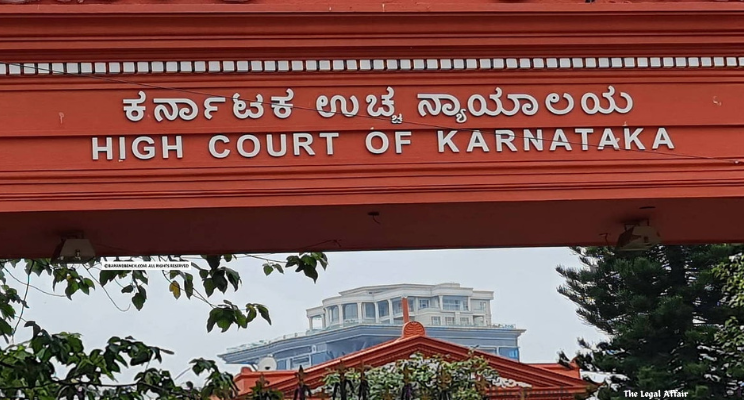
Introduction:
In Kumari Shamshad Begum & Another v. State of Karnataka & Others [2026 LiveLaw (Kar) 251], the Karnataka High Court refused to quash an FIR registered against a father-daughter duo accused of running a large-scale fake government recruitment racket involving more than ₹5.3 crore. Justice M. Nagaprasanna held that the allegations disclosed a clear prima facie case of an organised fraud in which innocent job aspirants were allegedly lured with false promises of government employment and supplied with forged appointment orders. Observing that courts cannot protect persons accused of deceiving unemployed youth through fabricated recruitment processes, the Court dismissed the petition seeking quashing of criminal proceedings.
According to the prosecution, the petitioners allegedly projected themselves as influential Congress leaders capable of securing appointments in several government departments, including the Railways, Income Tax Department, Irrigation Department, Health Department and Social Welfare Department. They allegedly targeted villagers and unemployed candidates aspiring for government jobs and induced them to pay substantial amounts of money in exchange for promised appointments.
The investigation revealed that the accused allegedly collected nearly ₹5.30 crore from numerous candidates. It was alleged that after receiving the money, they generated fake email IDs, forged appointment letters and fabricated joining instructions to convince victims that they had genuinely secured government employment. Some candidates were even directed to travel to Kolkata and Maharashtra for training and reportedly worked at locations mentioned in the fake appointment orders before discovering that the entire recruitment process was fraudulent.
An FIR was registered by the Central Crime Branch (CCB), Bengaluru, for offences under Sections 120B, 419, 420, 406, 465, 468, 471, 504, 506 and 34 of the Indian Penal Code. Challenging the registration of the FIR, the accused approached the Karnataka High Court seeking exercise of its inherent jurisdiction to quash the criminal proceedings.
Arguments of the Parties:
The petitioners argued that the criminal proceedings were malicious and amounted to an abuse of the process of law. It was contended that the complaint had not been lodged by any of the alleged victims but by a third person who was pursuing a separate cheque bounce dispute involving approximately ₹1.25 crore. According to the petitioners, the complainant had no direct connection with the alleged recruitment scam and had initiated criminal proceedings only to exert pressure in the pending financial dispute.
The petitioners further submitted that the allegations lacked credibility because none of the persons allegedly cheated had independently approached the police with complaints. On this basis, they requested the High Court to quash the FIR and terminate the criminal investigation.
The State strongly opposed the petition. The State Public Prosecutor argued that the investigation had uncovered a well-organised recruitment scam extending across multiple States. It was submitted that the accused had devised an elaborate scheme resembling sophisticated recruitment frauds, wherein fake appointment letters, fabricated email communications and false training programmes were used to create an appearance of legitimacy.
According to the prosecution, the accused initially collected money from a small group of candidates and later induced many more unemployed persons to transfer large sums electronically, resulting in collections exceeding ₹5.30 crore. The State further argued that the accused deliberately created forged documents and fake employment records, sending victims to different States for training so that the fraud would appear genuine. It was therefore submitted that the allegations clearly disclosed cognizable offences requiring a complete investigation.
Court’s Judgment:
After examining the material collected during the investigation, Justice M. Nagaprasanna declined to interfere with the FIR.
The Court observed that the allegations disclosed a detailed and systematic scheme to deceive unemployed candidates by exploiting their desire to secure government employment. The order records that the petitioners allegedly received substantial amounts of money from numerous candidates, generated forged appointment letters, created fake email IDs and fabricated places of posting in different government departments.
The Court noted that several candidates acted upon these appointment letters and travelled to Kolkata and Maharashtra for training before ultimately discovering that the appointments were entirely fictitious. Such allegations, according to the Court, revealed a carefully planned operation rather than isolated acts of deception.
Rejecting the petitioners’ contention regarding the maintainability of the complaint, the Court held that the mere fact that the complaint had not been filed by one of the victims was not sufficient to invalidate the criminal proceedings when the investigation itself disclosed commission of cognizable offences. The materials collected during investigation independently established a prima facie case warranting continuation of the prosecution.
Justice Nagaprasanna observed that the complaint comprehensively narrated the alleged modus operandi adopted by the accused. The investigation indicated that after collecting money, the petitioners allegedly manufactured fake recruitment documents and used forged communications to convince candidates that they had secured genuine government employment.
The Court further held that these allegations required a full-fledged investigation and could not be discarded at the threshold while exercising jurisdiction under Section 482 of the Code of Criminal Procedure.
While dismissing the petition, the Court made strong observations regarding the nature of the alleged fraud. Describing the facts as resembling a “classic potboiler,” the Court observed that innocent and gullible job seekers had allegedly been hoodwinked through false promises and forged appointment orders. It categorically stated that the High Court would not extend its protective jurisdiction to persons accused of exploiting unemployed youth by fabricating government recruitment processes.
The Court also referred to the principle “falsus in uno, falsus in omnibus”, observing that the allegations reflected a pattern of extensive fabrication involving fake documents, fake email accounts and fictitious appointments. Such material, according to the Court, clearly justified continuation of criminal proceedings.
Finding that the FIR and the evidence collected during investigation disclosed a prima facie case for offences including cheating, criminal conspiracy, forgery, criminal breach of trust and related offences, the High Court held that no case for quashing was made out.
Accordingly, the criminal petition was dismissed, permitting the investigating agency to proceed with the investigation in accordance with law.