


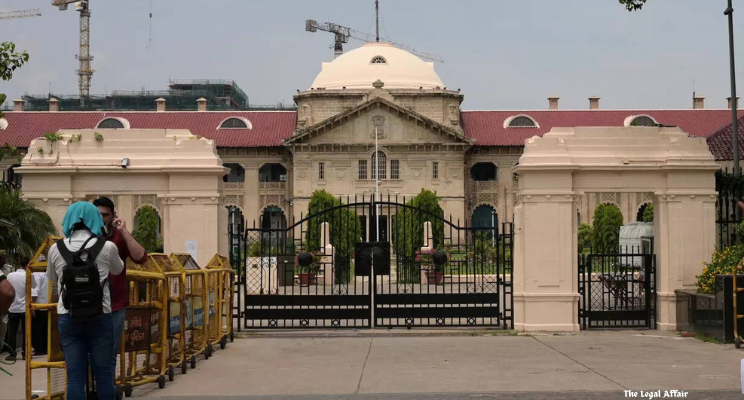
Introduction:
The Allahabad High Court has upheld the removal of a private hospital from the panel of hospitals empanelled under the Ayushman Bharat–Pradhan Mantri Jan Arogya Yojana (AB-PMJAY), after serious shortcomings allegedly emerged in the treatment provided to a two-month-old child suffering from blood cancer. The allegations concerned the charging of ₹9,000 for two units of blood that were required to be provided free of cost under the government-sponsored healthcare scheme, as well as the failure to record the blood transfusion units in the child’s Bed Head Ticket.
A Division Bench comprising Justice J.J. Munir and Justice Indrajeet Shukla dismissed the hospital’s writ petition challenging the order dated August 19, 2026, passed by the State Empanelment Committee. Through the impugned order, the Committee had removed the hospital from the panel maintained under the State Health Agency for Comprehensive and Integrated Services (SACHIS), which administers the scheme in Uttar Pradesh.
The judgment addresses an important question concerning the relationship between private healthcare institutions and government-sponsored health insurance programmes. While private hospitals are entitled to conduct their professional activities and provide medical services, their participation in a publicly funded healthcare scheme is subject to the conditions, procedures and obligations prescribed under that scheme. A hospital that accepts the benefits of empanelment is expected to comply with the applicable treatment protocols and administrative requirements, particularly where the scheme is intended to provide eligible patients with access to cashless healthcare.
The case arose from the treatment of an exceptionally vulnerable patient: an infant only two months old who was suffering from blood cancer. According to the material considered by the State Empanelment Committee, the hospital had allegedly charged ₹9,000 for two units of blood, despite the requirement that the units be supplied free of cost under the scheme. The Committee also found that the doctor attending to the child had not recorded the transfusion units in the Bed Head Ticket, a document that forms part of the patient’s treatment record. The omission was treated as a serious procedural lapse, particularly because the child had been admitted to the Intensive Care Unit (ICU), where accurate documentation of treatment is essential.
The hospital was issued a show-cause notice on June 18, 2026, before the State Empanelment Committee passed the order removing it from the scheme on August 19, 2026. Aggrieved by that decision, the hospital approached the High Court, seeking judicial interference with the administrative action.
While examining the challenge, the High Court acknowledged that the impugned order was not particularly elaborate in its reasoning. Nevertheless, it held that the lack of detailed expression did not undermine the substance of the facts emerging from the record. The Bench also took note of the admission of lapses by the doctor who appeared before the Committee on behalf of the hospital.
An important aspect of the ruling was the Court’s clarification that removal from the Ayushman Bharat or SACHIS panel does not prohibit a hospital from practising medicine or treating patients who approach it independently. The Court distinguished between a hospital’s ability to carry on its professional activities and its claim to participate in a government healthcare scheme. Empanelment, it observed, is a privilege conferred upon selected hospitals rather than an enforceable legal right, although the State must exercise its power to grant such empanelment in a non-discriminatory manner.
The decision reinforces the principle that participation in publicly funded healthcare arrangements carries corresponding responsibilities. It also highlights the limits of judicial review when an administrative authority has acted on material indicating serious shortcomings in compliance with the conditions governing a public welfare scheme.
Arguments of the Parties:
The Hospital’s Challenge to the Removal Order
The hospital challenged the State Empanelment Committee’s order dated August 19, 2026, before the Allahabad High Court. Its principal grievance was that the decision to remove it from the SACHIS panel was unjustified and warranted interference by the constitutional court. By challenging the order, the hospital sought to have the adverse administrative decision set aside so that it could continue participating in the government-sponsored healthcare arrangement.
The dispute centred on the circumstances surrounding the treatment of a two-month-old child suffering from blood cancer. The Committee’s order referred to the alleged collection of ₹9,000 for two units of blood, which were stated to be available to the patient free of cost under the Ayushman Bharat scheme. It also recorded that the transfusion units had not been entered in the child’s Bed Head Ticket by the attending doctor, despite the requirement to maintain such records for a patient admitted to the ICU.
The available case summary does not reproduce the hospital’s complete pleadings or the specific grounds advanced by its counsel. It would therefore be inappropriate to attribute to the hospital any particular defence concerning the payment, the medical necessity of the transfusion, the interpretation of the scheme’s conditions, or the procedural fairness of the Committee’s decision beyond what is established by the reported facts.
Nevertheless, the central legal issue arising from the hospital’s challenge was whether the State Empanelment Committee’s decision suffered from a defect serious enough to justify the High Court’s intervention under its writ jurisdiction. The challenge required the Court to examine the nature of the adverse order, the material supporting the Committee’s conclusions and the extent to which the hospital could claim a legal entitlement to remain on the scheme’s panel.
The hospital’s position also brought into focus the distinction between an administrative decision affecting participation in a government programme and a decision restricting the practice of a profession. Removal from an empanelled list may have practical consequences for a hospital’s access to patients covered by the scheme. However, the legal question is whether such removal amounts to an infringement of an enforceable right or whether it concerns a conditional benefit available only to institutions that satisfy the scheme’s requirements.
The High Court ultimately approached the matter by examining the legal character of empanelment and the material recorded by the Committee. It did not treat the hospital’s participation in the scheme as an unconditional entitlement that could continue irrespective of the shortcomings identified during the proceedings.
The State’s Position and the Findings of the Empanelment Committee
The State’s decision was founded on the alleged failure of the hospital to comply with the obligations associated with treatment under the Ayushman Bharat scheme. The State Empanelment Committee had considered the circumstances surrounding the treatment of the infant and concluded that the hospital’s conduct and record-keeping practices disclosed serious shortcomings.
The first concern was the alleged charging of ₹9,000 for two units of blood. According to the material described in the impugned order, the blood units were required to be provided free of cost under the scheme. If an empanelled hospital collects a separate amount for a service that is supposed to be covered by the government-funded arrangement, the issue goes beyond a routine disagreement over billing. It raises questions about whether the hospital is complying with the financial and treatment obligations attached to its participation in the programme.
The second concern related to the failure to document the transfusion units in the child’s Bed Head Ticket. The Committee regarded the omission as particularly significant because the patient had been admitted to the ICU, where treatment records are essential for monitoring the care provided, verifying the procedures performed and ensuring accountability. Documentation allows medical interventions to be assessed against the patient’s clinical condition and helps the relevant authorities verify whether the treatment claimed under a healthcare scheme was actually administered in accordance with prescribed requirements.
The Committee had issued a show-cause notice to the hospital on June 18, 2026. Thereafter, it passed the removal order on August 19, 2026. The proceedings also involved the appearance of a doctor representing the hospital before the Committee. The High Court specifically noted that the doctor had admitted to the lapses, a circumstance that formed part of the material supporting the adverse decision.
The State’s position, as reflected in the Committee’s order and the findings considered by the Court, was that the shortcomings were sufficiently serious to justify removing the hospital from the panel. The decision was not merely about the hospital’s general professional competence; it concerned its compliance with the requirements governing the delivery of treatment under a public welfare scheme.
The State’s authority to determine which hospitals may participate in such a programme must, of course, be exercised fairly and without discrimination. Empanelment decisions cannot be based on arbitrary preferences or irrelevant considerations. However, the obligation to act fairly does not prevent the State from taking appropriate action when material emerges indicating that an empanelled institution has failed to comply with the conditions governing its participation.
The High Court was therefore required to consider both sides of the issue: the hospital’s challenge to the adverse order and the State’s responsibility to ensure that public healthcare benefits are delivered through institutions that observe the prescribed procedures.
Court’s Judgment:
The Bench Finds Sufficient Material to Sustain the Administrative Decision
The Division Bench of Justice J.J. Munir and Justice Indrajeet Shukla dismissed the hospital’s writ petition, finding no sufficient ground to interfere with the State Empanelment Committee’s order dated August 19, 2026.
In reaching this conclusion, the Court examined the nature of the allegations and the material that had emerged during the Committee’s proceedings. The concerns were not confined to a minor clerical irregularity. They involved the alleged collection of money for blood units that were required to be supplied free of cost under the scheme and the failure to record the transfusion units in the medical documentation of a critically ill infant.
The Court took exception to the conduct attributed to the hospital and its doctors. It observed that prima facie material had surfaced showing serious shortcomings in the implementation of the scheme and in compliance with the necessary protocols while providing treatment under it.
The expression “prima facie” is important in understanding the scope of the judgment. It indicates that the material before the Court was sufficient, at the stage of judicial review, to support the administrative decision under challenge. It should not be interpreted as a general judicial declaration that every factual allegation against the hospital had been independently established through a separate trial or adjudication. The Court’s task was to determine whether the Committee’s order warranted interference in the exercise of its writ jurisdiction.
The Bench also attached significance to the doctor’s appearance before the Committee on behalf of the hospital and the admission of lapses recorded in the proceedings. Such an admission was relevant because the administrative authority was not relying solely on an unsupported allegation; the record, as described by the Court, contained material acknowledging deficiencies in the hospital’s compliance.
The ruling demonstrates that judicial review of an administrative decision does not necessarily require the High Court to substitute its own assessment for that of the competent authority. Where the record discloses a reasonable basis for the action taken and no sufficient ground for intervention is established, the Court may decline to disturb the decision.
An Order That Was Not Elaborate Could Still Be Sustained
One of the significant observations in the judgment concerned the manner in which the State Empanelment Committee had expressed its reasons for removing the hospital from the panel.
The High Court acknowledged that the impugned order was “not eloquent enough”. In other words, the order was not particularly detailed or persuasive in the manner in which it articulated its reasoning. However, the Bench clarified that this deficiency in expression did not detract from the substance of the facts emerging from the record.
This observation draws attention to an important distinction in administrative law. An order may be criticised for failing to explain its reasoning with sufficient clarity, but that shortcoming does not automatically establish that the decision is unlawful. The legal effect of inadequate reasoning depends on the nature of the decision, the material available, the applicable legal requirements and whether the deficiency prevents meaningful judicial review.
At the same time, the judgment should not be understood as suggesting that administrative authorities are generally free to pass unreasoned orders. Reasoned decisions are an important safeguard against arbitrariness. They allow the affected party to understand why action has been taken, help demonstrate that relevant considerations have been taken into account and enable a reviewing court to assess whether the authority acted within the law.
In the present case, however, the Bench considered the order in the context of the broader record. It took note of the allegations concerning the charging of money for blood units, the omission in the Bed Head Ticket and the doctor’s admission of lapses before the Committee. On that basis, it concluded that the shortcomings in the language of the impugned order did not warrant setting it aside.
The Court’s approach was therefore fact-specific. Rather than treating the order’s lack of elaboration as conclusive, it considered whether the material underlying the decision disclosed sufficient justification for the Committee’s action.
Empanelment Is a Privilege, Not a Justiciable Right
The central legal principle emerging from the ruling is the distinction between the right to practise a profession and the ability to participate in a government-sponsored healthcare scheme.
The Bench expressly observed that empanelment under SACHIS or the Ayushman Bharat scheme does not affect the hospital’s right to practise its profession. It clarified that removal from the panel would not prevent the hospital or its doctors from continuing their professional activities or treating patients who approached them for medical services.
The Court explained the distinction through an analogy involving a patient who chooses to stop consulting a particular doctor because the patient has lost confidence in that doctor. A person’s decision not to continue with a particular consultant does not ordinarily amount to a prohibition on the consultant’s ability to practise medicine. Similarly, the State’s decision to discontinue its arrangement with an empanelled hospital does not, by itself, amount to a ban on the hospital’s professional activities.
The analogy was used to distinguish the hospital’s general professional freedom from its participation in a specific healthcare programme. A hospital may continue to offer treatment independently, but participation in a scheme funded or administered by the State is governed by separate conditions. The State is not necessarily required to maintain every private hospital on its panel regardless of whether it complies with those conditions.
The Bench stated that “empanelment under the aforesaid scheme is not a justiciable right, but a privilege conferred on particular hospitals”. The significance of this observation lies in the legal character of empanelment. A justiciable right is one that can be asserted before a court and enforced in accordance with law. By contrast, a privilege or conditional benefit granted under an administrative scheme does not automatically create an unconditional entitlement to its continued enjoyment.
The ruling does not mean that empanelment decisions are beyond judicial scrutiny. Rather, it establishes that a hospital cannot demand continued participation merely because it was previously selected for the scheme. The authority’s decision must still be assessed against the applicable legal framework, including the requirement that the State act fairly and non-discriminatorily.
This distinction is particularly relevant to public-private healthcare arrangements. Private hospitals participate in such programmes to provide treatment to eligible beneficiaries under the terms prescribed by the scheme. Their continued participation depends on compliance with the applicable requirements. Where serious deficiencies are identified, the State may take action in accordance with its governing framework, subject to the ordinary limits of administrative legality.
The State Must Act Without Discrimination
Although the Court characterised empanelment as a privilege, it expressly recognised that the State must confer that privilege in a non-discriminatory manner.
This qualification is essential. The absence of an absolute right to empanelment does not give public authorities unlimited discretion. Administrative decisions remain subject to the requirement that State action be fair, rational and consistent with the applicable legal framework.
A government authority cannot arbitrarily favour one hospital over another, impose conditions selectively or remove an institution for reasons unrelated to the scheme’s requirements. Where a hospital challenges an empanelment decision, a court may examine whether the authority acted within its powers, considered relevant material and avoided arbitrary or discriminatory treatment.
The present case, however, involved material indicating prima facie serious shortcomings in the hospital’s implementation of the scheme and observance of treatment protocols. The Committee had issued a show-cause notice, considered the matter and passed the removal order. The High Court also took note of the doctor’s admission of lapses.
In those circumstances, the Bench found no sufficient reason to interfere with the Committee’s decision. The Court’s reasoning reflects the difference between a lawful exercise of administrative discretion and an arbitrary deprivation of a claimed entitlement. Although empanelment is not an absolute right, the State must act lawfully when deciding whether to grant, continue or withdraw it.
The decision consequently preserves the State’s ability to enforce scheme requirements while retaining the constitutional safeguard against discriminatory action. It does not confer unfettered power on the State; instead, it recognises that the absence of a guaranteed right to empanelment must be understood alongside the obligation to administer public schemes fairly.
Importance of Treatment Records and Compliance Under Public Healthcare Schemes
The circumstances of the case also underline the importance of maintaining proper medical records when treating patients under publicly funded healthcare programmes.
A Bed Head Ticket is an essential part of a hospital’s treatment documentation. It ordinarily records the patient’s condition, edical advice, treatment administered and other relevant c