


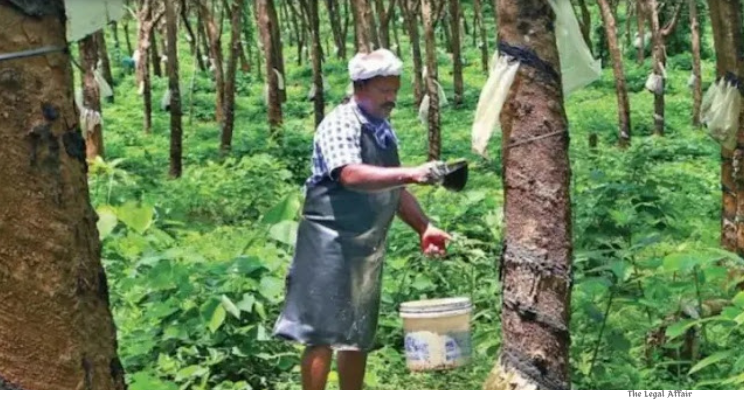
Introduction:
In the case of Thomas Baby v Jojo V. Varghese and Others, the Kerala High Court addressed a contentious issue regarding the registration requirement of an agreement pertaining to tapping rubber trees. The petitioner, represented by Advocate Rajeev V. Kurup, asserted rights granted through a purported agreement with the respondent, facilitated by a power of attorney. Conversely, Advocates Liji J. Vadakedom, V. Rajendran, N. Rajesh, and Gopakumar P., representing the respondents, contested the authenticity and enforceability of the agreement.
Arguments of Both Sides:
The petitioner claimed a legally binding agreement allowing the tapping of 750 yielding rubber trees over a 15-year period for a consideration of Rs. 10,00,000. The defense argued against the validity of the document, alleging forgery and incomplete execution. Central to the dispute was whether the agreement, unregistered under the Kerala Registration Act, could be admissible as evidence in court.
Court’s Judgment:
Justice Kauser Edappagath delivered the court’s verdict, emphasizing the immovable property status of rubber trees under Kerala law. The High Court ruled that an agreement to tap rubber trees constitutes an interest in immovable property, mandating registration under Section 17(1)(c) of the Kerala Registration Act. The court rejected the argument that the agreement merely constituted a license, affirming that the right to exploit yielding rubber trees creates a substantive interest in immovable property.
The dispute hinged on whether the agreement conferred a mere license or a lease-like interest over the rubber trees. The trial court’s characterization of latex (rubber tree juice) as movable property was overturned by the High Court, which reasoned that the agreement primarily involved the exploitation of the rubber trees themselves. Emphasizing the continuous vegetative process and sustenance drawn by rubber trees from the soil, the court concluded that they qualify as immovable property under Kerala law.