


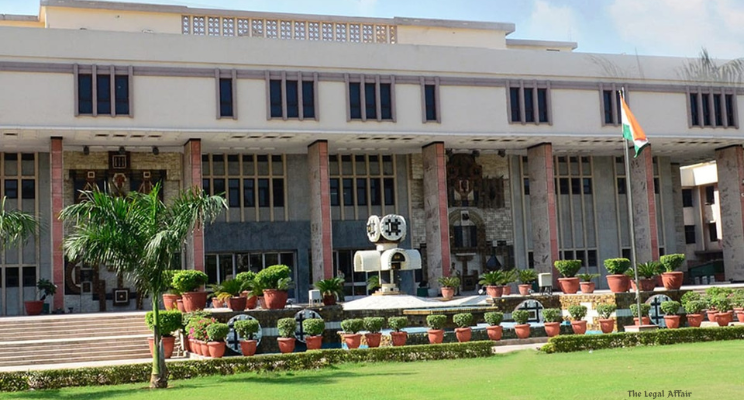
INTRODUCTION:
In the case IDP Education India Private Limited v. Government Of N.C.T. Of Delhi & Ors., W.P.(C) 17694/2025, the Delhi High Court was called upon to examine a significant systemic lapse in the adjudicatory mechanism under the Goods and Services Tax regime, particularly the inordinate delay in deciding appeals pertaining to GST refunds. The petitioner, a foreign education consultancy entity assisting students in securing admissions to overseas universities and earning commissions from such institutions, had approached the High Court aggrieved by the prolonged pendency of its GST refund appeals filed between 2021 and 2023. Despite repeated hearings, no final orders had been passed for over four years, causing a severe financial bottleneck and a substantial blockage of working capital. The division bench of Justices Prathiba M. Singh and Shail Jain observed with concern that such delays unequivocally defeat the statutory mandate contained under Section 107(13) of the Central Goods and Services Tax Act, 2017, which obligates the Appellate Authority to conclude appeals within one year. The Court had earlier clarified that consultancy services provided to foreign universities and paid for in foreign exchange constitute “export of services” and hence qualify for GST refund under zero-rated supplies. Yet, despite this settled judicial clarity, the petitioner was left stranded in a procedural limbo due to the non-adjudication of appeals, compelling the Court to intervene to ensure that statutory timelines are respected and the economic viability of businesses is not eroded by administrative inertia. The matter thus presented a compelling question not only about the petitioner’s entitlement to tax refunds, but also about whether prolonged bureaucratic inaction could be allowed to frustrate the fiscal ecosystem envisaged under GST law.
⚖️ ARGUMENTS OF THE PETITIONER:
The petitioner advanced a multi-layered and forceful submission, contending that the inordinate pendency of its refund appeals struck at the very essence of the GST framework, which was introduced with the object of easing tax procedures, eliminating cascading levies, and enabling the smooth functioning of trade and commerce by ensuring seamless credit flow. It was argued that the petitioner, being engaged in providing foreign education consultancy services, entered into agreements with international universities and earned commission on successful admissions of Indian students abroad. Such services, being rendered to foreign entities and paid for in convertible foreign exchange, undeniably fall within the ambit of “export of services” in terms of Sections 2(6) and 16 of the Integrated Goods and Services Tax Act, 2017. Consequently, the petitioner was legally entitled to claim a refund of input tax credit accumulated on account of zero-rated supplies. The petitioner stressed that this legal entitlement had already been judicially confirmed in prior proceedings where the High Court had categorically held that such services qualify for GST refunds. Therefore, with the classification dispute resolved, the only surviving issue was the expeditious grant of refund. The petitioner argued that the failure of the Appellate Authority to render decisions despite repeated hearings from 2021 onwards amounted to gross dereliction of duty, violating statutory timelines under Section 107(13) of the CGST Act, which mandates that appeals be decided within one year from the date of filing. The petitioner contended that the prolonged withholding of refund funds deprived it of vital liquidity, disrupted business operations, and hampered cash flow management. Moreover, the petitioner asserted that denial of timely refunds was contrary to Articles 14 and 19(1)(g) of the Constitution of India, amounting to arbitrary state action that impaired its fundamental right to conduct business. The petitioner further submitted that the GST mechanism is credit-based and refunds are not governmental largesse but the taxpayer’s rightful property. Blocking such funds without adjudication effectively amounted to an unlawful seizure of capital. It was contended that the authorities had acted in a manner inconsistent with ease-of-doing-business commitments and global trade facilitation norms, undermining investor confidence and impairing India’s credibility as a trading jurisdiction. The petitioner prayed for directions compelling the authorities to adjudicate the pending appeals within a time bound schedule and for consequential refunds along with statutory interest, as mandated under Section 56 of the CGST Act, from the date the refund became due until its actual realization.
⚖️ ARGUMENTS OF THE RESPONDENTS:
The respondent authorities, while not disputing the statutory requirement of adjudicating appeals within a prescribed period, attempted to justify the delays by citing administrative burdens, procedural complexity, and the heavy volume of pending cases. It was argued that the appellate forum was saddled with a substantial backlog of taxation matters, many of which involved extensive documentary scrutiny and cross-jurisdictional assessments. The respondents contended that the GST appellate regime was still evolving, and institutional challenges in its operationalization necessitated pragmatic flexibility. It was further contended that the petitioner’s appeals could not be decided earlier owing to clarificatory directions pending in related matters and due to changes in the legal position emerging from judicial pronouncements regarding export services and input tax credit eligibility. The respondents insisted that the petitioner had not suffered any irreparable loss because the claim, if approved, would eventually be refunded along with statutory interest, thereby compensating any financial inconvenience caused. The authorities submitted that no statutory penalty or adverse consequence had been imposed on the petitioner, and therefore, the delay could not be categorized as a violation of constitutional or legal rights. Additionally, they submitted that the appellate authority was mandated to follow natural justice procedures, which sometimes resulted in extended hearings and consequent delay. The respondents thus maintained that the High Court ought not to interfere in the administrative discretion of adjudicatory bodies or impose unreasonable timelines when systemic changes were still underway.
🧑⚖️ COURT’S JUDGMENT:
The Delhi High Court delivered a decisive judgment, finding unmistakable merit in the petitioner’s grievance and strongly admonishing the authorities for systemic inefficiency. The Court observed that the legislative architecture of GST was devised to foster efficiency, predictability, and financial discipline. The Court underscored that Section 107(13) of the CGST Act leaves no room for ambiguity: appellate proceedings must be concluded within one year. The Court remarked that the GST regime is credit-based, and input tax credits are not a fiscal concession but a vested right, the withholding of which distorts the financial calculus of enterprises. It held that the state machinery cannot retain taxpayers’ funds indefinitely under the guise of pendency when the statute mandates timely adjudication. The Court categorically observed that delayed refunds inflict tangible commercial injury by choking liquidity, undermining corporate planning, affecting tax compliance behavior, and destabilizing operational sustainability. The judges noted that present-day businesses depend on capital fluidity, and prolonged retention of funds amounts to a de facto financial embargo on legitimate trade activity. The Court further emphasized that in a globalized economy, regulatory delays reflect poorly on India’s institutional maturity and contradict the Union Government’s stated commitment to ease of doing business. The Court held that administrative laxity, however genuine, cannot trample statutory rights or override legislative mandates. The division bench, therefore, directed the Appellate Authority to dispose of all pending appeals filed by the petitioner on or before 10 January 2026, reiterating that such matters cannot linger indefinitely. Moreover, the Court mandated that if refunds are ultimately granted, the petitioner shall be entitled to statutory interest for the entire period of delay, thereby reaffirming that interest is not a bounty but a compensatory mechanism reflecting the time value of money wrongfully withheld. The Court thus reaffirmed the supremacy of statutory timelines, the enforceability of taxpayer refund rights, and the non-negotiable obligation of the state to act promptly in fiscal matters.