


Introduction:
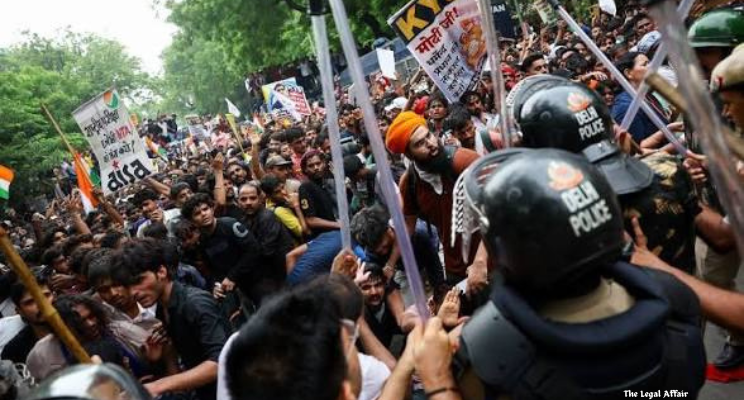
The Delhi High Court, in Shakeel Ahmed v. Union of India & Ors. (W.P. (CRL) 2127/2026), dismissed a Public Interest Litigation (PIL) challenging the alleged forcible removal of activist Sonam Wangchuk from Jantar Mantar on July 18, 2026, while he was on an indefinite hunger strike in support of students protesting the alleged NEET paper leak. The petition sought a declaration that the removal was illegal, a direction to register an FIR against the police officials involved, constitution of a Special Investigation Team (SIT), preservation of CCTV and other electronic records, and protection for peaceful protesters.
The matter came before a Division Bench comprising Chief Justice D.K. Upadhyaya and Justice Tejas Karia. The Court noted that the incident had already been the subject of proceedings initiated by Wangchuk’s wife, Dr. Gitanjali Angmo, who had approached the High Court seeking his transfer from Safdarjung Hospital to Medanta Hospital. That petition, along with the connected appeal, had already been disposed of on July 21. In this background, the Court examined whether the same incident could once again be agitated through a PIL and whether extraordinary writ jurisdiction should be exercised when statutory remedies under the Bharatiya Nagarik Suraksha Sanhita, 2023 (BNSS) were available.
The judgment highlights the limits of PIL jurisdiction, reiterates the importance of exhausting statutory remedies for criminal complaints, and clarifies that the existence of an alternative legal mechanism under the BNSS ordinarily weighs against judicial intervention in writ proceedings.
Arguments of the Parties:
The petitioner contended that Sonam Wangchuk was peacefully observing a hunger strike at Jantar Mantar when police officials allegedly entered the protest site, used force against protesters, and removed him without lawful authority. It was argued that the officials were not in proper uniform, lacked identification badges, and acted in an arbitrary and intimidating manner. According to the petitioner, the incident violated the constitutional right to peacefully protest and express dissent.
The petitioner further argued that the alleged conduct of the police disclosed several cognizable offences, including wrongful restraint, wrongful confinement, assault, criminal intimidation and use of excessive force. It was submitted that an independent SIT headed by a retired High Court judge should investigate the incident and that CCTV footage, body-camera recordings and other electronic evidence should be preserved to ensure a fair investigation. The petitioner also sought protection for persons continuing the hunger strike so that they were not subjected to harassment or unlawful removal.
Opposing the petition, the Union of India and Delhi Police submitted that no case for entertaining the PIL was made out. The Additional Solicitor General argued that if the petitioner believed a cognizable offence had been committed, the BNSS already provided a complete statutory mechanism for lodging a complaint and seeking registration of an FIR. It was further argued that Wangchuk himself had not lodged any criminal complaint and that proceedings concerning the incident had already been pursued by his wife before the High Court. The respondents maintained that the present petition amounted to an unnecessary attempt to reopen issues that had already been addressed and therefore deserved dismissal.
Court’s Judgment:
The Delhi High Court dismissed the PIL, holding that it was not inclined to entertain the petition in view of the earlier proceedings initiated by Wangchuk’s wife and the availability of statutory remedies under the BNSS.
The Bench observed that the principal grievance in the PIL arose out of the alleged removal of Sonam Wangchuk from Jantar Mantar on July 18. It noted that this very incident had already been brought before the Court by Dr. Gitanjali Angmo through a writ petition and a subsequent appeal, both of which had been disposed of. Consequently, the Court held that the same controversy could not be re-agitated through a PIL by another person.
With regard to the prayer seeking registration of an FIR, the Court held that the petitioner was free to invoke the procedure prescribed under the BNSS. It observed that if the petitioner believed a cognizable offence had occurred, he could file a complaint before the competent authorities. The Court also noted that if the police failed to act in accordance with law, the BNSS itself provides further remedies. Since an effective statutory mechanism already existed, there was no justification for issuing directions in writ jurisdiction.
The Court also declined the prayer for constitution of an SIT, observing that such a direction could not ordinarily be issued in the absence of registration of an FIR. It referred to the procedure under the new criminal law framework, noting that the police are empowered to conduct a preliminary inquiry in appropriate cases before registration of an FIR.
The Bench clarified that it had not expressed any opinion on the merits of the allegations made by either side. It expressly left it open to the petitioner to pursue all remedies available under law. Accordingly, the writ petition was dismissed.
The judgment reinforces the principle that writ courts ordinarily refrain from exercising extraordinary jurisdiction where effective statutory remedies are available. It also underlines that PIL jurisdiction cannot be invoked to repeatedly litigate an issue that has already been addressed in proceedings initiated by a person directly affected by the incident.