


Introduction:
In Save India Foundation v. Union of India & Others, the Delhi High Court declined to entertain a public interest petition seeking immediate criminal action against persons allegedly involved in violence during the student protest held at Jantar Mantar on July 20. The matter was heard by a Division Bench comprising Chief Justice D.K. Upadhyaya and Justice Tejas Karia.
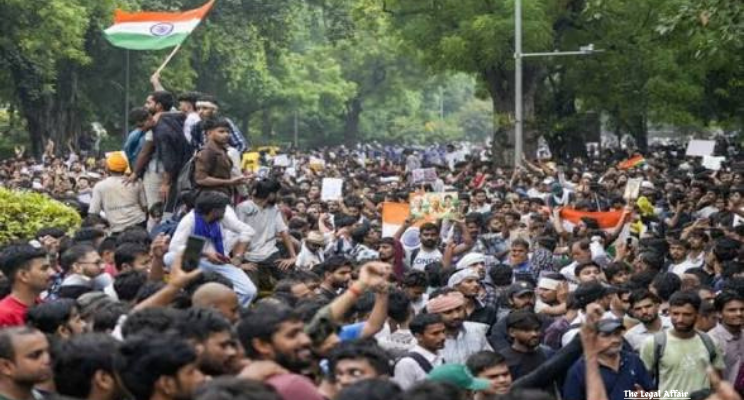
The petition was filed against the backdrop of allegations that the protest turned violent, resulting in attacks on police personnel, damage to public property and disruption of public life in central Delhi. The petitioner sought judicial directions requiring the authorities to identify those responsible, prosecute them under the applicable criminal laws and recover compensation for the damage allegedly caused to public property.
While considering the petition, the High Court examined whether such directions were necessary when an established legal mechanism already exists for dealing with incidents involving public violence and destruction of property. The Court ultimately declined to exercise its writ jurisdiction, observing that the Supreme Court has already laid down the legal framework governing such situations and that the competent authorities are responsible for taking appropriate action.
Arguments of the Parties:
The petitioner, Save India Foundation, contended that the student protest at Jantar Mantar escalated into serious acts of violence involving assault on police personnel, vandalism of public property and obstruction of normal public movement around Parliament, India Gate and nearby areas. It alleged that these incidents constituted serious criminal offences warranting immediate investigation and prosecution.
The petition further claimed that the protest had been organised by a group identified as the “Cockroach Janta Party” (CJP). According to the petitioner, social media campaigns associated with the group encouraged participants to engage in unlawful activities and openly defy law enforcement authorities. It was argued that videos and online content circulated before and during the protest allegedly incited violence and contributed to the disorder witnessed at the protest site.
On these allegations, the petitioner sought directions to the police and other authorities to identify all persons involved in the alleged violence, register criminal cases wherever required, prosecute those responsible under the relevant provisions of law and recover the cost of damage caused to public property from the persons found liable.
Although detailed submissions on behalf of the respondents were not recorded in the order, the Court considered the legal position governing such incidents. It noted that established mechanisms already exist for investigating offences involving public violence and destruction of public or private property, making direct judicial intervention unnecessary at that stage.
Court’s Judgment:
The Delhi High Court declined to entertain the writ petition and held that the issues raised by the petitioner were already governed by the legal framework laid down by the Supreme Court. The Bench observed that appropriate mechanisms are in place for dealing with incidents involving violence, damage to public property and assaults on law enforcement personnel.
At the outset, the Court reminded the petitioner that the Supreme Court has issued comprehensive directions in similar matters concerning destruction of public and private property during protests and demonstrations. Since those mechanisms continue to operate, there was no occasion for the High Court to issue fresh directions requiring the authorities to perform their statutory duties.
The Bench observed that if the petitioner believed that criminal offences had been committed during the protest, the appropriate course was to approach the competent authorities with the relevant material. It expressed confidence that the authorities would examine any such representation in accordance with law and take appropriate action wherever warranted.
Accordingly, the Court disposed of the petition while granting liberty to Save India Foundation to submit a representation before the concerned authorities. It directed that if such a representation is made, the authorities shall duly consider it and take an appropriate decision under law.
The judgment reflects the settled principle that constitutional courts ordinarily refrain from issuing directions in matters where statutory authorities are already empowered and obligated to investigate alleged criminal offences. The Court emphasised that judicial intervention is unnecessary when an adequate legal mechanism exists and there is no material to show that the authorities have failed to discharge their statutory responsibilities.
By declining to entertain the petition, the High Court reaffirmed the principle of institutional restraint and respected the statutory role of investigating agencies. Rather than assuming the functions of law enforcement, the Court ensured that the petitioner retained the liberty to place its grievances before the competent authorities, who remain legally bound to consider the allegations and proceed in accordance with applicable law.