


Introduction:
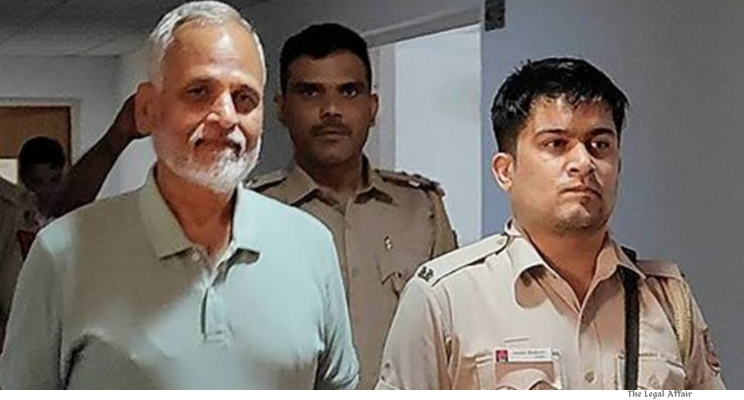
On Friday, a Delhi court granted bail to Satyendar Jain, a senior leader of the Aam Aadmi Party (AAP) and former Delhi minister, in a money laundering case. The bail was granted by Special Judge Vishal Gogne of the Rouse Avenue Courts, who cited Jain’s extended incarceration and the delay in trial proceedings as primary reasons for granting him bail. Jain has been in custody for over 18 months, and the court noted that the trial is yet to begin, let alone conclude. Jain was represented by a legal team led by Senior Advocate N Hariharan, along with advocates Vivek Jain, Mayank Jain, Parmatama Singh, Madhur Jain, Arpit Goel, and Sadiq Noor.
The case dates back to of 2022, when Jain was arrested by the Enforcement Directorate (ED) on allegations of money laundering involving four companies during the periods 2010-2012 and 2015-2016. The Supreme Court had earlier observed that Jain and his co-accused appeared prima facie guilty of money laundering, and both the Delhi High Court and the Apex Court had denied him bail earlier. The recent relief, however, comes after a long period of pre-trial incarceration and delays in the judicial process.
Background of the Case:
The roots of the case lie in allegations that Satyendar Jain was involved in a money laundering scheme through a network of shell companies. According to the Enforcement Directorate, Jain allegedly laundered money through four companies during the periods 2010-2012 and 2015-2016. The ED further claimed that these companies were used to route black money into legitimate accounts by creating layers of financial transactions that obfuscated the true origins of the funds.
Jain, who has served as a minister in the Delhi government, was arrested in 2022 after investigations under the Prevention of Money Laundering Act (PMLA) revealed his alleged involvement in laundering large sums of money. The ED’s case rests on the accusation that Jain used his political influence to carry out these illegal transactions and evade scrutiny.
Initially, the Delhi High Court and the Supreme Court both denied Jain’s request for bail. In March 2023, the Supreme Court found prima facie evidence against Jain and his co-accused, Ankush Jain and Vaibhav Jain, and observed that they were seemingly guilty of the charges. The Supreme Court also emphasized the twin conditions laid down under Section 45 of the PMLA for granting bail in money laundering cases, noting that Jain had not fulfilled these conditions.
In April 2023, the Delhi High Court denied regular bail to Jain, further asserting that the accusations against him were serious and required careful consideration in the light of the ongoing investigation.
Arguments by the Prosecution (ED):
The Enforcement Directorate (ED), acting as the prosecution in this case, argued that Satyendar Jain played a key role in a money laundering scheme and had funnelled illicit funds through shell companies. The ED claimed that Jain and his associates used four companies to launder money between 2010-2012 and 2015-2016. The financial transactions were made to look legitimate through multiple layers of transfers, but the ED alleged that the true purpose of these transactions was to convert black money into white money.
The ED presented evidence suggesting that Jain had misused his political position to engage in these unlawful activities and used his influence to evade detection. The prosecution also pointed to the 2017 raids that allegedly uncovered incriminating documents linking Jain to these transactions.
The prosecution’s main argument against bail was the gravity of the offense and the likelihood that Jain if released, could interfere with the investigation or tamper with evidence. Additionally, the Supreme Court’s ruling in March, which found prima facie guilt, was cited as a basis for denying bail. The ED emphasized that under Section 45 of the PMLA, bail should not be granted unless two conditions are met: that the accused is not guilty of the offense and that their release will not harm the ongoing investigation.
The ED asserted that neither condition had been met in Jain’s case, and therefore, his bail request should be denied.
Arguments by the Defense:
The defense, led by Senior Advocate N Hariharan, argued that Satyendar Jain had been incarcerated for over 18 months without any significant progress in the trial. They pointed out that despite the charges, the trial had not yet begun, and there was no clear timeline for when the trial would start or conclude.
The defense contended that Jain’s continued detention without a trial violated his fundamental rights, including his right to a fair trial. The defense argued that the delay in the trial was unjustified, and keeping Jain in custody for such a prolonged period amounted to pre-trial punishment, which goes against the basic principles of criminal justice.
Moreover, the defense highlighted that Jain had cooperated fully with the investigation and had no intention of tampering with evidence or influencing witnesses. They assured the court that Jain was ready to comply with any conditions the court may impose to ensure the integrity of the trial.
The defense also questioned the strength of the prosecution’s case, arguing that the evidence presented by the ED was circumstantial and lacked concrete proof of Jain’s direct involvement in money laundering. They asserted that the Supreme Court’s finding of prima facie guilt was not equivalent to a final conviction and that Jain should be granted bail until the trial concludes.
Court’s Judgement:
After considering the arguments presented by both sides, Special Judge Vishal Gogne of the Rouse Avenue Courts granted bail to Satyendar Jain. The court cited the long delay in the trial and Jain’s prolonged incarceration as the primary reasons for granting relief.
In his judgment, Judge Gogne noted that Jain had been in custody for 18 months, and there was no indication that the trial would begin anytime soon. The court highlighted that the delay in trial proceedings was significant and could not be ignored, as it infringed upon Jain’s right to a speedy trial.
The court also considered the fact that Jain’s bail applications had been previously rejected by both the Delhi High Court and the Supreme Court, but pointed out that these decisions were made at a different stage of the proceedings. At this point, Jain had already served a lengthy period of pre-trial detention, and the court concluded that further incarceration without trial would be unjust.
The judgment emphasized that Satyendar Jain had fully cooperated with the investigation and had not shown any intention to obstruct justice. The court also took into account the defense’s argument that Jain’s continued detention amounted to pre-trial punishment, which is inconsistent with the principles of a fair legal process.
In granting bail, the court imposed several conditions to ensure that Jain would not interfere with the investigation or influence witnesses. These conditions included regular reporting to the authorities, non-interference with evidence, and restrictions on travel outside the jurisdiction of the court.
Ultimately, the court concluded that Satyendar Jain was “favourably suited for the relief” given the delay in trial, the long period of incarceration, and the uncertainty surrounding the trial’s conclusion.
Conclusion:
The Delhi Court’s decision to grant bail to Satyendar Jain marks a significant moment in this ongoing money laundering case. After 18 months of incarceration and delays in the trial, the court deemed it unfair to keep Jain in detention without any clear timeline for the trial’s commencement or conclusion. While the Enforcement Directorate continues its investigation, this ruling highlights the court’s responsibility to balance fairness and justice—particularly in cases of prolonged pre-trial detention.