


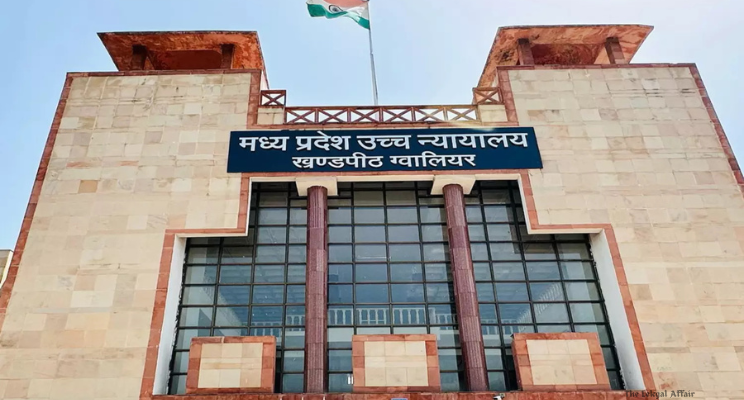
Introduction:
In a significant judgment underscoring the foundational principles governing criminal trials based on circumstantial evidence, the Madhya Pradesh High Court set aside the life sentences imposed on two individuals in a 2017 murder case arising out of Panna District. The Division Bench comprising Justice Vivek Agarwal and Justice Rajendra Kumar Vani, while allowing the criminal appeal, held that the chain of circumstantial evidence was incomplete and marred by serious investigative lapses. The Court went a step further by terming the memorandum prepared on the basis of the accused persons’ disclosure statements as a “fictitious” document and directed that a copy of the judgment be circulated among police personnel as a caution against fabrication of evidence. The appeal arose from the conviction of the appellants under Sections 302 and 34 of the Indian Penal Code by the First Additional Sessions Judge, Panna, for the alleged murder of Panthprakash Kushwaha. The appellants challenged their conviction contending that the prosecution’s case rested entirely on conjectures, with no complete chain of circumstances linking them to the crime.
Arguments on Behalf of the Appellants:
The defence mounted a comprehensive challenge to the prosecution’s narrative, asserting that the conviction was unsustainable in law as it was founded solely on circumstantial evidence that failed to meet the strict standards laid down by the Supreme Court. The appellants argued that the prosecution primarily relied on the “last seen” theory through the testimony of one Ramzan Khan (PW-15). However, during trial, the said witness turned hostile and categorically denied having seen the accused persons with the deceased on the date of the incident. The defence contended that once the principal circumstance of “last seen together” collapsed, the entire prosecution case lost its backbone. The appellants further attacked the credibility of the memorandums allegedly recorded under Section 27 of the Evidence Act pursuant to disclosure statements by the accused. It was pointed out that glaring inconsistencies existed in the timing and presence of the Investigating Officer, Inspector D.K. Singh. While the prosecution claimed that memorandums (Exhibit P/16 and P/17) were prepared at a particular time in the police station, evidence on record suggested that the officer was simultaneously present at the crime scene located four kilometres away. This contradiction, according to the defence, exposed the falsity of the documents and indicated that they were prepared subsequently to artificially strengthen a weak case. The appellants submitted that criminal conviction cannot be based on suspicion, however grave, and that the benefit of doubt must go to the accused when the prosecution fails to establish an unbroken chain of incriminating circumstances.
Arguments on Behalf of the State:
The State sought to sustain the conviction by contending that the cumulative effect of circumstances established the guilt of the accused beyond reasonable doubt. It argued that though the “last seen” witness had turned hostile, other surrounding circumstances, including the memorandums and alleged recoveries, sufficiently pointed towards the involvement of the appellants. The prosecution maintained that minor discrepancies in the timing or preparation of documents should not overshadow the broader evidentiary picture. It was urged that the trial court had meticulously appreciated the evidence and found that the circumstances, taken together, excluded any reasonable hypothesis other than guilt. The State emphasised that hostility of a witness does not necessarily demolish the prosecution case if other evidence remains intact.
Court’s Analysis and Findings:
The Division Bench undertook a careful reappraisal of the entire evidentiary record, keeping in mind the well-settled principles governing cases resting on circumstantial evidence. The Court relied heavily on the landmark decision in Sharad Birdhichand Sarda v. State of Maharashtra (1984) 4 SCC 116, wherein the Supreme Court crystallised the five golden principles, often referred to as the “panchsheel” of circumstantial evidence. These principles require that the circumstances from which the conclusion of guilt is drawn must be fully established; the facts so established must be consistent only with the hypothesis of the guilt of the accused; the circumstances must be of a conclusive nature; they must exclude every possible hypothesis except the one to be proved; and there must be a complete chain of evidence so as not to leave any reasonable ground for a conclusion consistent with innocence. Applying these principles, the High Court found that the prosecution had failed to establish the essential circumstance of “last seen together.” The sole witness who was projected as having seen the accused with the deceased had retracted his earlier statement and denied such knowledge during trial. The Court observed that in the absence of corroborative evidence, reliance on a hostile witness’s earlier statement would be unsafe. The Bench then turned to the memorandums drawn on the basis of disclosure statements. It scrutinised the record and noted a glaring anomaly: Inspector D.K. Singh was shown to be present at the crime scene at 8:30 a.m., yet the memorandums recorded his presence at the police station at the same time. Given the four-kilometre distance between the locations, such simultaneous presence was impossible. The Court concluded that the memorandums were not contemporaneously prepared but were subsequently created “as per the convenience of the Investigating Officer.” Terming them fictitious, the Bench held that such fabricated documentation strikes at the root of fair investigation and erodes the integrity of criminal justice administration. The Court unequivocally observed that the conviction appeared to have been recorded on the basis of surmises and conjectures rather than legally admissible and credible evidence. It further remarked that the investigation was not merely faulty but malicious, inasmuch as documents were manipulated to rope in the accused persons. Consequently, the impugned judgment of conviction could not be sustained in the eyes of law. The appellants were acquitted of the charges, and their life sentences were set aside.
Stern Warning to Police Machinery:
Beyond acquittal, the Bench issued a broader institutional caution. It directed that a copy of the judgment be supplied to the Government Advocate, who may request the Director General of Police to circulate the judgment among all police personnel. The Court emphasised that if any police official is found to have created fictitious or forged documents during investigation, departmental enquiry may be initiated. This directive was intended as a warning to ensure diligence and integrity in investigative processes. The Bench underscored that criminal investigation is not a mechanical formality but a solemn duty demanding fairness, accuracy, and adherence to law.