


Introduction:
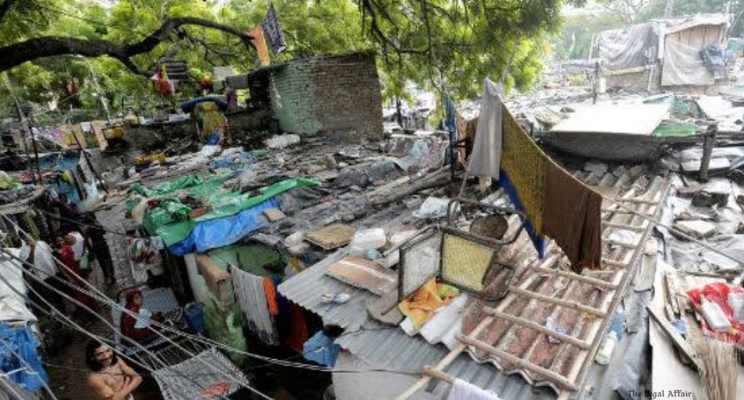
In a landmark ruling that merges the concepts of environmental protection with human dignity, the Bombay High Court has upheld the constitutional validity of Regulation 17(3)(D)(2) of the Development Control and Promotion Regulations (DCPR) 2034. The regulation allows the rehabilitation of slum dwellers residing on land that, although reserved as open spaces in city development plans, has long been encroached upon. The judgment came in the case of NGO Alliance for Governance and Renewal (NAGAR) v. State of Maharashtra (Writ Petition 1152 of 2002), in which a division bench comprising Justices Amit Borkar and Somasekhar Sundaresan deliberated on the constitutional clash between environmental rights and the rights of the urban poor.
Arguments:
The petitioners challenged the regulation arguing that it violated Article 21 by encroaching on green, open spaces meant for public use. Senior Advocate Shiraz Rustomjee, appearing for the petitioners, asserted that the rehabilitation scheme would result in the permanent loss of green areas crucial for the city’s air quality, recreation, and overall well-being. The petitioners contended that the State and municipal authorities must strictly enforce land-use laws and evict all encroachers to preserve these spaces.
On the other side, Senior Advocate Anil Sakhare for the State, along with other counsel representing the Slum Redevelopment Authority (SRA), the Municipal Corporation of Greater Mumbai (MCGM), and slum redevelopment agencies, argued that the regulation was a balanced response to decades-long urban realities. They highlighted that most of the land in question had already been encroached upon for years due to socio-economic distress and administrative apathy. Regulation 17(3)(D)(2) merely offered a humane solution that allows redevelopment, requiring 35% of the plot to be returned to open space post-rehabilitation, ensuring partial environmental restoration while simultaneously providing housing to thousands.
Judgement:
The Court, after examining extensive arguments and referring to constitutional jurisprudence, took a nuanced view of Article 21. The bench acknowledged the severe shortage of open spaces in Mumbai, exacerbated by population growth, unregulated urbanization, and limited land resources. Yet, it observed that the right to shelter for slum dwellers is equally protected under Article 21 and that both rights—the right to a clean environment and the right to shelter—must be harmonized, not treated as mutually exclusive. The judges made it clear that a constitutional democracy cannot resolve structural poverty by simply demolishing slums. Justice Borkar, authoring the 191-page verdict, noted, “People living in slums or informal settlements are not outside the protection of the Constitution. They may not have legal ownership of land, but they have an equal right to live with dignity, safety, and basic standards of living.” The court rejected the argument that green spaces must be preserved at all costs, stating that such an approach might ultimately violate Article 21 itself by rendering people homeless. The judgment emphasized that slums are not mere encroachments but symptoms of economic inequality and structural gaps in urban planning. The Constitution, the bench said, is a living document which must be interpreted in light of current realities. It underscored that Regulation 17(3)(D)(2) applies only to already encroached lands and mandates a fixed 35% of such plots be returned to public open spaces. This provision, far from being regressive, was seen as a restorative urban policy measure.
The bench also criticized the Appellate Tribunal’s mechanical insistence on eviction without considering the socio-economic ramifications or offering alternative housing. “A clean city that excludes the poor cannot be called just or fair,” the court observed, adding that environmental protection cannot become a tool of exclusion. It emphasized that environmental degradation and slum proliferation are not disconnected phenomena—they stem from poor governance and the failure to integrate the urban poor into formal housing policies. The judgment referenced the Supreme Court’s landmark decisions in Olga Tellis v. Bombay Municipal Corporation and Chameli Singh v. State of Uttar Pradesh, reiterating that the right to shelter includes not just a roof over one’s head, but access to basic civic amenities, security, and dignity. The Court clarified that it was not giving the State a free hand to permit indiscriminate construction on open spaces. Rather, it reminded planning authorities of their constitutional duty to improve open space per capita availability, especially in overcrowded city wards. It instructed that Regulation 17(3)(D)(2) does not apply to all open spaces, and certainly not to parks or gardens that are free from encroachment.
Finally, the judges concluded that the challenged regulation was an embodiment of the constitutional promise of balancing environmental conservation with social justice. It reflected a thoughtful compromise that neither rewarded encroachment nor sacrificed housing rights at the altar of ecological purism. The Court quashed the petition, upheld the validity of Regulation 17(3)(D)(2), and affirmed that a truly inclusive city must cater to both environmental needs and housing rights.