


Introduction:
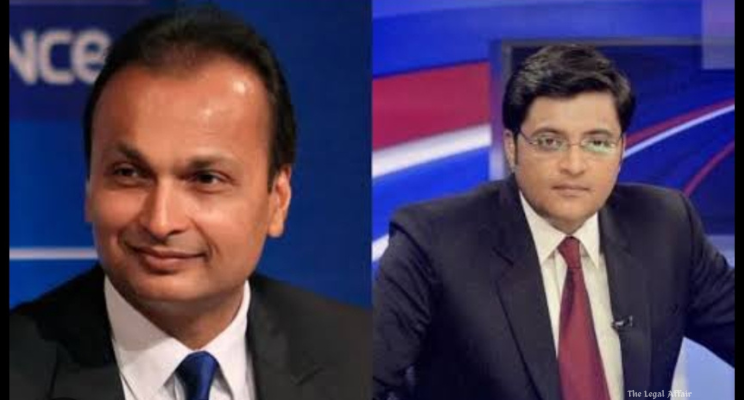
The present matter came up before the Bombay High Court in a defamation suit instituted by industrialist Anil Ambani against Republic TV and its Editor-in-Chief Arnab Goswami. The suit sought injunctive relief against allegedly defamatory broadcasts aired by the news channel in connection with ongoing investigations by enforcement agencies into certain companies associated with the Reliance group.
The controversy arose from news coverage relating to proceedings by the Enforcement Directorate involving Reliance Communications Ltd (RCOM), Reliance Home Finance Ltd, and Reliance Commercial Finance Ltd. The plaintiff contended that despite having stepped down as Non-Executive Director of RCOM in November 2019 and having no managerial involvement in the affairs of the other entities, the channel persistently and irresponsibly linked him to alleged financial irregularities.
It was alleged that the broadcasts employed highly sensationalized language and disparaging descriptors such as “fraud,” “scam mastermind,” “money launderer,” and “cheat,” thereby creating a false perception of guilt in the minds of the public. According to the plaintiff, this went beyond fair reporting and amounted to a deliberate and malicious attempt to tarnish his reputation.
The matter was heard by Justice Milind Jadhav, who, while not passing any immediate gag order, made significant oral observations emphasizing the limits of journalistic freedom and cautioning against the use of intemperate and derogatory language in news reporting. The Court highlighted the need to strike a balance between the freedom of the press and the right to reputation, which is an integral part of Article 21 of the Constitution.
Arguments on Behalf of the Plaintiff:
Counsel for the plaintiff, Advocate Mayur Khandeparkar, strongly contended that the defendant channel had crossed the boundaries of responsible journalism and had engaged in a sustained campaign of defamation.
It was argued that the broadcasts were not mere dissemination of facts regarding ongoing investigations but were crafted in a manner that imputed criminal liability to the plaintiff without any judicial determination. The repeated use of expressions such as “fraudster,” “scamster,” and “money launderer,” coupled with the continuous display of the plaintiff’s photograph, created a narrative that portrayed him as guilty of serious financial crimes.
The plaintiff emphasized that he had resigned from his position as Non-Executive Director of Reliance Communications Ltd in November 2019 and had no operational or managerial control over the affairs of the companies under investigation. Despite this, the channel allegedly continued to associate him personally with the alleged misconduct, thereby misleading the public.
It was further submitted that such reporting violated the fundamental principles of fairness and objectivity expected from media institutions. The plaintiff contended that the defendants’ actions amounted to “trial by media,” wherein the presumption of innocence was completely disregarded.
The plaintiff also asserted that the impugned broadcasts had caused significant damage to his personal and professional reputation. The use of sensational headlines and provocative language was said to have exposed him to public ridicule, hatred, and contempt.
In addition, it was argued that the defense of “fair comment” was not available to the defendants in the present case. For such a defense to succeed, the comment must be based on true facts, made in good faith, and expressed without malice. However, the plaintiff contended that the defendants had acted with clear malice, as evidenced by the repeated use of derogatory language and the deliberate attempt to link him to allegations without any factual basis.
The plaintiff therefore sought an injunction restraining the defendants from continuing such broadcasts and from using defamatory expressions in relation to him.
Arguments on Behalf of the Defendants:
Senior Advocate Mahesh Jethmalani, appearing for Republic TV and Arnab Goswami, sought to justify the broadcasts by invoking the defense of “fair comment.”
It was argued that the media has a fundamental right to report on matters of public interest, particularly when they involve investigations by statutory authorities such as the Enforcement Directorate. The defendants contended that their reporting was based on information already in the public domain and pertained to issues of significant public concern.
The defense emphasized that the role of the media in a लोकतांत्रिक (democratic) society is to inform the public and hold powerful entities accountable. It was submitted that the broadcasts were part of this broader journalistic duty and were not intended to defame the plaintiff.
With regard to the use of strong language, the defendants argued that news reporting often involves a certain degree of editorial expression and commentary. The defense maintained that such expressions should be viewed in the context of the overall reportage and should not be isolated to infer malice.
The defendants also contended that no prior restraint should be imposed on the media, as this would amount to censorship and would have a chilling effect on free speech. It was argued that any grievance regarding alleged defamation could be addressed through appropriate legal remedies after publication, rather than by imposing pre-publication restrictions.
However, during the course of the hearing, the defendants, through their counsel, assured the Court that certain expressions, including the phrase “the goose is cooked,” would not be used in future broadcasts.
Observations and Judgment of the Court:
Justice Milind Jadhav, while refraining from passing an immediate injunction, made strong oral observations highlighting the need for restraint in media reporting.
The Court made it clear that it was not seeking to gag the media or prevent the channel from reporting on matters of public interest. At the same time, it emphasized that the freedom of the press is not absolute and must be exercised responsibly.
In a candid remark addressed to the defendants’ counsel, the Court stated:
“Bring down the rhetoric… Please run stories without using adjectives or disparaging someone… You are doing your duty of giving news, that is okay, but hitting below the belt is NOT OKAY.”
The Court expressed concern over the increasing tendency of media houses to use sensational and provocative language in order to attract viewership. It noted that such practices undermine the credibility of journalism and can cause irreparable harm to individuals’ reputations.
Justice Jadhav specifically pointed out the use of phrases like “the goose is cooked,” questioning the appropriateness and implications of such language in a news broadcast. The Court observed that such expressions can carry multiple meanings and may unfairly prejudice viewers against the person being reported on.
The Court also cautioned the defendants about the consequences of continuing with such reporting practices. Referring to previous instances where courts had intervened in similar matters, the judge warned that failure to heed the Court’s advice could result in the passing of interim orders.
Importantly, the Court reiterated that it was not interfering with the substance of the news reports. It acknowledged the media’s role in informing the public and stated:
“You carry on with your stories… I am not saying anything about the stories… People have the right to know.”
However, the Court drew a clear line when it came to the use of derogatory language and personal attacks. It emphasized that reporting should be factual and devoid of unnecessary embellishments that could amount to defamation.
The Court thus sought to strike a balance between two competing rights: the freedom of speech and expression under Article 19(1)(a) and the right to reputation under Article 21.
The matter was adjourned to April 16, with directions to the defendants to file their reply to the suit. The Court indicated that it would consider the matter further after hearing both sides in detail.