


Introduction:
The Madhya Pradesh High Court delivered a significant judgment concerning the long-standing Bhojshala dispute in Dhar, Madhya Pradesh, holding that the religious character of the disputed site is that of a temple dedicated to Goddess Saraswati, also referred to as Vagdevi. The decision was rendered by a Division Bench comprising Justice Vijay Kumar Shukla and Justice Alok Awasthi while deciding writ petitions filed by the Hindu Front for Justice and other petitioners seeking exclusive recognition of the Bhojshala complex as a Hindu religious and cultural site.
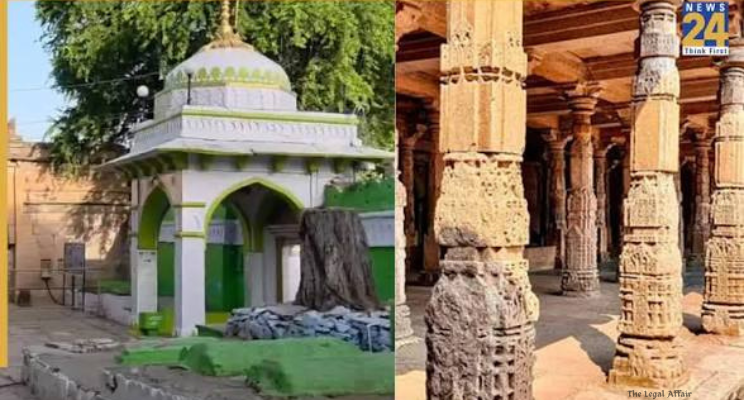
The dispute over Bhojshala has remained one of the most sensitive religious and historical controversies in central India. The monument, situated in Dhar district, is protected under the provisions governing ancient monuments and archaeological sites and has long been administered by the Archaeological Survey of India. Hindus have historically regarded the site as an ancient temple and seat of Sanskrit learning associated with Raja Bhoj, the celebrated Paramara ruler of Malwa. The Muslim community, on the other hand, has claimed the structure as the Kamal Maula Mosque and asserted a historical right to offer namaz at the premises.
The litigation acquired renewed significance after a series of petitions challenged the arrangement introduced by the ASI in 2003. Under that arrangement, Hindus were permitted to perform puja on Tuesdays while Muslims were allowed to offer Friday namaz within the complex. The petitioners argued that the arrangement diluted the historical and religious identity of Bhojshala and violated the rights of Hindu worshippers. They sought restoration of the site as a full-fledged Saraswati temple and prayed for restraint against Muslim prayers within the premises.
The controversy also involved questions regarding archaeological evidence, medieval history, constitutional protection of religious practices, preservation of ancient monuments, and competing claims over heritage structures. During the proceedings, the High Court ordered a scientific survey of the site, leading to objections and appeals before the Supreme Court of India. The Supreme Court later laid down a procedural framework for unsealing and examining the survey report, after which the matter returned to the High Court for final adjudication.
Apart from the Hindu and Muslim parties, certain Jain groups also intervened in the proceedings, claiming that the idol associated with the site represented Jain Goddess Ambika and that the architectural features of the structure reflected Jain temple traditions. The dispute, therefore, transformed into a broader contest involving religion, archaeology, historical interpretation, and constitutional rights.
Against this background, the High Court was called upon to determine the true religious character of the Bhojshala complex, the legality of the ASI’s 2003 arrangement, and the future administration of the monument. The judgment has now emerged as a landmark ruling dealing with the intersection of heritage preservation and competing religious claims.
Arguments of the Parties:
The petitioners representing the Hindu community contended that Bhojshala was originally established during the reign of Raja Bhoj as a centre of Sanskrit learning and worship dedicated to Goddess Saraswati. According to them, historical records, inscriptions, sculptures, architectural features, and archaeological findings demonstrated the existence of a pre-existing Hindu temple at the site. They argued that the structure’s pillars, carvings, motifs, and iconography unmistakably reflected Hindu temple architecture and indicated that the monument was not originally constructed as a mosque.
The petitioners further submitted that the Bhojshala complex was revered for centuries as a sacred educational and spiritual institution associated with Vagdevi Saraswati, the goddess of knowledge and learning. They asserted that Hindu worship at the site had continued historically, though at different times such worship was subjected to restrictions and regulation. Relying on historical literature and archaeological reports, the petitioners argued that the identity of the site as a Saraswati temple could not be erased merely because Muslim prayers were allowed during later historical periods.
Another major challenge was directed against the 2003 arrangement framed by the ASI. The petitioners argued that the arrangement permitting namaz on Fridays and Hindu worship only on Tuesdays was arbitrary, historically incorrect, and inconsistent with the true religious character of the monument. According to them, the ASI, being merely a custodian of protected monuments, could not alter the essential religious nature of the site through administrative arrangements. They contended that the arrangement effectively legitimised claims inconsistent with the archaeological and historical evidence.
The Hindu parties also referred to the scientific survey conducted under the orders of the High Court. They maintained that the survey revealed evidence supporting the existence of temple remains beneath and within the structure. They emphasized that inscriptions and sculptural remains associated with Hindu deities reinforced the conclusion that the site historically functioned as a temple and educational centre under Raja Bhoj’s patronage.
In addition to seeking restoration of unrestricted worship rights, the petitioners also requested the return of the idol presently housed in the British Museum. According to them, the idol represented Goddess Saraswati and originally belonged to Bhojshala. They submitted that repeated representations had already been made to the Government of India seeking repatriation of the idol from London.
On the other side, parties representing the Muslim community strongly opposed the petitions and defended the continuance of namaz at the site. They argued that historical accounts from the Khilji period and subsequent Islamic rule did not mention the destruction of a Saraswati temple at Dhar. According to them, the absence of reliable documentary proof weakened the petitioners’ claim regarding the alleged conversion of a temple into a mosque.
The Muslim parties also relied upon a 1935 “Alaan” issued during the princely rule of Dhar, which recognised the right of the Muslim community to offer prayers at the structure. They argued that namaz had been offered at the site for decades and that such practice constituted an established religious right protected under constitutional principles of religious freedom. It was further submitted that the site had acquired a dual religious character over time and that the existing arrangement attempted to maintain communal harmony and public order.
The respondents challenged the petitioners’ interpretation of archaeological evidence and argued that historical ambiguities should not be resolved solely in favour of one religious group. They contended that the dispute involved sensitive questions of faith and public peace, requiring a balanced approach instead of exclusive religious recognition.
The Jain intervenors raised separate claims regarding the identity of the monument. They argued that the idol presently located in the British Museum resembled Jain Goddess Ambika rather than Goddess Saraswati. They also referred to similarities between the architecture of Bhojshala and Jain temples situated at Mount Abu. On that basis, they sought recognition of Jain prayer rights at the site.
The State and the ASI defended their role as custodians of a protected monument. The Government argued that the 1935 Alaan relied upon by the Muslim parties lacked legal validity because the site had already been declared protected under the Ancient Monument Preservation Act, 1904. Consequently, the administration and preservation of the monument came within the statutory authority of the ASI under the Ancient Monuments and Archaeological Sites and Remains Act, 1958.
The ASI maintained that its 2003 arrangement was intended to balance competing claims and maintain law and order. However, it also acknowledged its responsibility to preserve the archaeological and historical integrity of the monument while complying with judicial directions.
Court’s Judgment:
After examining historical records, archaeological material, inscriptions, architectural evidence, and submissions of the parties, the High Court concluded that Bhojshala historically functioned as a temple dedicated to Goddess Saraswati and a centre of Sanskrit learning associated with Raja Bhoj. The Court observed that the continuity of Hindu worship at the site, though regulated over time, constituted a significant factor in determining the religious character of the monument.
The Bench noted that the available historical literature consistently referred to Bhojshala as a renowned educational institution connected with Sanskrit scholarship and worship of Goddess Saraswati. According to the Court, these materials collectively established that the site originally possessed a Hindu religious and cultural identity. The Court specifically held that the evidence indicated the existence of a temple dedicated to Goddess Saraswati at Dhar and therefore recognised the religious character of the disputed area as Bhojshala with a temple of Goddess Vagdevi Saraswati.
While arriving at this conclusion, the Court placed considerable emphasis on archaeological indicators and historical continuity. It observed that the structural features, inscriptions, and remnants within the complex reflected Hindu architectural traditions and supported the petitioners’ claims. The Court accepted the proposition that the site was not merely a secular educational institution but also a place of religious significance connected with Hindu worship.
The High Court further held that the ASI’s 2003 arrangement improperly restricted the worship rights of Hindus. Consequently, the Court quashed the arrangement to the extent that it limited Hindu worship and simultaneously permitted namaz within the premises. According to the Bench, administrative arrangements could not override the historically established religious character of the site.
However, the Court also attempted to balance competing religious interests and avoid communal injustice. Recognising the long-standing association of the Muslim community with the site, the Court observed that their religious rights also deserved constitutional protection. Instead of entirely ignoring those concerns, the Bench directed that if the Muslim community, represented through the Maulana Kamaludding Welfare Society or a duly constituted waqf body, submitted an application seeking land within Dhar district for construction of a mosque, the State Government could consider allotment of suitable land in accordance with law.
This part of the judgment reflected the Court’s effort to secure “complete justice” between the parties while simultaneously restoring what it considered the original religious character of the monument. The Court clarified that such allotment, if granted, could be used for the construction and administration of a mosque and related religious facilities.
The High Court also issued important directions concerning the future management of the Bhojshala complex. It directed the Central Government and the ASI to take an appropriate decision regarding the administration and management of the Bhojshala temple and the Sanskrit learning activities connected with the property. At the same time, the Court clarified that the ASI would continue to retain overall administrative control over the protected monument in accordance with statutory obligations.
Significantly, the Court reiterated the constitutional responsibility of governments to preserve and protect monuments of historical and archaeological importance. The Bench observed that the duty of preservation extends not only to physical structures but also to sanctum sanctorum areas and deities associated with spiritual significance. This observation underscored the Court’s view that cultural heritage and religious identity are interconnected aspects of monument preservation.
With respect to the idol presently situated in the British Museum, the Court refrained from issuing a mandatory direction for immediate repatriation. Nevertheless, it acknowledged that representations had already been submitted before the Government of India and observed that the Government may consider steps for bringing back the idol and reinstalling it within the Bhojshala complex. Although the Court stopped short of issuing enforceable directions, its observations are likely to strengthen future demands for repatriation of cultural artefacts connected with Indian heritage sites.
The judgment is legally significant because it addresses the relationship between archaeology, religious freedom, and heritage protection within the constitutional framework. The Court effectively treated historical and archaeological evidence as central factors in determining the religious identity of the monument. At the same time, it attempted to accommodate minority religious interests through alternative arrangements rather than through continued shared use of the disputed site.
The ruling is also likely to generate wider legal and political discussion regarding disputes involving historical religious structures in India. Questions relating to the extent of judicial intervention in determining religious character, the evidentiary value of archaeological findings, and the balance between heritage conservation and religious rights may continue to arise in future litigation.
For the present, the judgment marks a decisive shift in the legal status of Bhojshala. By recognising the site as a Saraswati temple and quashing the ASI’s shared worship arrangement, the High Court has fundamentally altered the legal and administrative framework governing the monument. Whether the decision will attain finality or face further constitutional scrutiny before the Supreme Court remains to be seen.