


Introduction:
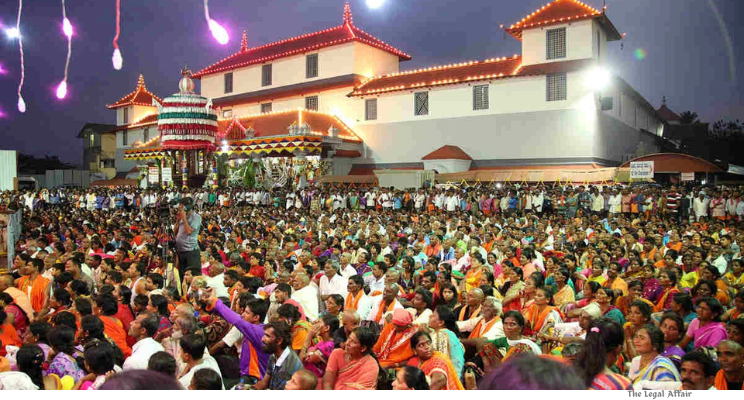
The case concerning the Dharmasthala burial controversy returned to judicial scrutiny when the Bengaluru City Civil Court re-issued a fresh interim injunction restraining certain media houses and digital platforms from publishing or transmitting allegedly defamatory content against the Dharmasthala temple administration and the family associated with its affairs. The matter has attracted considerable attention owing to the involvement of Harshendra Kumar D, brother of the Dharmadhikari of the Sri Manjunathaswamy Temple at Dharmasthala, and the continuous legal tussle between private rights to protect reputation and institutional sanctity on one hand, and the larger principles of press freedom and public interest on the other. The controversy has moved through different tiers of the judiciary, beginning with an ex-parte gag order against various media houses and YouTube channels, its subsequent quashing by the Karnataka High Court, the intervention of the Supreme Court directing an expedited hearing, and finally the re-examination of the issue by the civil court, which has now passed the fresh restraining order. The petitioner, Harshendra Kumar D, who is also the Secretary of the temple administration, has argued that unregulated circulation of defamatory and unverified material has caused severe harm to the reputation of the family and the religious institution. The respondents, comprising media houses, journalists, and content creators, have argued that such sweeping injunctions are unconstitutional prior restraints that suppress free speech, hinder journalistic inquiry, and go against the democratic principle of public accountability. Against this backdrop, the civil court sought to balance competing claims by granting a mandatory injunction against select defendants while excluding others and making it clear that the restraint would apply only until the disposal of the suit.
Arguments of the Petitioner:
The petitioner, Harshendra Kumar D, approached the civil court seeking urgent injunctive relief under Order XXXIX Rules 1 and 2 read with Section 151 of the Code of Civil Procedure. His primary argument was that multiple media houses and online platforms had published or broadcasted content regarding the so-called “Dharmasthala burial case,” which in his view was highly defamatory, factually baseless, and aimed at maligning both the temple institution and his family. He submitted that the continued transmission of such videos, articles, and URLs amounted to an orchestrated defamation campaign that threatened not only his personal reputation but also the sanctity of the temple, which is a centuries-old religious institution with enormous cultural and social significance. He emphasized that as the Secretary of the temple administration, it was his duty to safeguard the institutional reputation and prevent the spread of falsehoods that could mislead the public. The petitioner argued that freedom of speech and expression is not an absolute right under Article 19(1)(a) of the Constitution, as it is subject to reasonable restrictions under Article 19(2), particularly on grounds of defamation. He relied on precedents where courts had stepped in to protect individuals and institutions against malicious media campaigns. He further stressed that the High Court’s earlier quashing of the injunction against one YouTube channel did not absolve other media entities who continued to circulate defamatory content, and hence the civil court was bound to act to prevent irreparable harm. According to him, monetary damages would not be a sufficient remedy given the irreversible reputational loss, making injunctive relief the most appropriate legal course.
Arguments of the Respondents:
The respondents, which included a variety of media houses, digital platforms, and independent content creators, opposed the petition on several constitutional and procedural grounds. Their foremost contention was that the injunction sought amounted to an impermissible “prior restraint” on free speech, which has been consistently frowned upon by constitutional courts in India. They argued that freedom of the press is a cornerstone of democracy, and any blanket prohibition on publication of content—without specific findings of falsity or malice—would have a chilling effect on investigative journalism and public discourse. The respondents pointed out that the Karnataka High Court had already criticized the earlier ex-parte gag order, describing it as a sweeping injunction that “threatens any voice” against the petitioner, his family, or even the institution of Dharmasthala. They submitted that the present petition, though re-cast, was essentially an attempt to resurrect that unconstitutional restraint. Moreover, they contended that the plaintiff had not identified with precision the exact statements or content that was defamatory, and instead relied on a broad schedule of videos and URLs, some of which were simply critical commentary or reporting on matters of public concern. The respondents argued that in a democracy, even powerful religious institutions and influential families must remain subject to scrutiny, and criticism cannot be equated with defamation. They cited Supreme Court precedents cautioning against prior censorship and emphasized that the petitioner’s remedy, if any, lay in a subsequent defamation suit for damages, not in silencing the press. They also stressed that allowing such injunctions would set a dangerous precedent where wealthy and powerful individuals could muzzle the press by filing gag orders under the garb of protecting reputation.
Court’s Judgment:
The Bengaluru Civil Court, after considering the submissions, issued a nuanced order. It partly allowed the application for injunction, restraining a set of defendants (with specified exceptions) from transmitting or telecasting the videos and URLs mentioned in the schedule until final disposal of the suit. Importantly, the court excluded certain defendants against whom the plaintiff was not pressing the suit, as well as those against whom summons had not yet been served. The court thus sought to tailor the relief rather than issue a blanket prohibition, thereby addressing some of the concerns raised by the High Court earlier. The order directed the restrained parties, along with their men, servants, agents, administrators, or assignees, not to publish or circulate the impugned content. In doing so, the court emphasized that its injunction was not an absolute ban on reporting about the Dharmasthala burial case or on critical journalism in general; rather, it was confined to the specific videos and URLs cited in the application which were alleged to be defamatory. The court relied on the principle that while freedom of expression is fundamental, it cannot extend to false and malicious attacks on individual reputation and institutional dignity. The judge acknowledged that courts must be cautious in granting injunctions in defamation cases, as they risk becoming tools of censorship, but noted that in cases where prima facie defamatory material is identified and the potential harm is irreparable, injunctive relief may be justified pending final adjudication. The court also distinguished between “general criticism,” which remains permissible, and “defamatory assertions,” which can attract judicial restraint. Finally, the court clarified that the injunction would remain operative only until the disposal of the suit, thereby ensuring that the issue would be subject to detailed trial where evidence and defenses could be fully examined. The ruling thus attempted to strike a balance between safeguarding reputation and preventing abuse of press freedom, while leaving the ultimate determination of defamation to the trial stage.