


Introduction:
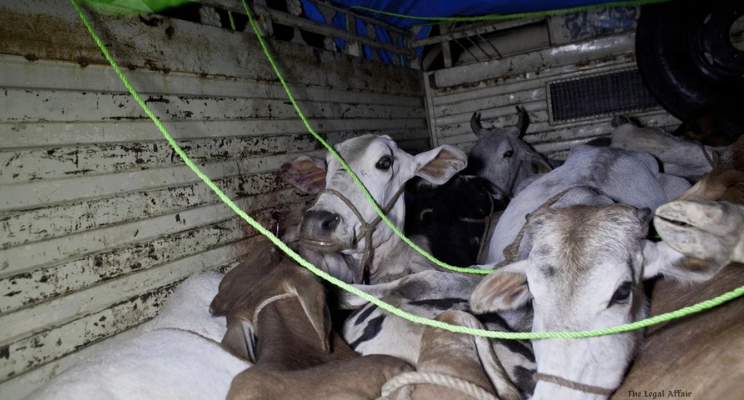
The case of Asif v. State of Haryana came before the Punjab and Haryana High Court, raising sensitive issues regarding the alleged illegal transportation of cows for slaughter and the scope of anticipatory bail under the Bharatiya Nagarik Suraksha Sanhita (BNSS). The petitioner, Asif, approached the Court seeking protection from arrest in connection with allegations that he was transporting two cows to Rajasthan for slaughter in violation of the Haryana Gauvansh Sanrakshan and Gausamvardhan Act as well as the Prevention of Cruelty to Animals Act. The matter was heard by Justice Sandeep Moudgil, who examined not only the factual matrix of the case but also the broader constitutional, cultural, and social implications of cow slaughter in India. While rejecting the bail application, the Court highlighted the unique position of the cow in Indian society, the misuse of judicial leniency by habitual offenders, and the need to balance personal liberty with public interest. This judgment also relied on the landmark precedent of State of Gujarat v. Mirzapur Moti Kureshi Kassab Jamat (2005) 8 SCC 534, where the Supreme Court upheld prohibitions on cow slaughter as consistent with constitutional directives under Article 48 of the Constitution of India. The Court further underscored the duties imposed by Article 51A(g), which calls upon every citizen to show compassion for all living creatures. The ruling ultimately reflects the judiciary’s approach in cases where religious, cultural, and social sentiments intersect with the enforcement of criminal law.
Arguments of the Petitioner:
Counsel for the petitioner, Ms. Rosi, submitted that Asif was being falsely implicated and that his alleged role in transporting cows was exaggerated for the purpose of criminal prosecution. It was argued that anticipatory bail under Section 482 of BNSS is a safeguard to protect individuals from arbitrary arrest, harassment, and undue hardship, particularly where the allegations are politically or communally motivated. The petitioner stressed that denial of anticipatory bail would amount to pre-trial punishment, contrary to the principle of presumption of innocence guaranteed under Article 21 of the Constitution of India.
The petitioner also emphasized that bail is the rule and jail is the exception, particularly in light of constitutional protections. It was argued that custodial interrogation was unnecessary, as the allegations related to transportation of animals and documentary evidence could be gathered without arresting him. Furthermore, counsel contended that mere suspicion or past allegations cannot be grounds to deny relief, and that the law cannot be applied in a manner that stigmatizes individuals from certain communities.
The petitioner maintained that there was no credible evidence to prove that the cows were being transported for slaughter. At best, the allegations pointed to transportation without necessary documents or licenses, which could not justify the denial of bail. The petitioner relied upon precedents where courts have stressed that anticipatory bail is meant to protect against misuse of criminal law for harassment and vengeance.
Arguments of the State:
On behalf of the State, it was argued that the petitioner was not a first-time offender. The prosecution pointed out that Asif had been previously booked in three other FIRs involving similar allegations of cow slaughter and transportation for slaughter. In each of those cases, bail had been granted, but the petitioner had misused the judicial trust by continuing to indulge in the same unlawful activities. This conduct, the State submitted, demonstrated a clear pattern of recidivism, which should disentitle the petitioner from the extraordinary relief of anticipatory bail.
The State further highlighted that cow slaughter is not an ordinary offence but one with deep religious, cultural, and social ramifications. It was contended that acts relating to cow slaughter can disrupt public peace and communal harmony, as they directly offend the sentiments of a significant section of society. Therefore, the prosecution argued, granting pre-arrest bail to a habitual offender in such matters would not only weaken the enforcement of law but also pose a risk of further unlawful activity.
Additionally, the State asserted that there was a real and imminent risk of the petitioner tampering with evidence, intimidating witnesses, and continuing with illegal transportation of cows if he were granted anticipatory bail. The prosecution relied on State of Gujarat v. Mirzapur Moti Kureshi Kassab Jamat, where the Supreme Court upheld cow slaughter prohibition laws and recognized them as consistent with constitutional morality and the directive principles of State policy. The State further emphasized Article 48, which directs the State to prohibit slaughter of cows and calves, and Article 51A(g), which mandates compassion towards animals, to argue that the offence in question strikes at the core of constitutional morality.
Court’s Judgment:
Justice Sandeep Moudgil, while rejecting the anticipatory bail plea, observed that the offence alleged against the petitioner was not merely a violation of statutory law but an act laden with cultural and emotional undertones. The Court acknowledged that in a pluralistic society like India, certain acts, though private in nature, can trigger larger consequences for public peace when they offend the deeply held beliefs of a significant portion of the population. The Court emphasized that it could not ignore the special and unique status of the cow in Indian society. Referring to State of Gujarat v. Mirzapur Moti Kureshi Kassab Jamat, the Court reiterated that cow slaughter prohibition laws serve both moral and economic purposes and reflect the constitutional ethos embedded in Article 48.
The Court observed that the cow is not only considered a sacred animal but also plays an integral role in India’s agrarian economy. The Constitution, the Court said, does not merely protect rights in abstraction but seeks to foster a just, compassionate, and cohesive society. Article 51A(g) imposes a fundamental duty on every citizen to show compassion towards all living beings. In this backdrop, the alleged act of repeated and deliberate cow slaughter struck at the very core of constitutional morality and social order.
The Court took serious note of the petitioner’s criminal antecedents. It pointed out that despite being granted bail in earlier cases, the petitioner had failed to respect the judicial trust and continued to indulge in similar offences. The repeated misconduct reflected an abuse of judicial leniency and suggested a high probability of future offences. Justice Moudgil remarked that anticipatory bail is a discretionary relief intended to protect innocent individuals from wrongful arrest and not a sanctuary for habitual offenders who repeatedly violate the law with impunity.
The Court categorically stated that protection under Section 482 of BNSS cannot be interpreted as an open invitation for offenders to evade lawful arrest. Liberty, the Court emphasized, must be safeguarded but cannot be allowed to degenerate into license for committing offences. The right to bail cannot be conflated with a right to impunity.
In denying anticipatory bail, the Court highlighted the balance between individual liberty and societal interest. While the judiciary is conscious of the importance of personal freedom, it cannot ignore cases where such liberty is demonstrably misused. The Court concluded that in light of the petitioner’s past conduct, the seriousness of the allegations, the possibility of tampering with investigation, and the cultural sensitivity of the offence, anticipatory bail could not be granted.
The judgment thus reinforces the principle that anticipatory bail, though a constitutional safeguard, remains an extraordinary remedy. Courts must carefully scrutinize the conduct of the applicant, the nature of allegations, and the larger societal implications before granting relief. In this case, the denial of bail was not merely punitive but was aimed at protecting public peace, upholding constitutional morality, and ensuring respect for judicial trust.