


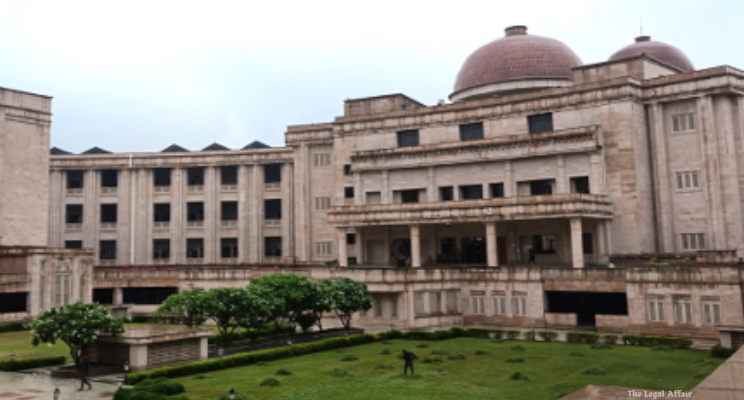
Introduction:
In a pivotal legal development, the Allahabad High Court, through a detailed 43-page order authored by Justice Arun Kumar Singh Deshwal, referred to a nine-judge bench two fundamental questions concerning the scope of the High Court’s inherent powers under Section 482 of the CrPC (corresponding to Section 528 of BNSS) to quash First Information Reports (FIRs) and ongoing investigations. The referral was made while hearing a plea filed by individuals challenging an order by the Chief Judicial Magistrate, Chitrakoot, which directed the registration of an FIR under Sections 498A, 323, 504, 506, and 342 of the IPC read with Section 3/4 of the Dowry Prohibition Act.
Arguments:
The petitioners, invoking Section 528 of BNSS, sought the quashing of the FIR and resultant police action. On the other side, the Additional Government Advocate (AGA) raised a preliminary objection, invoking the seven-judge bench decision in Ramlal Yadav & Others v. State of U.P. & Others (1989), which held that FIR quashing was not permissible under Section 482 CrPC, suggesting instead a writ petition under Article 226 of the Constitution.
Judgement:
Justice Deshwal, however, expressed respectful disagreement with the 1989 precedent, deeming it obsolete in light of Supreme Court rulings in State of Haryana v. Bhajan Lal (1990) and Neeharika Infrastructure Pvt. Ltd. v. State of Maharashtra (2021), which expanded the High Court’s scope to interfere even during investigation in certain circumstances. Highlighting the need to uphold judicial discipline and the doctrine of stare decisis, the Court referred the questions to a larger nine-judge bench, as the Ramlal Yadav ruling, though not expressly overruled, was rendered by a full bench of seven judges. The central questions now before the nine-judge bench are:
Whether the Ramlal Yadav ruling, in light of later Supreme Court judgments, still holds good law, and
Whether FIRs and investigations can be quashed under Section 528 BNSS when conditions outlined in Bhajan Lal and Neeharika Infrastructure are satisfied.
The Court emphasised that ignoring or deviating from the Ramlal Yadav ruling, even if arguably outdated, would erode judicial discipline and consistency. Nonetheless, the Court offered its own opinion that Section 528 BNSS (like Section 482 CrPC) can be invoked to quash FIRs and investigations even beyond cases of non-disclosure of cognizable offences, provided that established criteria—such as those in Bhajan Lal and Neeharika—are met. The decision also referenced the Supreme Court’s recent observation in Imran Pratapgadhi v. State of Gujarat 2025 LiveLaw (SC) 362, where the apex court held that there exists no blanket restriction on High Courts from quashing FIRs merely due to the early stage of investigation. This referral thus sets the stage for a landmark judicial verdict that may potentially reshape the doctrinal understanding of inherent judicial powers vis-a-vis criminal investigations in India.