


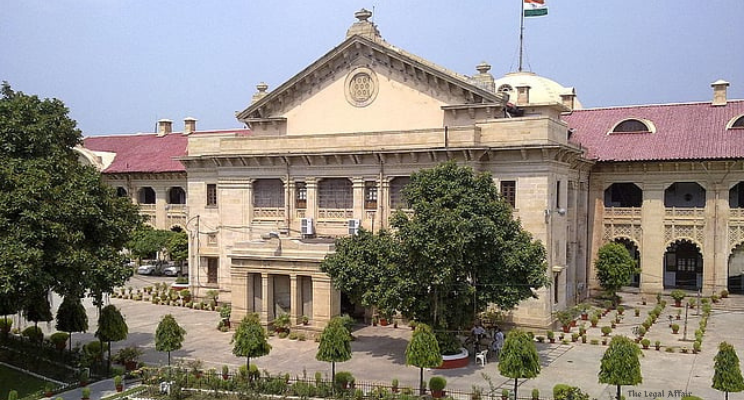
Introduction:
In a strong reminder to state authorities regarding their duty to uphold the law, the Allahabad High Court, while hearing a writ petition challenging orders of the Commercial Tax Department under the GST Act, called for a personal affidavit from the Principal Secretary, Institutional Finance, Government of Uttar Pradesh, Lucknow, seeking an explanation about the conduct of tax officers who failed to follow judicial precedents. The case, listed before Justice Piyush Agrawal, arose from a petition filed against the order of the Additional Commissioner, Grade-II (Appeal-1), Commercial Tax Department, Varanasi, who had rejected an appeal filed under Section 130 read with Section 122 of the GST Act. The petitioner contended that the appellate authority had summarily rejected the appeal without proper consideration of the material on record, and more importantly, without taking into account binding judicial pronouncements of the High Court in cases such as S/s Dinesh Kumar Pradeep Kumar v. Additional Commissioner, Grade-2 & Another and M/s Janta Machine Tools v. State of U.P. & 2 Others. The petitioner argued that despite the law being settled by the High Court in the aforementioned decisions, the appellate authority acted arbitrarily and mechanically, passing an order contrary to established principles. The High Court had earlier remarked that GST authorities in Uttar Pradesh, on almost a daily basis, have been disregarding binding rulings of both the High Court and the Supreme Court, thereby acting at their whims and fancies. The Court noted that such disregard for precedents represents not just an administrative lapse but a grave judicial impropriety, leading to erosion of uniformity in the application of law. Justice Piyush Agrawal observed that “while it is expected from the citizen to know the law, the duty of the officers increases that they should also know the law laid down by the higher courts,” highlighting that officers of the State are duty-bound to apply binding judicial precedents when adjudicating disputes and cannot plead ignorance or oversight.
Arguments:
In the petitioner’s submissions, it was contended that the impugned order was unsustainable because the appellate authority failed to examine the material facts and evidence presented, and more significantly, ignored settled law. The petitioner pointed out that in S/s Dinesh Kumar Pradeep Kumar, the High Court had categorically laid down guidelines on handling appeals under Section 130 of the GST Act, clarifying the scope of penalties and seizure of goods, while in M/s Janta Machine Tools, the Court had reiterated that arbitrary exercise of powers under Section 122 read with Section 130 is impermissible. It was further argued that the conduct of the Additional Commissioner reflects non-application of mind and a disregard for judicial discipline, thereby causing grave injustice. The petitioner stressed that the appellate authority, being a quasi-judicial body, was legally bound to follow binding precedents, and any deviation amounts to judicial indiscipline and arbitrariness, which cannot be permitted under Article 14 of the Constitution of India.
The State, represented by the Standing Counsel, attempted to defend the appellate authority’s conduct by submitting that the judgments relied upon by the petitioner were delivered subsequent to the passing of the impugned order and, therefore, could not have been considered at that time. The Additional Commissioner in his affidavit reiterated this stand, stating that the law laid down in those decisions was unavailable when he adjudicated the appeal. However, this explanation was immediately found wanting, as the Court noted that the decision in S/s Dinesh Kumar Pradeep Kumar was pronounced prior to the impugned order and, therefore, could have and ought to have been applied. The Court remarked that the Additional Commissioner had conveniently ignored this fact in his affidavit, which made his explanation wholly unsatisfactory.
Judgement:
In a detailed reasoning, Justice Piyush Agrawal underscored the significance of precedents in the judicial hierarchy. He stated that decisions of the High Court are binding on subordinate courts, tribunals, and authorities within its territorial jurisdiction, and such binding effect is an essential feature of the rule of law. The doctrine of precedent, the Court explained, ensures uniformity, consistency, and predictability in the application of law, thereby avoiding judicial chaos. By ignoring established law, authorities not only violate the principle of judicial discipline but also undermine public confidence in the legal system. The Court warned that repeated instances of officers disregarding binding rulings could not be tolerated and would invite strict accountability measures.
The Court also referred to the discretionary powers of the writ court under Article 226 of the Constitution to correct arbitrary and illegal actions of statutory authorities. It highlighted that when a High Court settles a principle of law, it is incumbent upon all officers to apply it in letter and spirit, failing which the entire system of justice delivery is compromised. Noting that “on almost every day, it has been noticed by this Court that in spite of the law settled by this Court as well as Apex Court, the GST authorities are acting at their whims and fancies,” the bench reiterated that such conduct is not just non-compliance but an affront to the rule of law.
Given the unsatisfactory affidavit of the Additional Commissioner, the Court imposed a cost of Rs. 5,000 on him, payable personally, for failing to justify his conduct. More importantly, the Court directed the Principal Secretary, Institutional Finance, Government of Uttar Pradesh, Lucknow, to file a personal affidavit explaining why officers in the State repeatedly fail to follow orders of the High Court and to specify corrective measures being undertaken to address this systemic issue. The Court did not stop there. It further directed the Principal Secretary to “formulate and disseminate a comprehensive and structured road map to ensure that all the concerned officers are duly updated regarding the recent judicial pronouncements.” The Court insisted that mechanisms must be institutionalized to prevent recurrence of such lapses, including regular training sessions, dissemination of judicial orders through official channels, and mandatory compliance monitoring.
This ruling represents a strong assertion by the High Court of its supervisory powers over administrative authorities and reiterates the binding nature of judicial precedents. It emphasizes that no officer, however high-ranking, can act contrary to established law, and any deviation invites personal accountability. It also reflects the judiciary’s concern that repeated disregard for binding precedents by GST authorities in the State is leading to judicial indiscipline and unnecessary litigation. The case has been adjourned and is next listed on 9 September 2025, by which date the Court expects the Principal Secretary’s affidavit and the proposed roadmap for ensuring compliance.
By holding officers personally accountable and calling for a systemic reform, the Allahabad High Court has sought to address the deeper malaise of bureaucratic indifference to judicial pronouncements. It reinforces that the rule of law demands strict adherence to precedents, and the administration cannot function in disregard of judicial authority. The ruling also sends a message that citizens cannot be harassed by arbitrary tax orders when the law on the subject has already been settled. Ultimately, this judgment strengthens the constitutional promise of equality before law and fair treatment by authorities, ensuring that governance is conducted within the framework of judicially settled principles.