


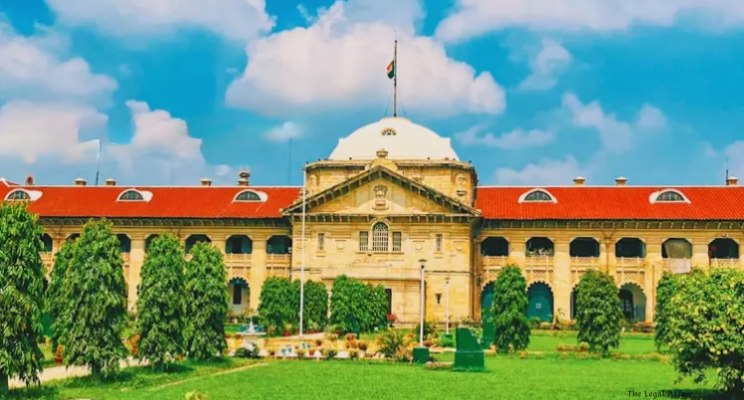
Introduction:
In a recent ruling, the Allahabad High Court awarded ₹5 lakhs as compensation to Ajay Kumar Pandey, a 35-year-old law student, whose admission to Prabha Devi Bhagwati Prasad Vidhi Mahavidhayalay, Anantpur, Harpur-Budhahat, Gorakhpur was found to violate the admission rules after he had already completed his first semester examinations. The Court, presided by a bench comprising Justice Manoj Kumar Gupta and Justice Vikas Budhwar, held that the student should not be penalized for the mistakes of the college, which acted recklessly in granting admissions. The case emphasized the college’s fault in enrolling students without following proper guidelines, ultimately risking their academic futures. Pandey’s appeal stemmed from the cancellation of his admission after he had passed his first-semester exams, claiming the error was on the institution’s part, not his.
Case Background:
Ajay Kumar Pandey approached the Allahabad High Court under Article 226 of the Constitution, seeking re-evaluation of his answer sheets for the first-semester LLB examinations for the academic year 2019-20. Initially dissatisfied with the marks he received, Pandey petitioned the court for a re-evaluation. The Court directed him to approach the University and assured him that copies of his answer sheets would be supplied upon request. Upon re-evaluation, his marks increased from 36 to 42. However, despite this, he was not allowed to appear for the viva voce examination for the second year. When Pandey approached the writ court again, the University revealed that his admission, along with 54 others, was cancelled as it was illegal, based on the fact that the undergraduate degree required for admission to the LLB course had to be from 2016 or later, while Pandey had graduated in 2008.
Pandey challenged the cancellation in a separate writ petition, which was dismissed. The writ court found no illegality in the University’s action, as the rules for admission, outlined in the brochure, were not challenged by the petitioner. Pandey then filed an intra-court appeal, contending that he should not be punished for the college’s errors and seeking compensation for the harm done to his academic career.
Arguments by the Appellant (Ajay Kumar Pandey):
Counsel for the appellant, Km. Anjana and Sarveshwari Prasad argued that Pandey, who had already completed his first semester successfully, should not be penalized for the mistakes of the Law College. The primary argument was that the appellant was a meritorious student who had passed the first semester and that the issue arose solely because of a technical error in his admission. While the admission brochure stated that an undergraduate degree should have been awarded in 2016 or later, the counsel contended that having a degree from 2008 did not disqualify Pandey from pursuing the 3-year LLB course. The fault, they argued, lay with the college, which admitted Pandey and subsequently charged fees without adhering to its admission guidelines.
Furthermore, the appellant argued that he had not committed any fraud in securing his admission and had submitted all necessary documents as required. Pandey’s counsel emphasized that the petitioner was unaware of the admission requirements being violated and had proceeded in good faith. They stressed that the Law College had acted recklessly, and Pandey, being a diligent and successful student, should not bear the consequences of the college’s negligence. The counsel also argued that the cancellation of the petitioner’s admission after he had successfully cleared the first semester examinations was not only unjust but also had jeopardized his academic career.
Arguments by the Respondents (Law College and University):
On behalf of the respondents, Rajiv Gupta, Grijesh Tiwari, and Nitin Chandra Mishra argued that Pandey had knowingly misrepresented his qualifications during the admission process. The Law College, affiliated with Deen Dayal Upadhyay Gorakhpur University, argued that the appellant was well aware of the terms laid out in the admission brochure, which explicitly required that the undergraduate degree of the applicant be from 2016 or later. According to the respondents, Pandey graduated in 2008 and falsely claimed his undergraduate degree was from 2015, to secure admission.
The respondents further argued that such misrepresentation warranted no relief from the Court. They contended that Pandey’s actions violated the terms and conditions outlined in the admission guidelines, and therefore, the cancellation of his admission was legally justified. They emphasized that the petitioner had been given admission based on faulty information, and once the mistake was identified, the University acted correctly by cancelling the admission. Furthermore, they argued that the rules of admission were never challenged by the petitioner and that there was no merit in his claims that the cancellation of his admission was illegal.
The counsel for the Law College also contested the imposition of ₹5 lakhs as compensation, arguing that the College was not in a position to pay such a large sum. They maintained that the institution had merely forwarded the recommendations for admissions to the University and was not solely responsible for the oversight.
Court’s Judgment:
The Allahabad High Court, after careful consideration, delivered a nuanced judgment. While it refused to permit Pandey to continue with his second-year LLB examination because his admission had indeed violated the rules outlined in the admission brochure, it did acknowledge that the student had not committed any fraud. The bench noted that Pandey had been accepted into the course through the Law College’s mistake, which had failed to properly check and follow its admission procedures. The Court found that the Law College acted in a “careless and reckless manner” and was responsible for jeopardizing the petitioner’s academic future.
The High Court was critical of the Law College’s actions, pointing out that while the college is responsible for processing applications and forwarding them to the University for final admission, it failed in its duty to ensure that admissions were conducted in accordance with the rules. The Court observed that the college’s actions were not only reckless but also motivated by the desire to collect fees, with little regard for the academic future of the students it enrolled.
Concerning the compensation, the Court acknowledged that the writ court had already awarded Pandey ₹30,000 in damages, and the University had not contested this amount. However, the High Court held that this amount was insufficient given the extent to which Pandey’s academic career had been compromised due to the Law College’s negligence. After deliberation, the bench modified the writ court’s order, awarding Pandey ₹5 lakhs in compensation.
The High Court justified the amount, stating that Pandey’s academic career had been severely jeopardized by the actions of the Law College, which enrolled him despite knowing that he did not meet the eligibility criteria. The Court reiterated that Pandey had submitted all necessary documents truthfully, and it was the responsibility of the Law College to verify these documents before granting admission. Since the Law College failed in this duty and subsequently cancelled Pandey’s admission after he had successfully cleared his first-semester exams, it was liable for the consequences.
While the Law College contended that it could not afford to pay ₹5 lakhs in compensation, the Court held that the amount was reasonable and not excessive. The bench emphasized that institutions must be held accountable for their actions, especially when those actions adversely affect students who trust them with their education and future.
Ultimately, the Court modified the lower court’s ruling, awarding Pandey ₹5 lakhs in compensation but denying his request to continue his LLB course. The Court stressed that the admission rules, which were not challenged by Pandey, clearly stipulated that the undergraduate degree had to be from 2016 or later, and since Pandey’s degree was from 2008, his admission could not be upheld.