


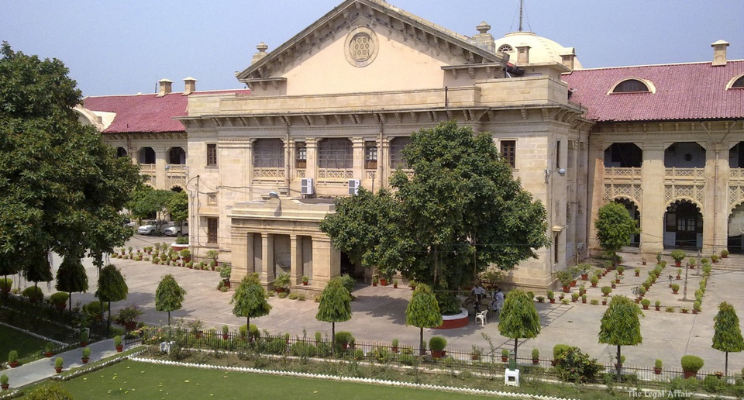
Introduction:
In Munazir Khan v. State of U.P. and 4 Others, reported as 2026 LiveLaw (AB) 114, the Allahabad High Court considered the scope of the constitutional guarantee under Article 25 of the Constitution of India in the context of prayers being offered on private property and the State’s role in ensuring that such religious exercise is not obstructed on vague law and order grounds. The case arose from a grievance raised by Munazir Khan, who approached the High Court alleging that the State administration in Uttar Pradesh was preventing him and other devotees from offering Namaz at a place where he claimed a mosque existed and where prayers had allegedly been offered for many years. According to the petitioner, during the holy month of Ramzan, a large number of people wished to gather and pray at the site, and the administration had no authority to place a restriction on the number of worshippers. Earlier, when the matter was heard on February 27, the Court had strongly reacted to the suggestion that the State was limiting the number of worshippers on law and order grounds, observing that maintenance of law and order is the State’s duty and not a justification for curtailing a fundamental right. The Bench had even remarked that if the local Superintendent of Police and District Magistrate were unable to maintain order while permitting lawful worship, they should resign or seek transfer rather than restrict prayers. When the matter came up again on March 16, the State attempted to clarify that the recording in the earlier order about a restriction of twenty worshippers had occurred due to a misrepresentation by the petitioner’s counsel and that no such restriction had actually been imposed. The Court, however, did not accept this submission, noting that the previous order had been dictated in open court in the presence of both parties and no objection had been raised by the State at that stage. Upon examining the material on record, including photographs of the premises filed with a supplementary affidavit, the Court noted that the structure in question was not a mosque as of the present date. Nevertheless, since the place had admittedly been used for offering Namaz earlier, the Court directed that there should be no obstruction to devotees offering prayers at the same place. While disposing of the writ petition, the Bench placed reliance on its earlier decision in Maranatha Full Gospel Ministries v. State of U.P. and 2 Others, where it had held that a citizen does not require prior permission under law to offer religious prayers within the private premises of his or her own property, as such prayer is an aspect of the fundamental right guaranteed by Article 25. At the same time, the Court made a careful constitutional distinction: while Article 25 protects the right of every religious denomination to congregate for prayer and worship, it does not protect conduct or speech that amounts to incitement of one faith against another under the guise of prayer. According to the Court, actions or expressions that have the propensity to disturb public order by setting one religious denomination against another fall outside the protective scope of Article 25 and may expose the actor to criminal consequences. The Court also clarified that Article 25 is religion-neutral and does not confer any special status on any one faith, including Islam. Instead, it safeguards freedom of conscience equally for believers of all religions and even for atheists. The judgment is significant because it affirms two principles side by side: first, that prayer within private property cannot ordinarily be curtailed by administrative apprehensions, and second, that constitutional protection for religion cannot be misused to shield provocation, hostility, or sectarian incitement.
Arguments of the Petitioner:
The petitioner, Munazir Khan, approached the High Court with the case that the local administration was unlawfully interfering with the exercise of his religious rights by preventing Namaz from being offered at a site where, according to him, prayers had been conducted over a long period of time. His argument was founded squarely on Article 25 of the Constitution, which guarantees freedom of conscience and the right freely to profess, practice and propagate religion, subject only to public order, morality and health and other provisions of Part III. The petitioner’s essential submission was that the offering of Namaz by a group of worshippers at a place regularly used for such prayer was a protected religious activity and that the State could not impose arbitrary numerical restrictions on the number of persons entitled to gather for worship. In particular, during Ramzan, when the number of persons desirous of joining congregational prayer naturally increases, any attempt by the administration to limit attendance would amount to an unjustified and unconstitutional intrusion into religious freedom.
The petitioner further argued that there can be no rigid administrative cap on the number of worshippers who may assemble for prayer at a private site if the place has historically been used for that purpose. He appears to have asserted that the administration’s stance was not rooted in any legal prohibition but in vague apprehensions of law and order. Such apprehension, according to the petitioner, cannot be elevated into a ground for curtailing a fundamental right. A constitutional right cannot be suspended merely because the State fears opposition from others or finds enforcement inconvenient. If there is any threat of disturbance from private persons objecting to the prayers, the duty of the State is to protect the worshippers and preserve peace, not to suppress the lawful exercise of religion by those who seek to pray. This line of argument found considerable resonance with the Bench at an earlier stage of the hearing when it emphasised that maintenance of law and order is the responsibility of the State and cannot become a pretext for preventing worship.
The petitioner also relied upon the factual position that the place in question had been used for offering Namaz earlier and that this practice had continued over time. Although the Court later noted that the structure as it stood was not a mosque as of the date of decision, the petitioner’s case did not appear to depend solely on the formal architectural or legal status of the structure as a mosque. Rather, his contention was that the site had an established history of prayer and that worship at that location could not suddenly be interdicted by administrative action. To reinforce this, the petitioner filed a supplementary affidavit with photographs of the premises, seeking to demonstrate the nature of the site and the continuity of worship there. The petitioner therefore presented the dispute not as an attempt to create a new place of worship or claim special rights, but as an attempt to prevent an established pattern of prayer on private property.
In essence, the petitioner’s constitutional argument was that the right to pray on one’s own premises, or on premises lawfully used for worship by that community, is part of the core of religious freedom. He sought protection not only for individual prayer but also for congregational worship, which in Islam forms an important element of religious practice, especially in relation to Friday prayer and Ramzan observances. The petitioner thus asked the Court to ensure that the State does not obstruct worshippers and that any challenge from private objectors is met through legal protection rather than restrictions on prayer.
Arguments of the State:
The State of Uttar Pradesh, represented by the Additional Advocate General, sought to clarify its position when the matter was heard again on March 16. The principal attempt on behalf of the State was to explain that the previous recording in the Court’s order regarding a restriction of twenty worshippers had crept in because of a misrepresentation by the petitioner’s counsel, and that in fact the State had never imposed such a restriction. This was an important submission because the earlier hearing had seen the Court react sharply to the idea that worshippers were being numerically restricted on law and order grounds. By contending that no such restriction had ever officially been imposed, the State appears to have tried to defuse the constitutional criticism directed at the administration and to suggest that the dispute had, at least in part, arisen from an incorrect presentation of facts.
However, the State’s argument faced immediate difficulty because the Court noted that the earlier order had been passed in open court with both sides present and that the State had raised no objection when the order was being dictated. This made it difficult for the administration to later say that the order incorrectly reflected its position. Nonetheless, the State sought to maintain that it had no intention of interfering with legitimate worship carried out by any denomination within private property or at recognised places of worship. In fact, the Court recorded the State’s submission that it shall not interfere with or interrupt worship carried out by any denomination in their private properties or at their respective places of worship. This was a significant position because it effectively aligned the State with the constitutional principle already laid down by the same Bench in Maranatha Full Gospel Ministries, namely that prayer on one’s own private premises does not require prior permission under law.
The State’s position may also be understood as one seeking to preserve the role of public order regulation without appearing to deny religious freedom. Administrative authorities often contend that where religious gatherings are likely to create tension, they may need to monitor or regulate the situation in order to maintain peace. However, in this case, the Court made it clear that such concerns cannot justify blanket interference with worship in private property. Thus, the State’s more sustainable submission was not that it had the power to prohibit the prayers, but that it did not intend to obstruct private worship and would act within constitutional limits. This concession significantly narrowed the controversy.
At a broader level, the State also had to address the petitioner’s claim concerning the nature of the site. Since the Court eventually recorded that the structure was not a mosque as of date, the State may have been relying on this factual aspect to deny that the petitioner could insist on treatment of the premises as a formal mosque attracting unrestricted congregational rights. But this argument had only limited utility because the Court’s ultimate reasoning focused not on whether the structure was presently a mosque in the technical sense, but on the admitted fact that the site had earlier been used for Namaz and that prayer there, especially on private premises, could not be obstructed without lawful cause. Thus, the State’s more effective course was to assure the Court that it would not interfere with prayers conducted on private property and would remain guided by the constitutional principles already declared by the Court.
Court’s Judgment:
The Allahabad High Court disposed of the writ petition with a set of directions and constitutional observations that are significant both for religious liberty jurisprudence and for the administrative handling of local religious disputes. The Court first rejected the State’s attempt to argue that the earlier recording of a twenty-person restriction had occurred due to a misrepresentation by the petitioner’s counsel. The Bench observed that its order dated February 27 had been dictated in open court in the presence of both sides and that the State had not objected at that time. This meant that the Court was unwilling to permit a belated factual correction where the State itself had remained silent when the matter was previously recorded. That rejection preserved the force of the Court’s earlier disapproval of administrative restrictions on the number of worshippers.
The Court then turned to the factual material, especially the supplementary affidavit and photographs filed by the petitioner. On that basis, it recorded that the structure in question was not a mosque as of date. This was an important factual finding because it prevented any overstatement of the legal status of the premises. Yet the Court did not allow that finding to become the basis for denying worship altogether. Instead, it noted that the place had been used earlier for offering Namaz and held that there should therefore be no obstruction to devotees offering prayers at the same place. This approach is notable for its realism: the Court did not treat the matter as turning entirely on labels or formal designations, but on the actual use of the premises and the constitutional protection available to prayer on private property.
In disposing of the petition, the Bench directed the State to remain fully cognizant of its earlier decision in Maranatha Full Gospel Ministries v. State of U.P. and 2 Others. In that case, the same Bench had already held that a citizen does not require permission under law to conduct religious prayer on private premises owned by him or her. Reaffirming that principle, the Court in the present case reiterated that there can be no impediment or embargo on prayers or religious functions being conducted within the private premises of a person, regardless of the denomination to which that person belongs. The Court went further and directed that if any person or group raises objections to such prayers in private space, the State must take cognizance of those objections and, where necessary, provide protection to the place of worship and to the worshippers. Thus, the judgment not only restrains the State from interfering but also positively imposes on it a duty of protection.
The most substantial part of the ruling lies in the Bench’s broader exposition of Article 25. The Court recognised that congregating for prayer is a feature of several religions and that Article 25 protects such congregation as part of the freedom to practice religion. In explaining this, the Bench referred to the religious traditions of Jews, Christians and Muslims, noting that these faiths have established practices of congregational worship on particular days. It contrasted that pattern with certain Eastern faith traditions where fixed days of congregational worship may not occupy the same place, though festivals and community celebrations do involve collective worship. Through this discussion, the Court clarified that the constitutional right under Article 25 must be understood in a manner sensitive to the actual modalities of different faith traditions. In other words, the Constitution protects the reality of worship as practiced by different communities rather than forcing all religions into a uniform mould.
At the same time, the Court drew a firm constitutional line. It held that Article 25 does not protect incitement of one faith by another in the garb of prayer. The Bench stated that actions or speech having the propensity to disturb public order by pitting one religious denomination against another would go beyond the protective scope of Article 25 and expose the person concerned to the operation of criminal law. This is a critical doctrinal clarification. The Court did not dilute the right to pray; rather, it distinguished prayer and worship from conduct that weaponises religion to provoke hostility or communal disturbance. Thus, the judgment upholds a generous space for religious freedom while refusing to constitutionalise sectarian incitement.
The Court also clarified that Article 25 is faith-neutral and does not grant any special status to adherents of Islam or any other religion in India. According to the Bench, the constitutional guarantee of freedom of conscience extends equally to every believer and even to atheists, who are free to profess the absence of God based on reason, logic, or science. This observation broadens the judgment beyond the immediate dispute and places it firmly within the secular structure of the Constitution. Religious freedom, in the Court’s view, is not a communal privilege but a universal civil liberty grounded in equal respect for conscience.
An additional practical direction issued by the Court was that the petitioner must ensure that the traditions continuously observed at the place since 1995 are strictly followed. This appears intended to preserve continuity and prevent any abrupt alteration in the nature or scale of use that might provoke avoidable disputes. The Court thus balanced rights with responsibility: while worship is protected, it should remain within the framework of established practice at that site.
Finally, recognising the wider administrative importance of the issue, the Court requested the State to ensure that a copy of the order reaches the Director General of Police, U.P. and the Additional Chief Secretary (Home), U.P., for circulation down to the lowest law enforcement authority in the State. This direction is particularly important because many conflicts over prayer gatherings arise not from formal state policy but from actions of local authorities uncertain about the law. By requiring circulation of the order, the Court sought to institutionalise constitutional clarity at the operational level of governance.
The judgment therefore stands out for the balance it strikes. It protects the right to worship, including congregational prayer, especially on private property. It rejects administrative overreach based on vague law and order concerns. It places a positive duty on the State to protect worshippers against obstruction by private individuals or groups. At the same time, it clearly states that religious freedom cannot be used as a shield for speech or conduct that incites one faith against another. In this sense, the ruling strengthens both religious liberty and constitutional order, insisting that the State must protect genuine worship while preventing communal provocation.