


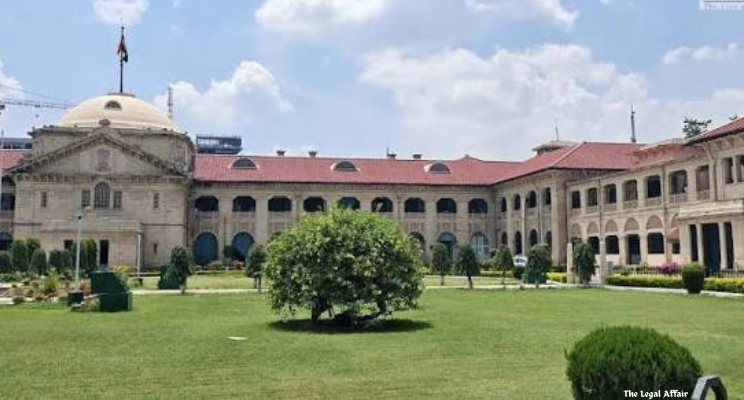
Introduction:
The Allahabad High Court has held that a madarsa teacher cannot be deprived of gratuity merely because she continued in service beyond the age of 60 and retired at 62 after not exercising the prescribed option to retire at the earlier age. The Court found that where the authorities had themselves permitted the employee to continue in service for the extended period and accepted the benefit of that service, the same continuation could not subsequently be relied upon as a ground to deny her a statutory or otherwise admissible retiral benefit.
Justice Irshad Ali delivered the judgment while allowing a writ petition filed by a former Assistant Teacher of Madarsa Ahle Sunnat Merajul Uloom, Faizabad. The petitioner had been appointed as an Assistant Teacher at the Tahtaniya level on August 16, 1992 and continued in service until her retirement on March 31, 2019.
Despite completing several decades of service, the petitioner was not paid gratuity. She made repeated representations before the District Minority Welfare Officer and other authorities seeking release of her retiral dues. When those representations did not yield the desired result, she approached the Allahabad High Court in Writ Petition No. 7351 (S/S) of 2020.
The earlier writ petition was disposed of on February 15, 2023, with a direction to the petitioner to submit a comprehensive representation before the Principal Secretary, Minority Welfare Department. Pursuant to that direction, she submitted her representation seeking consideration of her claim for gratuity.
The competent authority, however, rejected her claim by an order dated September 13, 2023. The rejection was based essentially on the ground that the petitioner had not exercised the option to retire at the age of 60 and had instead continued in service until she attained 62 years.
The petitioner challenged that decision before the High Court. Her case was that the authorities could not take advantage of the very service continuation which they had permitted. If the petitioner had been allowed to remain in service up to 62 years and had been paid other admissible service and retiral benefits, her continuation could not retrospectively be treated as a disqualification for gratuity.
The petitioner also relied upon a subsequent decision of the Lucknow Bench of the Allahabad High Court in University College Ret. Teachers Welfare Asso. Lko. v. State of U.P., decided on October 1, 2024. In that case, the High Court had quashed Government Orders to the extent that they denied gratuity to teachers who had opted to continue in service for the extended period.
Reliance was also placed on the Supreme Court’s order in State of U.P. v. Smt. Priyanka, which, according to the petitioner, further supported the proposition that continuation in service beyond the ordinary age of retirement could not, by itself, extinguish the entitlement to gratuity.
The respondents sought to sustain the rejection order by referring to the Government Orders governing the service conditions of teachers serving in madarsas. They argued that the applicable Government Orders prescribed an option for employees who wished to continue beyond the age of 60 and that the petitioner had not exercised that option within the prescribed period.
The respondents further pointed out that the petitioner had been permitted to continue up to the age of 62 with the benefit of the relevant session-based service arrangement and that she had already received all other dues admissible to her. According to the authorities, therefore, there was no basis to interfere with the decision denying gratuity.
The High Court rejected that approach. It held that the absence of an option could not, by itself, determine the petitioner’s entitlement when the same issue had already been examined by the High Court and the Supreme Court. The Court further emphasised that gratuity is a distinct retiral benefit and cannot be treated as having been waived merely because other service dues had been paid.
The Court ultimately quashed the order dated September 13, 2023 and directed the competent authority to determine and release the gratuity payable to the petitioner on the basis of her qualifying service. The exercise was required to be completed within three months from the date on which a certified copy of the judgment was produced.
Significantly, the Court directed that the petitioner’s failure to exercise the option to retire at 60 should not be treated as a ground for denying gratuity. It also awarded interest at the rate of six per cent per annum from March 31, 2019, the date of her retirement, until the gratuity was actually paid.
The judgment consequently reinforces an important principle concerning retiral benefits: an employee cannot ordinarily be deprived of gratuity by relying upon a circumstance which the employer itself accepted and acted upon by allowing the employee to continue rendering service.
Arguments of the Parties:
The petitioner challenged the order dated September 13, 2023, by which her representation for release of gratuity had been rejected. Her primary contention was that the authorities had adopted an internally inconsistent position. On one hand, they had permitted her to continue working beyond the age of 60 and had accepted her service until she reached 62. On the other hand, they sought to use that very continuation as the reason for denying gratuity.
The petitioner submitted that she had served the institution from August 16, 1992 until March 31, 2019. Her long period of service was not disputed. She had not been treated as having ceased to be an employee at the age of 60. Instead, she was allowed to continue in service and ultimately retired after attaining the age of 62.
According to the petitioner, once the competent authorities accepted her continued service and extended the benefits applicable to that period, they could not subsequently characterise the absence of a formal option as a ground for forfeiting gratuity.
The petitioner also drew the Court’s attention to her earlier litigation. She had already approached the High Court through Writ Petition No. 7351 (S/S) of 2020 because her gratuity had not been released despite repeated representations. The High Court had disposed of that petition on February 15, 2023 and directed her to submit a comprehensive representation to the Principal Secretary of the Minority Welfare Department.
The petitioner complied with that direction. However, instead of examining the claim on its substantive merits, the authorities rejected it on September 13, 2023 by relying on the fact that she had not opted to retire at 60.
The petitioner argued that this reasoning failed to properly address the legal position governing gratuity. She relied upon the decision of the Allahabad High Court’s Lucknow Bench in University College Ret. Teachers Welfare Asso. Lko. v. State of U.P., decided on October 1, 2024.
In that case, the High Court had considered Government Orders that denied gratuity to teachers who had continued in service for the extended period. The Court had quashed the Government Orders to the extent that they operated to deny gratuity to such teachers.
The petitioner also relied upon the Supreme Court’s order in State of U.P. v. Smt. Priyanka. The submission was that the legal position concerning gratuity and continuation beyond the age of 60 had already received judicial consideration and that the State could not continue to deny the benefit by relying on the absence of an option alone.
The petitioner also addressed the chronological issue arising from the later High Court decision. Since the decision in University College Ret. Teachers Welfare Asso. was delivered after the rejection order dated September 13, 2023, the petitioner did not contend that the later judgment retrospectively created a new entitlement from its date.
Instead, the argument was that the subsequent decision could be relied upon to test whether the legal basis adopted by the authorities in the impugned order was sustainable. The later judgment demonstrated that the very ground relied upon by the authorities for denying gratuity had already been found legally insufficient in respect of similarly situated teachers.
The petitioner further submitted that payment of other retiral or service benefits could not answer the gratuity claim. Gratuity was an independent retiral benefit, and the fact that the authorities had paid other admissible dues did not amount to a legal determination that gratuity was unavailable.
The respondents, represented by the State authorities, defended the impugned order. Their principal submission was that service conditions applicable to madarsa teachers were regulated by Government Orders issued from time to time. Those Government Orders, according to the respondents, prescribed the procedure and conditions governing retirement and continuation beyond the normal retirement age.
The respondents argued that the petitioner had failed to exercise the option to retire at 60 within the prescribed period. Since the prescribed option had not been submitted, the petitioner could not claim the benefit associated with the applicable retirement framework.
It was further contended that the petitioner had nevertheless continued in service until the age of 62 and had received the benefit of session-based continuation. The State therefore argued that the petitioner had already been granted the benefit of the extended service period and had also received the other dues admissible to her.
From the respondents’ perspective, the absence of the prescribed option was therefore not an insignificant procedural lapse but a circumstance directly affecting the petitioner’s entitlement to gratuity. They sought to justify the September 13, 2023 order on that basis.
The State’s submissions also raised the question of whether the later decision of the High Court in University College Ret. Teachers Welfare Asso. could be relied upon to invalidate an earlier administrative decision. Since the impugned order preceded the 2024 judgment, the respondents’ position was that the subsequent decision could not simply be treated as having retrospectively altered the legal position.
The High Court, however, considered that question differently. It clarified that it was not treating the 2024 decision as creating a new right from the date on which that judgment was delivered. Instead, the judgment was relevant for determining whether the reasoning adopted in the impugned order could legally sustain the denial of gratuity.
The Court therefore examined the respondents’ reliance on the absence of an option against the larger legal and factual circumstances of the petitioner’s service.
Court’s Judgment:
Justice Irshad Ali allowed the writ petition after examining the basis on which the petitioner had been denied gratuity. The Court found that the respondents’ reasoning suffered from a fundamental difficulty: the very circumstance used to deny the benefit was the same circumstance that had enabled the petitioner to continue rendering service to the institution for an additional period.
The Court succinctly captured this contradiction by observing:
“Thus, the circumstance which has been relied upon for denying gratuity is, in substance, the very circumstance which enabled the petitioner to render further service to the institution.”
The observation formed the central reasoning of the judgment.
The petitioner had not simply remained absent from the prescribed retirement process and then independently claimed an entitlement. Rather, the authorities had permitted her to continue in service beyond 60. She ultimately served until March 31, 2019, when she retired at the age of 62.
The Court therefore found it difficult to accept a situation in which the State could first recognise and accept the employee’s extended service and later rely upon that same extended service as a reason for depriving her of gratuity.
The principle is particularly significant in the context of retiral benefits. Gratuity is intended to recognise and reward qualifying service and ordinarily becomes payable upon cessation of employment when the applicable statutory or service conditions are satisfied. Its denial requires a legally sustainable basis.
The Court consequently rejected the respondents’ attempt to treat payment of other dues as sufficient justification for withholding gratuity. It expressly held:
“Payment of other retiral or service dues cannot, by itself, amount to a valid determination that gratuity was not payable. Gratuity constitutes a distinct retiral benefit and its denial must have a sustainable legal foundation.”
This observation makes clear that different components of an employee’s retiral package must be examined independently. Salary arrears, pension-related benefits, leave encashment or other service dues may be governed by their respective rules. Payment of those benefits cannot automatically establish that gratuity is unavailable.
The Court also considered the Government Orders governing service conditions in madarsas. The respondents had relied upon the prescribed option and the petitioner’s failure to exercise it within the relevant period.
The Bench, however, held that merely referring to the Government Orders and pointing out that the petitioner had not submitted the option could not finally determine her entitlement. The legal effect of the option requirement had already been examined in judicial proceedings.
The Court considered the subsequent decision in University College Ret. Teachers Welfare Asso. Lko. v. State of U.P., decided by the Lucknow Bench on October 1, 2024. That decision had quashed the relevant Government Orders to the extent that they denied gratuity to teachers who opted to continue for the extended period.
The High Court was conscious that this judgment came after the impugned order in the present case. It therefore expressly clarified that it was not applying the later decision as though it had created a new right for the petitioner with retrospective effect from October 1, 2024.
Instead, the Court used the later decision as an aid in examining the legal sustainability of the reason already relied upon by the authorities to reject the petitioner’s claim.
This distinction was important. A subsequent judicial decision may clarify the legal position without necessarily being treated as legislation creating a wholly new entitlement from the date of the judgment. The Court found that the 2024 decision demonstrated that there was no legally sustainable basis for distinguishing the petitioner merely because she had continued in service beyond the age of 60.
The Court also took note of the Supreme Court’s order in State of U.P. v. Smt. Priyanka. The petitioner’s reliance upon the Supreme Court’s decision further supported her contention that the issue concerning gratuity and continuation in service could not be decided solely by mechanically referring to the absence of an option.
The Court found that nothing substantive had been demonstrated by the respondents to distinguish the petitioner’s circumstances from those of the employees whose claims had received judicial protection.
The fact that the petitioner had served until 62 was therefore not treated as an independent disqualification. If the authorities had permitted her to render that additional service, the resulting service period could not subsequently become the basis for depriving her of a retiral benefit.
The judgment also reflects the broader principle that an administrative authority must give a legally sustainable reason for withholding a benefit otherwise claimed by an employee. An order cannot be sustained merely because it refers to a Government Order or a procedural requirement without examining how that requirement operates in the factual circumstances of the employee’s case.
Here, the September 13, 2023 order rested on the petitioner’s failure to opt for retirement at 60. But the undisputed position was that the petitioner had been allowed to remain in service until 62. The authorities had therefore accepted the factual consequence of her continued service.
The Court found that this circumstance substantially weakened the State’s reliance upon the missing option as an absolute bar to gratuity.
The reasoning can also be understood through the principle that an employer cannot approbate and reprobate in relation to the same service arrangement. Having accepted the benefit of the employee’s continued service, the authorities could not conveniently treat that continuation as an illegitimate circumstance only when the employee sought her retiral benefits.
The Court did not, however, direct an immediate payment of an unspecified amount without verification. Instead, it directed the competent authority to determine the gratuity payable to the petitioner on the basis of her qualifying service.
This ensured that the actual computation remained with the competent authority. The authority was required to calculate the amount in accordance with the applicable rules and thereafter release it to the petitioner.
The Court fixed a period of three months for completion of the exercise from the date on which a certified copy of the judgment was produced.
The direction was accompanied by a significant safeguard. While determining and releasing the gratuity, the authorities were specifically prohibited from treating the petitioner’s non-exercise of the option to retire at 60 as a ground for denial.
The Court also addressed the financial consequence of the prolonged withholding of the benefit. The petitioner had retired on March 31, 2019, but gratuity had remained unpaid despite her representations and subsequent litigation.
The High Court therefore directed that interest at the rate of six per cent per annum be paid on the gratuity amount from March 31, 2019 until the date of actual payment.
The award of interest recognises that gratuity is not merely an optional ex gratia payment that an employer may release at its convenience. Once an employee becomes entitled to a retiral benefit under the governing legal framework, prolonged withholding without a sustainable legal basis causes financial prejudice.
The Court’s direction consequently places the petitioner, as far as monetary compensation for the delay is concerned, in a position closer to that which she would have occupied had the benefit been released when it became due.
The judgment also carries significance for employees of aided or regulated educational institutions whose service conditions may be governed by executive orders and departmental instructions. The existence of Government Orders does not mean that every procedural requirement can be applied mechanically, particularly where the authorities themselves have acted inconsistently with the interpretation they later seek to place upon those orders.
The Court’s ruling does not establish that every employee who continues beyond 60 is automatically entitled to gratuity irrespective of the governing service rules. Rather, it holds that in the circumstances before it, the absence of the option could not be treated as a standalone ground to deny gratuity after the employee had been permitted to continue in service up to 62.
This distinction is important because entitlement to retiral benefits remains dependent upon the applicable legal framework. What the Court rejected was the particular reasoning adopted by the authorities in the petitioner’s case.
The decision also demonstrates the significance of judicial review of administrative orders. The High Court was not merely examining whether the authority had referred to an applicable Government Order. It examined whether the reason stated in the order could logically and egally justify the consequence imposed upon the employee.
The answer w