


Introduction:
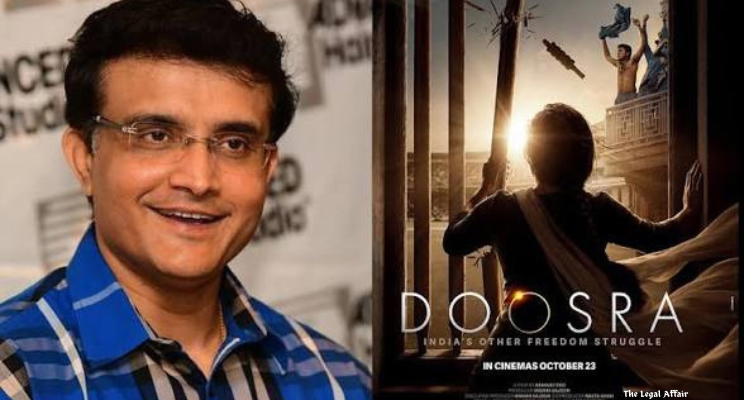
The Delhi High Court has directed the makers of the upcoming film Doosra to prominently display disclaimers at both the beginning and the end of the movie, clarifying that the film is not intended to infringe the personality rights of former Indian cricket captain Sourav Ganguly. The Court also directed the filmmakers to furnish an unconditional bank guarantee of ₹2 crore to secure Ganguly’s personality rights during the pendency of the suit. The directions were issued while considering an interim injunction application filed by Ganguly and filmmaker Luv Films LLP, who alleged that the film commercially exploits Ganguly’s identity, persona and professional achievements without his consent.
Justice Tejas Karia, while passing the interim order, observed that the plaintiffs had established a prima facie case for interim protection. The Court noted that the film was not merely confined to depicting historical events associated with Ganguly but prima facie appeared to use his recognisable identity to generate commercial interest. It further observed that the unauthorised exploitation of his personality affected his ability to decide how his identity and persona could be commercially used.
The dispute raises significant questions concerning the protection of personality rights, particularly where a film draws upon the life, achievements and public identity of a well-known sportsperson. Personality rights are generally understood as an individual’s right to control the commercial exploitation of aspects of their identity, including their name, image, likeness, voice, reputation and other distinctive attributes. These rights assume particular importance in the case of public figures whose identities have substantial commercial value.
The proceedings arose from a suit filed by Sourav Ganguly and Luv Films LLP against the producers and director of Doosra, filmmaker Abhinay Deo, the production entities involved in the project and its distributor, PVR INOX, among others. The plaintiffs alleged that the film and its promotional campaign made unauthorised commercial use of Ganguly’s identity and professional accomplishments, thereby interfering with the personality rights asserted by him and the contractual interests acquired by Luv Films.
According to the plaint, Ganguly had entered into an agreement with Luv Films on August 5, 2021. Under the agreement, the production house was granted exclusive contractual rights to develop, produce and commercially exploit audiovisual content, including a biographical film based on Ganguly’s life, personal and professional journey, experiences and achievements. The arrangement was intended to enable the production house to develop an authorised biographical project concerning the former Indian cricket captain.
Luv Films claimed that it had made substantial investments in the authorised biopic and that filming of the project had already been completed. It also stated that it had undertaken licensing arrangements concerning the exploitation rights in the authorised project, thereby creating interests involving third parties. According to the plaintiffs, these contractual arrangements gave the production house a legitimate commercial interest in the exclusive development and exploitation of the authorised biographical content.
The plaintiffs alleged that Doosra, directed by Abhinay Deo, made repeated and prominent references to Ganguly’s leadership of the Indian cricket team, his professional achievements and the celebrated moment at Lord’s following India’s victory in the 2002 NatWest Series. They contended that the film’s trailer and promotional campaign used these recognisable elements to attract public attention and generate commercial interest.
Their grievance was not simply that the film referred to events in Indian cricket history. Rather, they alleged that the defendants had used Ganguly’s identity and public persona in a manner that commercially capitalised on his reputation without obtaining his consent or authorisation. They further argued that such exploitation threatened to diminish the commercial value of the rights granted to Luv Films and adversely affect the market position of its authorised biopic.
The dispute therefore brought before the High Court the need to balance an individual’s interest in controlling the commercial use of their identity against the public’s interest in viewing a film that had already been released. The Court was required to consider whether immediate restraint was justified or whether a less restrictive interim measure could adequately protect the plaintiffs’ asserted rights while the main suit remained pending.
After examining the material placed before it, the Court concluded that the plaintiffs had established a prima facie case for interim protection. However, instead of directing the removal of selected scenes or restraining public viewing of the film, it ordered prominent disclaimers in both English and Hindi, together with a bank guarantee of ₹2 crore.
Arguments of the Parties:
The plaintiffs, Sourav Ganguly and Luv Films LLP, approached the Delhi High Court alleging unauthorised commercial exploitation of Ganguly’s personality, identity and professional achievements through the film Doosra. Their case rested on the assertion that the defendants had used distinctive aspects of Ganguly’s public identity to promote and commercially position the film without obtaining the necessary consent or authorisation.
Ganguly’s grievance was that his name, professional reputation and association with significant moments in Indian cricket had been used in a manner that went beyond an ordinary reference to historical events. According to the plaintiffs, the film repeatedly drew upon his leadership of the Indian cricket team, his achievements as a cricketer and the iconic celebrations at Lord’s after India’s victory in the 2002 NatWest Series.
The plaintiffs contended that these references were not incidental or merely historical in nature. Instead, they allegedly formed an important part of the film’s appeal and promotional strategy. By invoking events and achievements closely associated with Ganguly, the defendants were said to have used his recognisable identity to attract audiences and generate commercial traction.
The plaintiffs also relied on the agreement executed between Ganguly and Luv Films on August 5, 2021. They maintained that the agreement granted Luv Films exclusive contractual rights to develop, produce and commercially exploit audiovisual content based on Ganguly’s life and professional journey, including an authorised biographical film.
Luv Films asserted that it had acted upon these contractual rights by investing substantial resources in the authorised biopic. It claimed that the shooting of the project had been completed and that licensing arrangements had been undertaken for the exploitation of the film. Consequently, third-party interests had also been created in connection with the authorised project.
According to the plaintiffs, the commercial use of Ganguly’s identity in Doosra threatened to interfere with the value of these contractual rights. If another film could use the same recognisable aspects of Ganguly’s personality and professional achievements without authorisation, the exclusivity and commercial positioning of the authorised biopic could be adversely affected.
The plaintiffs further alleged that the trailer and promotional material for Doosra had already used Ganguly’s recognisable identity and reputation to create public interest in the film. They argued that the defendants could not commercially benefit from his personality and achievements without obtaining the requisite consent, particularly when contractual rights concerning an authorised biographical project had already been granted to Luv Films.
The interim injunction application therefore sought judicial protection against the alleged unauthorised exploitation. The plaintiffs’ case was that allowing the defendants to continue using Ganguly’s identity in this manner would prejudice his ability to determine how his personality could be commercially represented and would also undermine the contractual and commercial interests of Luv Films.
The defendants included the film’s producers, director Abhinay Deo, the production entities and distributor PVR INOX. The supplied case summary does not set out their detailed written or oral submissions, and therefore their specific defences cannot be attributed to them. Nevertheless, the Court’s consideration of possible remedies indicates that the question before it involved whether the alleged infringement required restrictions on the film itself or whether the plaintiffs’ interests could be protected through less restrictive conditions.
In particular, the Court considered whether selected scenes could be deleted as an alternative to permitting the film to be viewed in its existing form. It also examined the practical consequences of restraining public viewing when the film had already been released. The Court ultimately concluded that selective deletion of scenes was not a workable alternative and that the balance of convenience did not favour restraining the public from viewing the film.
The interim proceedings thus required the Court to consider the competing interests without finally determining the allegations in the suit. The plaintiffs sought protection of their asserted personality and contractual rights, while the Court had to ensure that any interim relief was proportionate to the circumstances and did not unnecessarily interfere with the film’s release and public exhibition.
Court’s Judgment:
Justice Tejas Karia held that the plaintiffs had made out a prima facie case for the grant of interim protection. The Court observed that the film Doosra was not confined merely to depicting historical events but prima facie indicated that Ganguly’s identity had been employed to generate commercial interest in the film.
This observation was central to the Court’s assessment of the alleged personality rights infringement. A film may refer to historical events, public achievements and incidents that form part of a well-known person’s life. However, the legal concern becomes different when the identity of that person is allegedly used as a commercial instrument to attract audiences and promote a film without authorisation.
The Court’s prima facie assessment indicated that the material placed before it went beyond a simple historical depiction. The repeated references to Ganguly’s leadership, professional achievements and association with the 2002 NatWest Series victory at Lord’s suggested that his recognisable public identity had been used in a manner capable of generating commercial value for the film.
The distinction is important because personality rights concern an individual’s interest in controlling the commercial use of their identity. A public figure’s achievements may be widely known and may form part of public history. Nevertheless, the fact that an individual is a public personality does not automatically mean that every commercial use of their name, likeness or recognisable persona is free from legal scrutiny.
The Court observed that the defendants had exploited Ganguly’s personality rights through the unauthorised use of his identity and persona. It further noted that the alleged prejudice affected his ability to determine the manner in which his personality could be commercially used.
The right to control the commercial exploitation of one’s personality is particularly relevant where a public figure’s identity has developed substantial goodwill and market value. An individual’s name, image, reputation and distinctive achievements may carry commercial significance, especially in the entertainment and advertising industries. The ability to decide whether and how these attributes may be used commercially forms an important aspect of the protection claimed through personality rights.
In the present case, Ganguly’s association with Indian cricket and his achievements as captain were alleged to have been used as prominent elements of the film’s presentation and promotion. The Court’s prima facie finding recognised that such use could raise a legitimate question of unauthorised commercial exploitation, rather than being treated automatically as an ordinary reference to public events.
The Court also considered the contractual arrangement between Ganguly and Luv Films. According to the plaintiffs, the agreement dated August 5, 2021, granted the production house exclusive rights to develop and commercially exploit audiovisual content based on Ganguly’s life and professional journey. Luv Films claimed that it had made substantial investments in the authorised biopic, completed its shooting and undertaken licensing arrangements concerning its exploitation.
These circumstances were relevant to the plaintiffs’ claim of commercial prejudice. The alleged use of Ganguly’s identity in another film could potentially affect the value and market positioning of the authorised biopic. The plaintiffs’ case was that the defendants’ use of the same recognisable aspects of Ganguly’s personality could interfere with the exclusivity and commercial interests arising from the agreement.
However, the interim order did not finally decide the scope or enforceability of every contractual right claimed by Luv Films. Nor did it conclusively determine the full extent of the defendants’ liability. The Court’s observations were made at the stage of considering interim protection, and the ultimate questions in the suit remain open for adjudication.
After finding a prima facie case, the Court turned to the nature of the interim relief that should be granted. The plaintiffs had sought protection against the alleged infringement, but the Court was required to assess whether restraining the film’s public viewing or directing changes to selected portions would be an appropriate and proportionate response.
The Court specifically observed that selective deletion of scenes was not a workable alternative. This is significant because the alleged infringement was not viewed as a matter that could necessarily be resolved by removing a few isolated portions of the film. The plaintiffs’ grievance concerned the broader use of Ganguly’s identity and persona to generate commercial interest. In such circumstances, simply deleting selected scenes might not adequately address the concern identified by the Court.
At the same time, the Court took into account that the film had already been released. It observed that the balance of convenience did not lie in restraining the public from viewing the film. The balance of convenience is an important consideration in applications for interim injunctions. A court must assess the comparative hardship likely to be caused to the parties by granting or refusing temporary relief, while also considering whether the applicant has demonstrated a prima facie case and whether the alleged injury requires immediate protection.
The Court’s approach reflected an attempt to reconcile the plaintiffs’ asserted personality rights with the practical circumstances surrounding the film’s release. Although the plaintiffs had established a prima facie case, the Court did not consider a complete restraint on public viewing to be justified at that stage.
Instead, it adopted a more limited measure by directing the filmmakers to include a clear disclaimer at both the beginning and the end of the film. The disclaimer must be displayed in English and Hindi and must appear in large fonts so that it is clearly visible to viewers.
Importantly, the Court specified that the disclaimer must state that the film is not intended to infringe the personality rights of Sourav Ganguly. It must also make clear that the use of Ganguly’s name in the film shall not be construed as an acknowledgement of, or consent to, such use.
This direction is significant because it addresses the possibility that audiences may interpret the film’s references to Ganguly as indicating his participation, approval or authorisation. The disclaimer is intended to remove such ambiguity by expressly clarifying the position to viewers. It also ensures that the film’s use of his name is not presented as evidence that he has consented to the commercial use of his personality.
The Court directed that the disclaimers be incorporated within two days. By requiring their display at both the beginning and the end, the Court sought to ensure that the clarification would be visible at the outset and reiterated when the film concludes. The requirement of large fonts further emphasises that the disclaimer must be sufficiently prominent rather than appearing as an inconspicuous or difficult-to-read statement.
Apart from the disclaimer, the Court imposed a financial safeguard to protect the plaintiffs’ interests during the pendency of the litigation. It directed the filmmakers to furnish an unconditional bank guarantee of ₹2 crore in favour of the Registrar General of the Delhi High Court.
The bank guarantee is intended to secure the personality rights asserted by Ganguly while the suit remains pending. Such a direction provides an additional form of interim protection without immediately stopping the film’s public exhibition. It also ensures that the defendants furnish financial security in accordance with the Court’s order while the underlying dispute awaits final adjudication.
The requirement of an unconditional bank guarantee is particularly important because it creates a financial safeguard independent of the disclaimer. The disclaimer addresses the manner in which the film communicates its relationship, or lack of authorised association, with Ganguly. The bank guarantee, on the other hand, secures the interests asserted by the plaintiffs during the litigation. Together, these measures reflect the Court’s decision to grant interim protection without imposing a complete prohibition on the film’s viewing.
The Court clarified that its order was confined to the interim application and should not be treated as an expression on the merits of the main suit. This clarification is legally significant. A prima facie finding at the interim stage is not equivalent to a final determination of liability. The Court’s observations are based on the material available at that stage and are intended to assess whether temporary protection is warranted.
The parties will still have the opportunity to present their respective cases in the main proceedings. Questions concerning the precise scope of Ganguly’s personality rights, the nature of the use made in the film, the effect of the agreement with Luv Films and the extent of any alleged commercial prejudice remain subject to final adjudication.
The order also highlights the importance of proportionality when courts consider interim injunctions involving films and other creative works. A dispute concerning personality rights may require protection of an individual’s commercial and reputational interests, but the remedy must be considered in light of the stage of release, the nature of the alleged use and the consequences of restraining public access to the work.
By rejecting selective scene deletion as an unworkable solution and declining to restrain public viewing, the Court chose a measure that sought to address the plaintiffs’ concerns without stopping the film’s exhibition. The disclaimer requirement provides viewers with an express clarification, while the bank guarantee secures the plaintiffs’ asserted interests until the suit is decided.
The ruling is therefore significant for the growing body of disputes involving the commercial use of public personalities in films and other forms of entertainment. It recognise that public achievements and historical events ma