


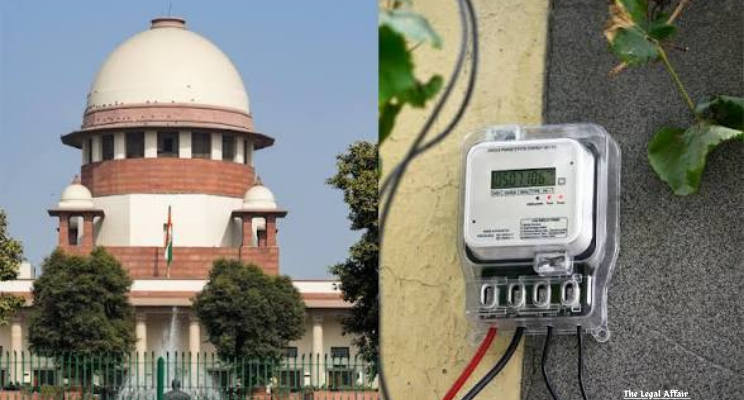
Introduction:
The Supreme Court of India has reaffirmed that electricity distribution companies cannot ordinarily recover outstanding electricity charges after the expiry of two years from the date on which the amount first became due, unless the statutory exception under Section 56(2) of the Electricity Act, 2003, is satisfied. The Court clarified that when a distribution licensee seeks to recover an amount beyond this period, it must demonstrate that the amount was continuously shown as recoverable arrears of electricity charges.
The ruling was delivered by a Bench comprising Justice S.V.N. Bhatti and Justice N.V. Anjaria in Dakshinanchal Vidyut Vitran Nigam Ltd. v. Vidut Lokpal, Uttar Pradesh and Others, reported as 2026 LiveLaw (SC) 929. The Court dismissed the appeal filed by the distribution licensee and upheld the Allahabad High Court’s decision rejecting its challenge to an order of the Electricity Ombudsman.
The dispute concerned a demand of ₹57,74,164 raised by the distribution licensee towards Minimum Consumption Guarantee Charges (MCGC) for the period from February 1998 to September 1998. The charges were claimed in connection with an additional electricity load of 2,000 KVA that the distribution licensee had offered to a consumer. The consumer, however, had not availed the additional load facility.
The demand was raised on 13 February 2007, nearly nine years after the period for which the charges were claimed. The consumer challenged the demand before the Electricity Ombudsman, contending that the additional load had never been accepted or utilised and that the distribution licensee could not recover the amount after such a prolonged delay.
The Electricity Ombudsman accepted the consumer’s objection, relying upon Section 56(2) of the Electricity Act, 2003. The distribution licensee challenged that decision before the Allahabad High Court, but the High Court declined to interfere. The matter eventually reached the Supreme Court.
The principal legal question before the Supreme Court was whether the distribution licensee could recover the disputed amount after the statutory period of two years when the amount had not been continuously shown as recoverable arrears in the consumer’s electricity bills.
Section 56(2) of the Electricity Act, 2003, provides a limitation-related protection to electricity consumers. It states that a sum due from a consumer cannot ordinarily be recovered after two years from the date on which it first became due, unless the amount has been continuously shown as recoverable as arrears of electricity charges. The provision also restricts disconnection of electricity supply for recovery of such time-barred dues.
The provision does not mean that every electricity charge automatically becomes irrecoverable after two years. Rather, it establishes a statutory condition for recovering older dues. A distribution licensee seeking to rely on the exception must establish that the amount was continuously treated as recoverable arrears during the relevant period.
The present judgment is significant because it explains the importance of identifying when an electricity charge first became due and examining whether the distribution licensee continuously reflected that amount as an outstanding liability. A demand raised after several years cannot be justified merely by asserting that the charges relate to an earlier electricity connection or contractual arrangement.
The Court’s decision also highlights the importance of maintaining accurate billing records. Electricity distribution companies must ensure that charges are raised within the prescribed period and that any outstanding amounts intended to be recovered later are continuously reflected in the consumer’s bills in accordance with the statute.
In the present case, the distribution licensee had issued regular monthly bills under the original agreement but had not included the disputed charges for the additional 2,000 KVA load. The Supreme Court upheld the finding that the amount had not been continuously treated as recoverable arrears and that the demand raised in 2007 was barred by limitation.
The ruling therefore reinforces the statutory protection available to electricity consumers against delayed demands while clarifying that the limitation exception depends upon continuous treatment of the amount as recoverable arrears.
Arguments of the Parties:
The dispute before the Supreme Court arose from the distribution licensee’s attempt to recover Minimum Consumption Guarantee Charges from the consumer for a period dating back to 1998. The appellant challenged the decisions of the Electricity Ombudsman and the Allahabad High Court, while the consumer maintained that the demand was legally unsustainable because the additional load had never been availed and the amount had not been continuously shown as recoverable arrears.
Appellant’s Contentions
Dakshinanchal Vidyut Vitran Nigam Limited, the distribution licensee, challenged the Allahabad High Court’s order upholding the Electricity Ombudsman’s decision. Its appeal concerned the legality of the demand for ₹57,74,164 towards Minimum Consumption Guarantee Charges for the period between February 1998 and September 1998.
The appellant’s claim arose from the electricity connection originally applied for by Respondent No. 3, who had sought a sanctioned load of 4,000 KVA. Due to limitations prevailing at the time, the distribution licensee had agreed to sanction and release a load of 2,000 KVA under an agreement dated 24 February 1997.
The appellant subsequently offered to increase the contract load by an additional 2,000 KVA. The disputed charges were connected with this additional facility, which the appellant sought to treat as part of the contractual arrangement governing the consumer’s electricity connection.
The distribution licensee’s appeal was directed against the conclusion that the demand could not be recovered after the expiry of the statutory period. By challenging the Ombudsman’s order and the High Court’s decision, the appellant sought to establish its entitlement to recover the claimed charges despite the considerable interval between the relevant period and the eventual demand.
The legal issue raised by the appellant’s challenge was whether the amount claimed towards Minimum Consumption Guarantee Charges could be recovered under the applicable contractual and statutory framework, notwithstanding the objection based on Section 56(2) of the Electricity Act, 2003.
The appellant’s position had to be considered against the statutory exception permitting recovery of older electricity dues where the amount has been continuously shown as recoverable arrears. The dispute therefore required the Court to examine not merely the existence of the contractual arrangement but also whether the statutory conditions for recovering the disputed amount had been fulfilled.
The distribution licensee’s appeal was ultimately unsuccessful because the courts below had found that the additional load had not been availed and that the disputed amount had not been continuously treated as recoverable arrears from 1998 until the demand was raised in 2007.
Respondent’s Contentions
Respondent No. 3, the consumer, opposed the demand on the ground that the additional 2,000 KVA load had never been accepted or utilised. The consumer had originally sought a 4,000 KVA connection, but the distribution licensee initially sanctioned and released only 2,000 KVA because of contemporaneous limitations.
When the distribution licensee offered the additional load on 31 January 1998, the consumer expressed its lack of interest in accepting the facility. Consequently, the consumer disputed the appellant’s attempt to impose Minimum Consumption Guarantee Charges for the additional load.
The consumer’s objection was not limited to the question of whether the additional facility had been availed. It also concerned the delay in raising the demand. The appellant sought to recover charges relating to February 1998 to September 1998 only on 13 February 2007, nearly nine years after the relevant period.
The consumer relied upon Section 56(2) of the Electricity Act, 2003, which restricts the recovery of electricity dues after two years from the date on which the amount first became due, unless the amount has been continuously shown as recoverable arrears.
The consumer’s case was that the distribution licensee had issued regular monthly electricity bills under the agreement dated 24 February 1997 but had not included the disputed charges relating to the additional 2,000 KVA load in those bills.
Accordingly, the consumer contended that the appellant could not raise a fresh demand after several years and claim the benefit of the statutory exception without establishing that the amount had been continuously reflected as recoverable arrears.
The consumer also relied upon the absence of any continuous record showing the disputed amount as outstanding from 1998 onwards. The delay in raising the demand, coupled with the failure to continuously treat the amount as arrears, formed the basis of the challenge before the Electricity Ombudsman.
The Ombudsman accepted the consumer’s objections and set aside the demand. The Allahabad High Court subsequently upheld that decision, finding that the disputed amount had not been continuously treated as recoverable arrears and that the additional load facility had never been availed.
Before the Supreme Court, the central issue was therefore whether the distribution licensee could overcome the statutory limitation merely by relying on the earlier contractual arrangement, without demonstrating compliance with the specific condition prescribed under Section 56(2).
Court’s Judgment:
The Supreme Court dismissed the appeal and refused to interfere with the findings recorded by the Allahabad High Court. The judgment, authored by Justice S.V.N. Bhatti, focused on the statutory requirements under Section 56(2) of the Electricity Act, 2003, and the failure of the distribution licensee to establish that the disputed charges had been continuously shown as recoverable arrears.
The Court examined the circumstances in which the demand was raised, the nature of the additional load facility and the billing history of the consumer. It ultimately concluded that the demand raised on 13 February 2007 for charges relating to February 1998 to September 1998 was barred by limitation.
Statutory Framework Under Section 56(2)
Section 56(2) of the Electricity Act, 2003, provides:
“Notwithstanding anything contained in any other law for the time being in force, no sum due from any consumer, under this section shall be recoverable after the period of two years from the date when such sum became first due unless such sum has been shown continuously as recoverable as arrear of charges for electricity supplied and the licensee shall not cut off the supply of the electricity.”
The provision establishes a two-year period for the recovery of electricity dues, calculated from the date on which the amount first became due. However, it also recognises an exception where the amount has been continuously shown as recoverable arrears of electricity charges.
The Supreme Court emphasised that the statutory exception cannot be applied merely because the distribution licensee claims that an amount was payable under an earlier contractual arrangement. The licensee must establish that the amount was continuously treated as recoverable arrears.
The distinction is important because the provision does not simply prohibit the recovery of every outstanding amount after two years. It permits recovery beyond that period where the statutory condition is satisfied. The question is whether the distribution licensee has maintained the required continuity in treating the amount as an outstanding liability.
The Court held that a distribution licensee seeking to recover electricity dues beyond the prescribed period must demonstrate that the amount was continuously shown as recoverable arrears in the consumer’s monthly bills.
This requirement ensures that consumers are informed of outstanding liabilities and prevents distribution companies from raising substantial demands after several years without having reflected those amounts in their regular billing records.
Determining When the Amount First Became Due
A significant aspect of the judgment was the determination of when the disputed amount first became due.
The High Court had observed that the distribution licensee issued monthly bills for electricity consumption under the agreement dated 24 February 1997. However, no bills were issued for the additional 2,000 KVA load along with the regular monthly bills.
The Supreme Court upheld the High Court’s reasoning on this issue. The Court emphasised that the expression “due” must be understood as referring to a specific point in time. It cannot be treated as an uncertain event that remains indefinitely open to determination at the discretion of the distribution licensee.
The High Court’s observation, which was upheld by the Supreme Court, was that the amount became due when the supplier was entitled to raise the bill.
This principle is significant for determining the commencement of the two-year period under Section 56(2). The date on which an electricity charge first becomes due cannot be postponed merely because the distribution licensee chooses to raise the demand at a later stage.
If the supplier was entitled to raise a bill for a particular charge during an earlier period, the statutory period must be examined with reference to that point in time. A delayed demand does not, by itself, create a new starting point for limitation.
In the present case, the disputed charges related to the period between February 1998 and September 1998. The demand was not raised until 13 February 2007.
The Court therefore upheld the conclusion that the demand had been raised well beyond the statutory period. The distribution licensee could not avoid the limitation objection merely by asserting that the charges related to a contractual arrangement dating back to 1997.
Continuous Treatment of Electricity Dues as Recoverable Arrears
The most important aspect of the judgment concerns the requirement that electricity dues must be continuously shown as recoverable arrears if the distribution licensee seeks to recover them after two years.
The Supreme Court upheld the High Court’s finding that no material or pleading established that the disputed amount had been continuously treated as recoverable arrears from 1998 onwards.
The High Court had noted that regular monthly bills were issued under the original agreement, but the additional 2,000 KVA load charges were not included in those bills. The amount was therefore not continuously reflected as an outstanding liability.
The Supreme Court accepted this reasoning and held that the statutory exception under Section 56(2) could not be invoked in the absence of such continuity.
The Court’s approach makes clear that the burden lies on the distribution licensee to establish compliance with the statutory requirement. It is not sufficient to show that the consumer had entered into an agreement or that a charge could potentially have been raised under that arrangement.
The licensee must demonstrate that the amount was continuously shown as recoverable arrears during the relevant period. Where the billing records do not establish such continuity, the exception cannot be used to justify recovery beyond two years.
The requirement also prevents the limitation period from becoming ineffective through the mere passage of time. If a distribution company could raise a demand after several years without having previously reflected the amount as arrears, the statutory protection would lose much of its practical significance.
The Supreme Court’s decision therefore reinforces the importance of maintaining accurate and continuous billing records. A distribution licensee seeking to recover older electricity dues must be able to demonstrate, through the relevant bills and records, that the amount was continuously treated as recoverable.
Additional Load Was Never Availed by the Consumer
The Court also considered the factual background concerning the additional 2,000 KVA load.
Respondent No. 3 had originally applied for a 4,000 KVA electricity connection. However, because of contemporaneous limitations, the distribution licensee initially sanctioned and released only 2,000 KVA under the agreement dated 24 February 1997.
The distribution licensee subsequently offered an additional 2,000 KVA load on 31 January 1998. The consumer, however, expressed its lack of interest in accepting the additional facility.
The disputed Minimum Consumption Guarantee Charges were claimed for the period from February 1998 to September 1998 in connection with this additional load.
The High Court had found that the additional facility was never actually availed by the consumer. This finding was upheld by the Supreme Court.
The significance of this circumstance was that the distribution licensee sought to recover substantial charges connected with an additional load that the consumer had not accepted or utilised. The demand was also raised after the expiry of several years, without the amount having been continuously shown as recoverable arrears.
The Court’s decision, however, rested on the statutory limitation issue and the failure to establish continuous treatment of the amount as arrears. The judgment should not be understood as laying down a general rule that Minimum Consumption Guarantee Charges can never be payable in relation to an unused or unavailed electricity facility.
The enforceability of such charges may depend upon the terms of the relevant agreement and the applicable statutory framework. In the present case, the decisive consideration was that the distribution licensee had not satisfied the requirements necessary to recover the disputed amount after the prescribed period.
Reliance on Earlier Supreme Court Decisions
The Supreme Court referred to its earlier decisions in K.C. Ninan v. Kerala State Electricity Board and Others, 2023 LiveLaw (SC) 453, and Assistant Engineer (D1), Ajmer Vidyut Vitran Nigam Limited and Another v. Rahamatullah Khan Alias Rahamjulla.
These decisions formed part of the legal framework concerning the recovery of electricity dues and the interpretation of Section 56(2) of the Electricity Act, 2003.
The reference to these precedents reinforced the need to examine when the amount first became due and whether the statutory conditions for recovering older dues had been fulfilled.
In the present dispute, the demand concerned alleged charges arising in 1998, whereas the distribution licensee sought recovery only in February 2007. The Supreme Court upheld the conclusion that the demand could not be sustained because it was barred by limitation.
The judgment thus applied the established principles governing delayed electricity demands to the specific contractual and billing circumstances before it.
Demand Raised in 2007 Was Barred by Limitation
After examining the relevant facts, the statutory provision and the earlier decisions, the Supreme Court endorsed the High Court’s conclusion that the demand was time-barred.
The Court upheld the finding that the distribution licensee had not established that the disputed amount was continuously treated as recoverable arrears from 1998 until the demand was raised on 13 February 2007.
The Court observed that even if the relevant statutory provision was applied, the demand raised for the first time in 2007 in respect of the period from February 1998 to September 1998 was barred by limitation.
The conclusion was based on two connected considerations First, the charges had become due during the earlier period, and the distribution