


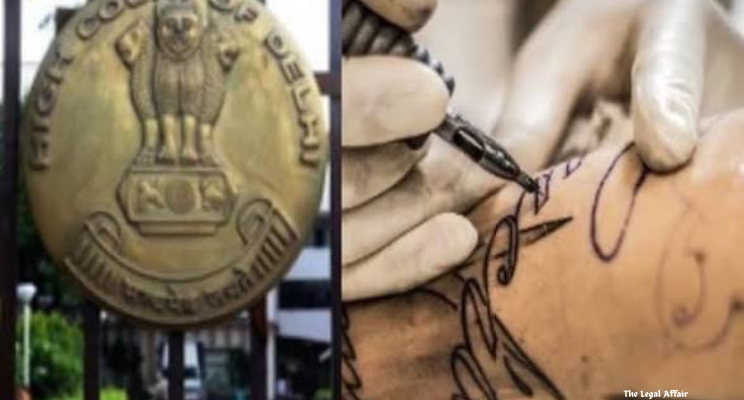
Introduction:
The Delhi High Court has delivered a significant judgment clarifying the legal position regarding tattoos in recruitment to the Central Armed Police Forces (CAPFs). In Ankit Maan v. Union of India and Others and the connected matter, a Division Bench comprising Justice Anil Kshetarpal and Justice Amit Mahajan held that there is no blanket prohibition on candidates possessing tattoos while seeking appointment or promotion within the CAPFs. However, the Court emphasized that any tattoo must strictly conform to the medical guidelines governing its location, size and content. Tattoos that fall outside the permissible standards prescribed under the recruitment rules can render a candidate medically unfit and consequently ineligible for appointment or promotion.
The petitions arose from the Limited Departmental Competitive Examination (LDCE), 2023, conducted for recruitment to the post of Assistant Commandant (General Duty) in the Central Reserve Police Force (CRPF). The petitioners, who were already serving personnel in the CRPF, successfully participated in the selection process but were declared medically unfit during the Detailed Medical Examination (DME). Their disqualification was subsequently affirmed during the Review Medical Examination (RME) on account of tattoos located on their right forearm, which is regarded as the saluting arm under the applicable recruitment guidelines.
Aggrieved by their medical disqualification, the petitioners approached the Delhi High Court challenging the validity of the decision. They contended that neither the recruitment notification nor the governing rules expressly prohibited candidates from having tattoos. According to them, they had continued to serve in the CRPF for several years without any objection regarding their tattoos, and therefore, disqualifying them at the promotional stage was arbitrary and unreasonable. They also informed the Court that after being declared medically unfit, they had undergone medical procedures to remove the tattoos and requested that they be granted another opportunity to undergo a fresh medical examination.
The Union of India opposed the petitions by relying upon the revised medical guidelines applicable to recruitment in the CAPFs and Assam Rifles. The Government argued that while tattoos are not absolutely prohibited, the guidelines clearly specify the only permissible locations where tattoos may exist. Since the petitioners admittedly had tattoos on their right forearm—a prohibited location—they were rightly declared medically unfit.
The case required the High Court to examine the scope of judicial review in recruitment matters, the binding nature of medical eligibility standards, and whether subsequent removal of a disqualifying condition could cure ineligibility that existed on the last date prescribed for determining eligibility. The judgment provides valuable guidance on the extent to which courts can interfere with recruitment decisions involving uniformed and disciplined forces, while also clarifying that the governing policy does not impose a complete ban on tattoos but regulates them through clearly defined standards.
Arguments of the Parties:
The petitioners argued that their medical disqualification was legally unsustainable because the recruitment advertisement for the Limited Departmental Competitive Examination did not contain any express prohibition against candidates possessing tattoos. According to them, a candidate cannot be disqualified on the basis of a condition that was not specifically highlighted in the recruitment notification. They submitted that the absence of an explicit prohibition created a legitimate expectation that possessing tattoos would not adversely affect their candidature.
It was further contended that both petitioners were already serving members of the Central Reserve Police Force and had been performing their duties efficiently despite having the same tattoos. Throughout their service, no disciplinary proceedings or objections had ever been raised concerning their tattoos. The petitioners argued that if the tattoos had not affected their suitability for service as members of the force, the same tattoos could not suddenly become a ground for denying them promotion to the post of Assistant Commandant.
The petitioners also placed considerable emphasis on the fact that, after being declared medically unfit, they voluntarily underwent tattoo removal procedures. They argued that the very purpose of the medical guidelines was to ensure conformity with prescribed standards. Since the tattoos had subsequently been removed, they urged the Court to direct the respondents to conduct another Detailed Medical Examination or Review Medical Examination so that their present medical condition could be assessed afresh. According to them, denying such an opportunity would elevate procedural technicalities over substantive fairness.
The petitioners further submitted that recruitment rules should receive a reasonable and purposive interpretation rather than one that unnecessarily deprives deserving candidates of promotional opportunities. Since they had already qualified through the competitive examination and had corrected the alleged medical deficiency, equity demanded that they be permitted to continue in the selection process.
The Union of India and the concerned authorities opposed the petitions by placing reliance upon the revised medical guidelines governing recruitment to the Central Armed Police Forces and the Assam Rifles. The respondents clarified that the applicable policy did not impose an absolute prohibition on tattoos. Instead, it specifically prescribed the locations where tattoos would be permissible and laid down standards relating to their content and dimensions.
According to the Government, tattoos are permissible only on the inner aspect of the left forearm, which is treated as the non-saluting limb, or on the dorsum of the hands, subject to limitations regarding their size and content. Tattoos situated on the right forearm, which constitutes the saluting arm, are expressly outside the permissible category. Since the petitioners admittedly possessed tattoos on the prohibited location at the relevant point of time, the medical authorities had correctly declared them unfit.
The respondents further argued that the petitioners, being serving members of a disciplined force, could not plead ignorance of the revised medical standards. They submitted that departmental personnel aspiring for promotion through the Limited Departmental Competitive Examination were expected to remain aware of all applicable recruitment rules and eligibility conditions. Ignorance of the governing guidelines could not confer any legal right upon them.
The Government also contended that eligibility for recruitment or promotion must necessarily be determined with reference to the last date prescribed for submission of applications or the relevant stage specified under the recruitment rules. Any subsequent event, including removal of tattoos after medical examination, could not retrospectively cure an existing disqualification. Accepting the petitioners’ request would effectively amount to permitting candidates to improve their eligibility after the recruitment process had already progressed, thereby compromising the integrity and certainty of public recruitment.
The respondents therefore urged the Court to dismiss the petitions, maintaining that the petitioners had been correctly declared medically unfit under the applicable recruitment policy.
Court’s Judgment:
The Delhi High Court dismissed both writ petitions and upheld the decision of the recruitment authorities declaring the petitioners medically unfit. Delivering the judgment, the Division Bench undertook a careful examination of the relevant recruitment guidelines and clarified the legal position concerning tattoos in the Central Armed Police Forces.
At the outset, the Court rejected the assumption that the applicable policy imposed a complete ban on tattoos. After examining the revised medical guidelines, the Bench observed that the rules merely regulate tattoos by prescribing the permissible location, content and size. The Court succinctly observed:
“The rules do not per se stipulate an embargo on having a tattoo. They only provide the permissible location, content and size of the tattoo.”
The Court explained that the medical policy strikes a balance between maintaining the standards expected of members of disciplined armed forces and accommodating limited personal expression. Therefore, tattoos are not inherently disqualifying. However, they must conform strictly to the prescribed norms. Any tattoo existing outside the permissible parameters would legitimately attract medical disqualification.
Applying these principles to the facts of the case, the Court noted that there was no dispute regarding the location of the petitioners’ tattoos. Both petitioners admittedly possessed tattoos on their right forearm. Under the governing guidelines, the right forearm constitutes the saluting arm, whereas tattoos are permitted only on the inner aspect of the left forearm, being the non-saluting limb, or on the dorsum of the hands, subject to prescribed conditions. Since the petitioners’ tattoos were situated on a prohibited part of the body, the medical authorities had correctly declared them unfit.
The Bench also rejected the contention that the petitioners could claim ignorance of the revised medical guidelines. It observed that the petitioners were not first-time civilian applicants but were already serving members of the Central Reserve Police Force. As personnel belonging to a disciplined uniformed service, they were expected to remain informed about the rules governing recruitment and promotion within the organisation. The Court therefore held that they could not avoid the consequences of non-compliance by pleading lack of awareness of the applicable policy.
One of the principal issues before the Court concerned the legal effect of the petitioners’ subsequent tattoo removal. The Bench held that recruitment eligibility is assessed with reference to the relevant cut-off date prescribed under the recruitment process. Once a candidate is ineligible on the date when eligibility is required to be examined, subsequent correction of the deficiency cannot retrospectively validate the candidature.
The Court emphasised that judicial review under Article 226 of the Constitution is intended to examine the legality of administrative action rather than to create additional opportunities for candidates to satisfy eligibility conditions after the recruitment process has progressed. Granting a fresh medical examination merely because the petitioners removed their tattoos after being declared unfit would undermine the certainty and fairness of the recruitment process.
The Bench observed:
“Furthermore, the eligibility of the Petitioners is required to be examined on the last day of submitting the application. In exercise of powers of judicial review, the Court is not expected to provide an additional opportunity to the Petitioners. Consequently, subsequent removal of the tattoo would not cure the ineligibility suffered by the Petitioners.”
The Court further noted that the existence of impermissible tattoos was never disputed by the petitioners. Since the factual basis for the medical disqualification stood admitted, there was no reason for the Court to interfere with the expert medical opinion or the recruitment authorities’ decision.
The judgment also reflects the settled principle that courts ordinarily exercise restraint in matters involving recruitment to the armed and paramilitary forces, particularly where eligibility is based upon medical standards framed by expert authorities. Unless such standards are shown to be arbitrary, discriminatory or unconstitutional, courts generally refrain from substituting their own views for those of specialised recruiting agencies.
While dismissing the petitions, the Court observed that the petitioners would not be left remediless. Since they had now removed their tattoos, they would be free to participate in future recruitment or promotional examinations, provided they satisfied all the applicable eligibility conditions at the relevant time. However, they could not seek to alter the outcome of the concluded recruitment process by relying upon changes made after the cut-off date.
The judgment therefore reinforces two important legal principles. First, it clarifies that there is no absolute prohibition on tattoos in recruitment to the Central Armed Police Forces. Instead, tattoos are permissible only if they comply with the prescribed standards relating to their location, size and content. Secondly, it reiterates the settled doctrine that eligibility for public employment must be determined on the relevant cut-off date and cannot be improved by subsequent events. By refusing to grant an additional medical examination, the Delhi High Court preserved the integrity, certainty and uniform application of recruitment rules while recognising the limited but regulated acceptance of tattoos within India’s disciplined security forces.