


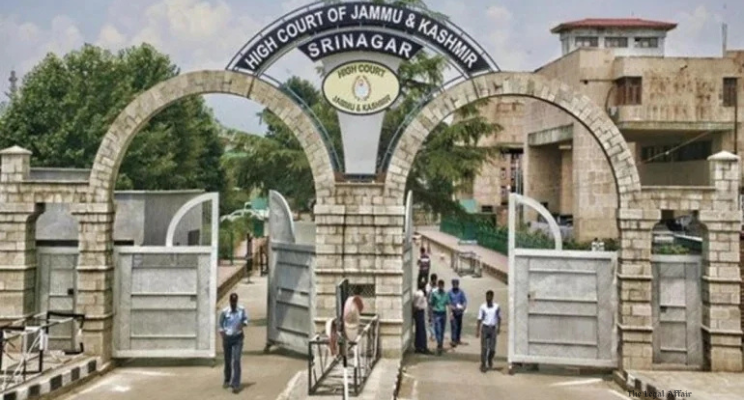
Introduction:
In the case of Mehraj-ud-Din Khan v. Union Territory of Jammu & Kashmir & Ors., the Jammu & Kashmir and Ladakh High Court dealt with an extraordinary situation where a police official remained absent from duty for nearly nineteen years on the plea that he was unable to resume service due to militant threats. The Division Bench of Chief Justice Arun Palli and Justice Rajnesh Oswal categorically ruled that such a prolonged absence without producing any credible evidence amounted to grave misconduct and was unbecoming of a member of the police force. The Court emphasized that the duties of police personnel are especially critical in times of heightened militancy and cannot be shirked under unsubstantiated claims. The petitioner had joined the force in the early 1990s but went on earned leave in June 1990, subsequently extending his absence. He resurfaced only in 2009 with a representation, claiming that militant threats prevented his return. His request for reinstatement was rejected by the authorities, a decision later upheld by the Tribunal. After a Single Judge ordered reconsideration, he was heard in 2017 but was again denied relief. Dissatisfied, he approached the High Court, where his petition was ultimately dismissed as meritless. This case highlights the importance of accountability within the police force, especially during times of crisis, and reiterates that law enforcement officers cannot abdicate their responsibilities under the guise of personal safety without corroborative proof.
Arguments of the Petitioner:
The petitioner, Mehraj-ud-Din Khan, argued that his absence from duty was neither voluntary nor deliberate but was compelled by extraordinary circumstances prevailing in Jammu and Kashmir during the early 1990s. According to him, he had proceeded on earned leave for thirty days beginning on 15 June 1990, later extending it for another thirty days. He contended that upon the completion of this period, he was unable to resume his duties due to the severe security situation in the Valley, where militancy was at its peak. He submitted that his life was under constant threat from militants, which prevented him from returning to active service.
He further claimed that when he attempted to resume his duties later, his superiors did not permit him to mark attendance. He maintained that despite the prolonged gap, he had made sincere attempts to rejoin and had submitted multiple representations to the authorities, the last of which was in 2009. The petitioner contended that his representation was wrongly rejected as being time-barred, ignoring the special circumstances he faced. He relied on humanitarian grounds, asserting that the volatile situation in the 1990s was beyond his control and that his absence should be condoned.
In support of his arguments, the petitioner claimed that as an individual living under militant threats, his right to life and personal safety under Article 21 of the Constitution had to be given paramount consideration. He argued that his absence should not be treated as misconduct but as a forced circumstance beyond his choosing. Moreover, he challenged the Tribunal’s findings, arguing that they had failed to consider the extraordinary security conditions during the period in question.
Arguments of the Respondents:
The Union Territory of Jammu & Kashmir, represented by the respondents, opposed the petition, arguing that the petitioner’s absence from service for nearly nineteen years could not be excused on the ground of unsubstantiated claims of militant threats. They emphasized that the petitioner failed to provide any evidence before the Designated Committee to corroborate his allegations of life threats. Despite repeated notices and signals directing him to resume his duties, he chose to remain absent without justifiable cause.
The respondents argued that being a police officer entails a heightened responsibility, particularly during times of law-and-order crisis and militancy. They highlighted that at the peak of militancy in the early 1990s, when the State required every officer’s service to maintain peace and order, the petitioner abandoned his duty. Such conduct, they contended, was unbecoming of a disciplined force member and amounted to gross misconduct.
They further argued that the petitioner’s conduct undermined the functioning of the police force, which depended heavily on discipline and reliability. If militant threats were accepted as an excuse for prolonged absence without evidence, it would set a dangerous precedent, allowing officials to evade responsibility under the garb of personal safety.
The respondents also pointed out that the Tribunal had carefully examined the case and confirmed that the petitioner was served with notices to rejoin but had deliberately failed to comply. They maintained that the authorities had already given him ample opportunity to be heard, including in 2017, when his representation was reconsidered and rejected for lack of evidence. Thus, they argued that the petition was devoid of merit and deserved dismissal.
Court’s Judgment:
After hearing both sides, the Division Bench of Chief Justice Arun Palli and Justice Rajnesh Oswal delivered a categorical ruling dismissing the petitioner’s plea. The Court observed that the petitioner had failed to produce any material evidence in support of his claim that he could not resume duties due to militant threats. The Court underscored that while security threats during the peak of militancy were a reality, a police official cannot simply abandon his duties indefinitely without substantiating his claims.
The Bench stated in unambiguous terms that “a police official, who does not join duty just because of threat from militants, cannot be expected to protect the life and property of the citizens of the country.” The Court noted that the petitioner had received several notices and signals asking him to return to duty, yet he ignored them for nearly two decades. His conduct was thus held to be inexcusable.
The Court also emphasized the importance of discipline in a police force, particularly during times of turmoil. It observed that the absence of even a single official during a crisis situation can severely compromise public safety and weaken law enforcement efforts. By failing to resume duties when manpower was urgently required, the petitioner had demonstrated misconduct and irresponsibility.
The Division Bench also agreed with the Tribunal’s findings that the petitioner’s absence could not be condoned and that he had been given ample opportunities, including a personal hearing in 2017, but had failed to substantiate his claims. The Court noted that his plea was reconsidered only due to a Single Judge’s order in 2016, but even then, no material was presented to support his case.
The Court concluded that the petitioner’s conduct amounted to abandonment of service, which could not be excused under law. It dismissed the petition as meritless, thereby upholding the decision of the authorities and the Tribunal.