


Introduction:
The Supreme Court of India is currently examining a challenge against the Allahabad High Court’s order permitting the inclusion of the Archaeological Survey of India (ASI) and the Union of India as defendants in the ongoing legal disputes concerning the Krishna Janmabhoomi-Shahi Idgah issue in Mathura. This challenge has been brought forth by the Management Committee of the Shahi Masjid Idgah.
Case Overview:
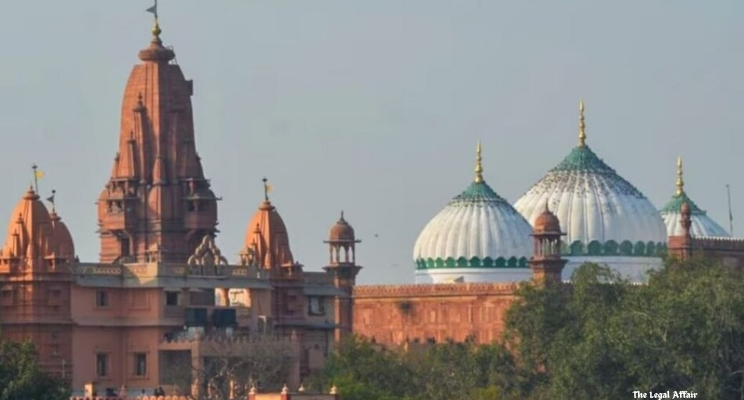
The legal contention centers around the Shahi Idgah Mosque, which certain Hindu groups assert was constructed on the birthplace of Lord Krishna. Multiple lawsuits have been filed by Hindu deities and devotees seeking the mosque’s removal, claiming the site originally housed a temple. In response, the Management Committee of the Shahi Masjid Idgah has contested these claims, leading to a protracted legal battle.
Mosque Committee’s Position:
Represented by Advocate Tasneem Ahmadi, the mosque committee challenges the Allahabad High Court’s decision on several grounds:
- Pending Supreme Court Review: The committee highlights that the Supreme Court is already deliberating on the maintainability of the plaintiffs’ suits, referencing the High Court’s August 1, 2024, order, which deemed the 18 suits maintainable. They argue that introducing new parties at this juncture is premature.
- Nature of the Amendment: They contend that amending the plaint to include ASI and the Union introduces a new dimension to the case, altering its original nature and potentially prejudicing the defense.
- Procedural Concerns: The committee points out that the High Court permitted the amendment without a formal application under Order I, Rule 10 of the Civil Procedure Code, questioning the justification for adding ASI and the Union as necessary parties.
- Contravention of the Supreme Court’s Directive: They assert that the High Court’s decision contradicts the Supreme Court’s December 12 order, which advised against passing significant interim or final orders in pending suits related to places of worship.
Plaintiffs’ Position:
Advocate Vishnu Shankar Jain, representing the plaintiffs, defends the High Court’s decision by emphasizing:
- Relevance of ASI and Union: Given that the mosque committee invokes the Places of Worship Act, 1991, in their defense, the plaintiffs argue that ASI and the Union are pertinent parties to determine the Act’s applicability, especially concerning monuments under ASI’s purview.
- Challenging the Act’s Applicability: They maintain that the Places of Worship Act does not extend to monuments managed by ASI, making the inclusion of ASI and the Union crucial for a comprehensive adjudication.
Supreme Court’s Observations:
A bench comprising Chief Justice Sanjiv Khanna, Justice Sanjay Kumar, and Justice KV Viswanathan has provided preliminary observations:
- Prima Facie Agreement with High Court: The bench indicated initial concurrence with the High Court’s rationale, noting that when a defense cites a specific Act, the plaintiffs are entitled to contest its applicability by involving relevant parties like ASI and the Union.
- Clarification on Case Dynamics: Addressing concerns about introducing a new case, Chief Justice Khanna clarified that challenging a defense does not equate to presenting a new case but is a legitimate aspect of legal proceedings.
- Existing Deliberations on the Act’s Scope: The bench acknowledged that the broader question of whether ASI-protected monuments used as mosques fall under the Places of Worship Act is under consideration in multiple cases before the Court.
Current Status and Implications:
The Supreme Court has scheduled further hearings for April 8, during which it will delve deeper into the arguments presented. The Court’s forthcoming decision holds significant implications for the intersection of heritage conservation, religious rights, and legal interpretations of the Places of Worship Act, 1991.