


Introduction:
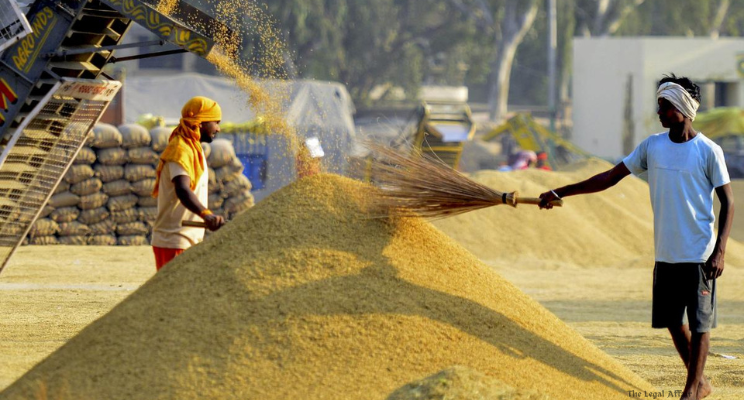
In the case, Sunpreet Singh v. Union of India and others, the Punjab and Haryana High Court recently addressed a Public Interest Litigation (PIL) that underscored a critical storage issue affecting Punjab’s agricultural sector. The PIL, filed by Advocate Sunpreet Singh, highlighted the distress of farmers who, due to limited storage space and delayed procurement, face financial and operational setbacks. The High Court urged both the Central and State Governments to collaboratively address the pressing shortage of storage space, which has caused unrest among farmers.
This legal matter is set against the backdrop of the Food Corporation of India’s (FCI) inability to procure and store the newly harvested paddy crop in Punjab. With FCI’s godowns nearing full capacity, farmers have voiced their frustration through widespread protests since October 13, demanding timely procurement of their produce. The petition highlighted that these delays could trigger a cascading impact on farmers’ financial stability, loan repayments, and future crop planning.
The Court’s deliberation brought in various stakeholders from both the Central and State Governments, underscoring the complex interplay of agricultural policy, market forces, and government accountability.
Petitioner’s Argument:
Advocate Sunpreet Singh, the petitioner, stressed the urgency of timely paddy procurement. He argued that a delay in procurement would directly affect farmers’ finances and agricultural schedules. With paddy not procured promptly, farmers may struggle to meet their debt obligations, impacting both their current financial commitments and their ability to obtain new credit. This delay, according to the petitioner, threatens to increase the financial burden on farmers, who are crucial to Punjab’s agrarian economy. Singh’s plea called for immediate government intervention, emphasizing that failure to secure procurement could lead to severe repercussions for Punjab’s farmers.
The petitioner further highlighted that despite the state’s centralized procurement scheme, the lack of sufficient storage capacity is exacerbating the issue. According to the plea, farmers are losing income opportunities due to these delays, and their mounting frustration is evident in the ongoing protests.
Respondent’s Argument:
The Attorney General for Punjab, Gurminder Singh, representing the State, clarified that Punjab operates under the Centralized Procurement Scheme as a Non-De-Centralized Procurement (Non-DCP) State, meaning procurement is primarily handled by the Central Government, specifically through the FCI. The state’s role is limited to assisting in the facilitation and initial handling of grain storage until FCI assumes responsibility. He stated that an MOU between the Punjab Government, the Union, and FCI establishes that FCI must ensure sufficient storage and transportation to prevent such crises.
Additional Solicitor General of India, Satya Pal Jain, also spoke on behalf of the Central Government. He assured the Court that both the Central and State Governments are committed to addressing this issue. According to Jain, the Central Government has implemented regular meetings between the authorities of both governments to assess and respond to the crisis in real time. FCI, as part of its mandate, will strive to ensure the movement of rice from Punjab to other regions, thereby creating space for new stock in its godowns. This coordinated effort, he suggested, is aimed at alleviating farmers’ concerns.
Court’s Judgment and Observations:
Chief Justice Sheel Nagu and Justice Anil Kshetarpal, in their judgment, observed that the issue revolves significantly around variable market forces and depends on policy-based decisions between the Central and State Governments. Recognizing the pressing nature of the case, the Court noted that this matter must be resolved at the policy level to address both immediate and long-term solutions. They urged the Central and State Governments to come together, sit at the table, and expedite a solution for the benefit of the agricultural community.
The Court appreciated the commitment from both sides, particularly the assurance from ASG Satya Pal Jain that frequent and regular meetings would continue among the relevant authorities until a resolution is reached. The Court acknowledged that while policy decisions can be complex and multifaceted, the dynamic nature of the situation necessitates swift action to stabilize the market and protect the interests of the farmers.
With these observations, the Court concluded the hearing and disposed of the PIL. However, the Court’s strong recommendation for cooperative decision-making signals the judiciary’s expectation of timely action from both governments to prevent further escalation of the issue.