


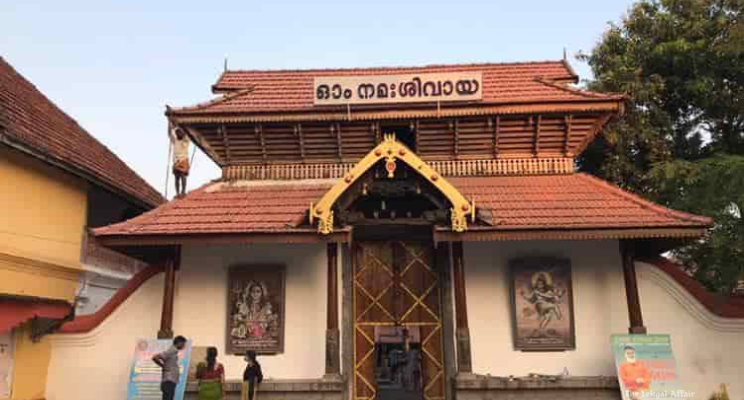
Introduction:
The case of Suo Motu v. State of Kerala & Ors. and Ernakulam Kshethra Kshema Samithi v. Cochin Devaswom Board & Ors. marks a significant judicial intervention by the Kerala High Court in safeguarding religious and charitable properties from misappropriation and unauthorized control. The Division Bench comprising Justice Raja Vijayaraghavan V. and Justice K.V. Jayakumar dealt with a deeply concerning issue involving the ownership and management of property acquired for the Ernakulam Shiva Temple under a public fundraising initiative titled “Ernakulathappanu Oradi Mannu” (One Foot Land for Lord Shiva).
The dispute came to light during the hearing of two matters—one concerning the challenge raised by the Ernakulam Kshethra Kshema Samithi against its removal as a Temple Advisory Committee, and another suo motu proceeding initiated by the Court to examine irregularities in the sharing of income generated from temple property. While scrutinizing the records, the Court uncovered startling irregularities, including the fact that property acquired entirely through donations collected from devotees had been partly registered in the name of the Samithi, a private entity.
The Court was thus called upon to determine whether such co-ownership could legally exist, especially when the funds used for acquisition were entirely sourced from the public for the benefit of the deity. The case raised broader questions about fiduciary responsibility, transparency, and the legal status of temple properties under statutory frameworks such as the Travancore-Cochin Hindu Religious Institutions Act, 1950.
Arguments of the Petitioner (Ernakulam Kshethra Kshema Samithi):
The Ernakulam Kshethra Kshema Samithi, which had previously functioned as the Temple Advisory Committee, sought to justify its role in the acquisition and management of the property.
The Samithi argued that it had played a pivotal role in mobilizing funds from devotees under the “One Foot Land for Lord Shiva” scheme. According to it, the initiative was driven by public sentiment and the collective desire of devotees to secure land for the temple’s benefit. The Samithi contended that its involvement was not only instrumental but also necessary to ensure the success of the fundraising effort.
It was further argued that the decision to include the Samithi as a co-owner of the property was based on practical considerations. The Samithi claimed that devotees had expressed apprehensions that if the property were vested solely in the Devaswom Board, it might be treated as part of its general assets and potentially used for purposes unrelated to the temple.
On this basis, the Samithi sought to portray itself as a custodian acting in the best interests of the deity. It contended that its role was akin to that of a caretaker, ensuring that the property and its income were utilized exclusively for temple-related activities.
The Samithi also relied on certain governmental orders and judicial observations to argue that its involvement had tacit approval. It maintained that the purchase was always intended for the benefit of the deity, and its inclusion as a co-owner did not alter this fundamental objective.
Additionally, the Samithi attempted to explain the absence of complete financial records by alleging that certain documents had been taken away by officials of the Devaswom Board. It argued that this hindered its ability to produce a full account of the funds collected and utilized.
In essence, the Samithi’s defense rested on the premise that its actions were guided by public interest, devotional sentiment, and a desire to protect temple assets from potential misuse.
Arguments of the Respondents (Devaswom Board, State Authorities):
The respondents, including the Cochin Devaswom Board and the State authorities, opposed the claims of the Samithi and supported the Court’s scrutiny of the irregularities.
They emphasized that the funds used for the acquisition of the property were collected from devotees explicitly for the benefit of the deity. Therefore, the property could not be treated as belonging to any private entity, including the Samithi.
The respondents highlighted that the Devaswom Board, under the Travancore-Cochin Hindu Religious Institutions Act, functions as a trustee of temple properties and is bound by strict fiduciary obligations. It was argued that any deviation from this framework, including conferring ownership rights on a private body, would be contrary to law.
They further pointed out that the Court had, in earlier proceedings, explicitly directed that the property be transferred in favour of the temple. Despite these directions, the sale deed was executed in a manner that granted a half share to the Samithi, which was in clear violation of judicial orders.
The respondents also raised serious concerns regarding the lack of transparency in the handling of funds by the Samithi. They argued that despite collecting substantial amounts from the public, the Samithi had failed to maintain proper accounts or provide a satisfactory explanation for the utilization of funds.
The allegation that records had been taken away by Board officials was strongly disputed. The respondents contended that this claim was an attempt to evade accountability and conceal irregularities.
Additionally, the respondents supported the decision to remove the Samithi as the Temple Advisory Committee, citing amendments to the bye-laws which no longer permitted organizations to hold such status. They emphasized that only individual devotees meeting specific criteria could now be appointed to the Committee.
Overall, the respondents argued that the actions of the Samithi amounted to an unauthorized usurpation of temple property and warranted strict judicial intervention.
Judgment of the Kerala High Court:
The Kerala High Court delivered a strongly worded judgment, unequivocally holding that temple property acquired through public donations must vest exclusively in the deity and cannot be shared with any private entity.
At the outset, the Court emphasized the fundamental principle that properties dedicated to a deity, especially those acquired through public contributions, are held in trust for the deity and must be administered accordingly. The Court observed that there was no legal basis for conferring co-ownership rights on the Samithi, which was merely an advisory body.
The Bench noted:
“Where land is acquired entirely with funds donated for the deity, there can be no justification whatsoever for conferring co-ownership rights on a private entity.”
The Court found that the sale deed executed in favour of both the temple and the Samithi was in blatant violation of its earlier directions, which had clearly mandated that the property be transferred solely in favour of the temple. The inclusion of the Samithi as a co-owner was described as a serious irregularity that struck at the root of judicial compliance.
The Court also rejected the justifications offered by the Samithi, observing that reliance on public sentiment or administrative convenience cannot override binding legal requirements. It held that the Samithi’s attempt to portray itself as a custodian was misplaced and unsupported by law.
A significant aspect of the judgment was the Court’s finding regarding the lack of transparency in the handling of funds. The Court noted that substantial amounts had been collected from devotees, yet no proper accounts were maintained or produced. It rejected the explanation that records had been taken away, terming it untenable and indicative of an attempt to obscure the truth.
The Court further emphasized the fiduciary role of the Devaswom Board, which is obligated to act in the best interests of the deity with utmost good faith and diligence. It held that any failure to uphold these duties would invite judicial scrutiny.
In light of these findings, the Court declared that the entire property, including the portion held in the name of the Samithi, vests absolutely in the deity. It directed the revenue authorities to mutate the property in the name of the deity or the Devaswom Board acting as trustee.
The Court also issued directions for a comprehensive audit of the funds collected by the Samithi and mandated initiation of appropriate proceedings in case of any misappropriation or breach of trust.
On the issue of the Samithi’s status as a Temple Advisory Committee, the Court upheld its removal, noting that the amended bye-laws no longer permitted organizations to hold such status. It clarified that only individual devotees meeting specific criteria could be appointed.
The petitions were accordingly disposed of with these directions.