


Introduction:
In Safety Matters Foundation v. Union of India & Ors., Diary No. 53715/2025 (along with connected matters), the Supreme Court of India was confronted with issues of profound national and human significance arising out of a tragic Air India aircraft crash that claimed nearly 260 innocent lives. The proceedings were heard by a Bench comprising the Chief Justice of India, Justice Surya Kant, and Justice Joymalya Bagchi. The petitioners included Safety Matters Foundation, pilot bodies, and the father of the deceased pilot, Captain Sumeet Sabharwal, represented by Senior Advocate Gopal Sankaranarayanan, along with Advocate Prashant Bhushan. The Union of India was represented by Solicitor General Tushar Mehta.
At the heart of the matter lay concerns regarding the procedural protocol adopted by the Union Government in enquiring into the crash, the role of the Aircraft Accident Investigation Bureau (AAIB), the alleged conflict of interest arising from the participation of Directorate General of Civil Aviation (DGCA) officials in the investigation, and the wider public narrative—largely media-driven—attributing blame either to pilots or to specific aircraft models, particularly the Boeing 787 Dreamliner.
While passing an interim order, the Supreme Court called upon the Union of India to file a report within three weeks, detailing the procedure followed for enquiring into the crash. At the same time, the Court delivered strong oral observations underscoring the need for restraint, objectivity, and confidentiality, cautioning all stakeholders against premature conclusions, media speculation, and brand-specific condemnation until the completion of the statutory investigation.
Background of the Tragedy and Proceedings:
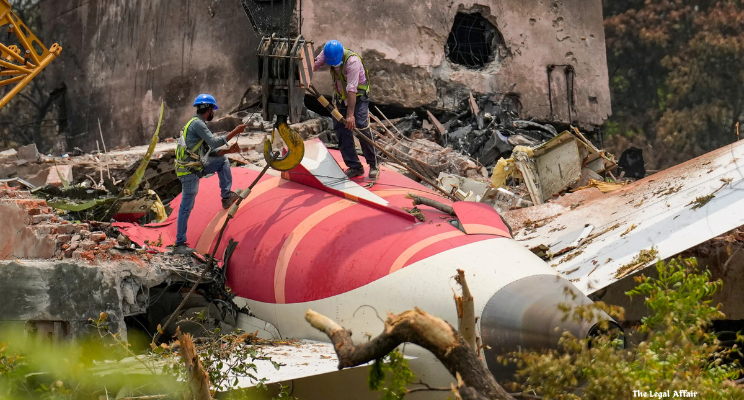
The Air India plane crash under consideration stands as one of the gravest aviation disasters in recent Indian history, resulting in the loss of approximately 260–261 lives, including passengers, crew members, and pilots. Among the deceased was Captain Sumeet Sabharwal, whose father approached the Court seeking accountability, transparency, and fairness in the investigative process.
Soon after the crash, the AAIB initiated an inquiry, as mandated under the Aircraft (Investigation of Accidents and Incidents) Rules. However, public discourse rapidly became polarized. Media reports began speculating about technical glitches in Boeing 787 aircraft, while selective leaks of the AAIB’s preliminary report allegedly created a narrative of pilot error, causing reputational harm to deceased pilots who were unable to defend themselves.
The Supreme Court had previously intervened in September 2025, expressing strong displeasure over the selective and piecemeal leak of the preliminary inquiry report, terming it “unfortunate” and stressing that absolute confidentiality must be maintained until the enquiry is complete. In November 2025, the Court had gone a step further and orally clarified that no blame could be attributed to Captain Sumeet Sabharwal, thereby attempting to counter the emerging narrative of pilot fault.
Against this backdrop, the present hearing assumed critical importance, as the petitioners sought either a Court of Inquiry or enhanced judicial oversight over the investigation process.
Issues Before the Supreme Court:
The proceedings raised several interconnected legal and institutional questions:
Whether the procedure adopted by the Union Government and AAIB in enquiring into the Air India crash adhered to statutory rules and established protocols.
Whether, in light of the gravity of the incident, a Court of Inquiry was mandatory under existing governmental rules.
Whether the inclusion of DGCA officials in the AAIB investigation team amounted to a conflict of interest, given that the DGCA’s regulatory actions were also under scrutiny.
Whether ongoing media narratives attributing blame to pilots or specific aircraft models were prejudicial, premature, and harmful.
What level of judicial intervention, if any, was warranted at the present stage of the investigation.
Arguments on Behalf of the Petitioners:
Advocate Prashant Bhushan mounted a strong challenge to the existing investigative framework. He argued that even under the Government’s own rules, accidents of such magnitude—particularly those involving mass casualties—mandate the constitution of a Court of Inquiry. According to him, reliance solely on the AAIB enquiry was insufficient given the seriousness of the incident and the public interest involved.
Bhushan raised serious concerns regarding the composition of the AAIB investigation team, pointing out that five members were officials of the DGCA. He contended that since the regulatory actions (or omissions) of the DGCA were themselves under question, their presence in the investigation compromised the independence and credibility of the inquiry.
He further alleged that since the Air India crash, at least three other Boeing 787 aircraft had suffered similar technical glitches, suggesting a possible systemic issue. Although he clarified that he was not relying solely on media speculation, his submissions drew from reports that had gained public traction. He also claimed that around 8,000 pilots had written to the government, asserting that Boeing 787 aircraft were unsafe and should be grounded as a precautionary measure.
Bhushan argued that unless an independent Court of Inquiry was instituted, public confidence in the investigation would remain eroded, especially given past experiences where pilot error narratives later turned out to be incorrect.
Senior Advocate Gopal Sankaranarayanan, appearing for pilot associations and the father of Captain Sumeet Sabharwal, adopted a more contextual and historical approach. He referred to two major crash cases involving Boeing 737 aircraft, where initial blame had been squarely placed on pilots. Eventually, investigations by the Federal Aviation Administration (FAA) in the United States revealed inherent defects in the aircraft systems. According to him, crucial documents exposing these defects were initially withheld from the public, and the matters were later settled for substantial monetary sums.
Drawing parallels, Sankaranarayanan cautioned against the knee-jerk tendency to attribute fault to pilots, particularly deceased pilots, who become easy scapegoats. He emphasized the psychological trauma suffered by the families, especially when reputational damage is inflicted posthumously.
He also placed before the Court a list of air crash cases in India where the Supreme Court had, in the past, ordered Courts of Inquiry headed by former judges, underscoring that judicially supervised inquiries were not unprecedented.
When raising concerns about notices allegedly issued to the nephew and niece of Captain Sabharwal’s father, who were themselves pilots, as part of the inquiry, Sankaranarayanan suggested that such actions added to the family’s distress and required judicial sensitivity.
Arguments on Behalf of the Union of India:
Solicitor General Tushar Mehta firmly defended the existing investigative process. He submitted that the AAIB inquiry was already at an advanced or “fag end” stage, and premature judicial intervention could disrupt a technically complex process. He urged the Court to allow the statutory mechanism to reach its logical conclusion before considering any further steps, including the possibility of a Court of Inquiry.
Responding to the claim that 8,000 pilots had written to the government, Mehta categorically stated, “Nobody has told us,” indicating that no such formal representation had been officially received or acknowledged by the Union Government.
He emphasized that the purpose of the AAIB inquiry was to ascertain the cause of the accident, not to apportion blame or determine culpability. Any assessment of responsibility, he argued, would arise only after the factual findings were complete.
The Solicitor General sought additional time to place the procedural details on record, assuring the Court that the Union would cooperate fully and transparently.
Court’s Observations and Oral Remarks:
The Supreme Court’s oral observations during the hearing reflected a careful balance between institutional restraint and empathetic acknowledgment of human suffering.
Chief Justice Surya Kant made poignant remarks on the magnitude of the tragedy, observing that the loss of 261 innocent lives was “not a small tragedy for any nation.” He expressed deep sympathy for the father of the deceased pilot, acknowledging the unimaginable shock and void caused by such a loss.
At the same time, the CJI strongly cautioned against being swayed by media reports, particularly those alleging technical glitches or singling out specific aircraft brands. He observed that aviation safety assessments must be grounded in verified technical data, not speculation.
In a telling remark, the CJI noted:
“There was a time Dreamliner was treated as one of the best and safest aircraft.”
He even shared a personal anecdote, stating that he had recently travelled on a Boeing 787 Dreamliner from Paris to Delhi, underscoring his point that isolated reports should not trigger panic or prejudice.
When Bhushan referred to media reports about a Dreamliner flight from London to Bengaluru suffering a switch-related issue, the CJI clarified that the airline had subsequently issued an official statement confirming that the switch was functioning properly.
Justice Joymalya Bagchi reinforced the principle that the objective of the enquiry is causal determination, not blame assignment, reiterating that accountability mechanisms would depend on the outcome of the investigation.
Order of the Supreme Court:
After hearing all parties, the Supreme Court passed an interim order with the following key directions and observations:
The Union of India was directed to file, within three weeks, a report detailing the procedural protocol followed in enquiring into the Air India crash.
The Court refrained from ordering a Court of Inquiry at this stage, indicating that such a decision would depend on the outcome of the AAIB investigation.
The Bench impressed upon the petitioners to await the completion of the AAIB enquiry, emphasizing institutional discipline and statutory processes.
The Court reiterated its earlier concerns regarding confidentiality, cautioning against selective leaks and media-driven narratives.
The disclosure of sensitive personal details relating to family members of the deceased was deprecated, reflecting judicial sensitivity to the dignity and privacy of affected families.
Chief Justice Kant concluded by observing:
“Let’s see what kind of Court of Inquiry is necessitated based on the outcome [of the AAIB enquiry].”