


Introduction:
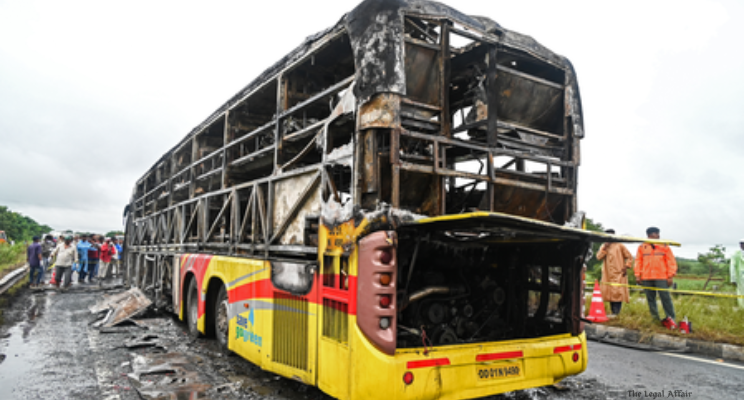
In Ram Milan Rai v. Regional Transport Authority (MP-5921-2025), the Madhya Pradesh High Court delivered a significant ruling underscoring the primacy of passenger safety over commercial convenience in public transport operations. The case arose from a dispute concerning the cancellation of a stage carriage permit granted to the petitioner, Ram Milan Rai, which had been set aside by the State Transport Appellate Tribunal (STAT) upon a challenge raised by a rival operator. The petitioner approached the High Court invoking its supervisory jurisdiction under Article 227 of the Constitution, seeking to overturn the decision of the STAT and restore the permit. However, while adjudicating the dispute, the Court went beyond the narrow confines of the case and addressed a systemic issue plaguing the transport sector—widespread non-compliance with statutory safety norms prescribed under the Madhya Pradesh Motor Vehicle Rules, 1994. Justice Vivek Jain, presiding over the matter, expressed grave concern over the alarming disregard for safety requirements, particularly Rule 164, which mandates that stage carriages and tourist buses must have separate entry and exit doors on the left side along with an additional emergency exit. The Court noted that despite clear statutory mandates, a large number of buses—including air-conditioned luxury and sleeper buses—were operating without adhering to these essential safety provisions, thereby endangering the lives of passengers. The Court described the situation as a “very sorry state of affairs” and criticized the authorities for their lax enforcement, pointing out that permits were being issued indiscriminately without ensuring compliance. While the dispute before the Court involved questions of locus standi and validity of permit cancellation, the judgment ultimately turned on statutory non-compliance, particularly the failure of the petitioner’s vehicle to meet the requirements of Rule 77(1-A), which defines the specifications of a deluxe air-conditioned bus. In a broader sense, the ruling serves as a stern reminder that regulatory frameworks governing public transport are not mere formalities but are essential safeguards designed to protect human life. The Court’s directions to enforce Rule 164 across the State within a strict timeline of 45 days mark a decisive step toward strengthening accountability and ensuring that safety norms are not sacrificed at the altar of profitability.
Arguments on Behalf of the Petitioner:
The petitioner, represented by Advocate Ashish Rawat, primarily challenged the legality of the order passed by the State Transport Appellate Tribunal (STAT), which had cancelled the permit granted to him. The central plank of the petitioner’s argument rested on the issue of locus standi of the rival operator (respondent no. 2). It was contended that respondent no. 2 did not possess the legal standing to challenge the grant of the permit, as he was not a rival route operator at the relevant point in time.
The petitioner’s counsel argued that the petitioner had already lifted the permit on May 2, 2025, whereas respondent no. 2 became a route operator only on May 5, 2025. Therefore, at the time when the permit was granted to the petitioner, respondent no. 2 had no competing interest in the route and could not be considered an aggrieved party. On this basis, it was submitted that the revision petition filed before the STAT was not maintainable, and the Tribunal had erred in entertaining and allowing the same.
It was further argued that the grant of the permit in favor of the petitioner was lawful and in accordance with the applicable rules. The petitioner sought to portray the challenge by respondent no. 2 as an afterthought aimed at disrupting his legitimate business operations. The counsel emphasized that once a permit had been validly granted and acted upon, it should not be lightly interfered with, especially at the instance of a party who lacked the requisite legal standing.
With respect to the alleged violations of the Motor Vehicle Rules, the petitioner attempted to downplay the significance of the deficiencies pointed out. It was argued that the absence of certain features, such as a separate conductor’s provision or additional doors, should not be treated as fatal to the validity of the permit. The petitioner’s counsel suggested that practical considerations in operating buses, including space constraints and economic viability, often necessitate certain adjustments, and strict adherence to every technical requirement may not always be feasible.
The petitioner also contended that the requirement of a conductor should not be interpreted rigidly, and that modern operational practices could accommodate variations. It was submitted that the bus in question had a total seating capacity of 36, which substantially complied with the requirement, and minor deviations should not result in the drastic consequence of permit cancellation.
Overall, the petitioner sought to persuade the Court that the STAT’s decision was legally flawed, both on the ground of locus standi and on the merits, and that the permit deserved to be restored.
Arguments on Behalf of the Respondents:
The respondents, represented by Advocate Brajesh Kumar Dubey and supported by the State through Advocate Mayur Gulati, defended the decision of the STAT and opposed the petitioner’s plea for restoration of the permit. The respondents argued that the issue of locus standi was not as decisive as the petitioner sought to portray, and that the legality of the permit itself was the primary consideration.
Addressing the petitioner’s contention regarding locus standi, the respondents pointed out that although the petitioner had lifted the permit on May 2, 2025, the application submitted by respondent no. 2 had been filed earlier. It was further highlighted that the grant order in favor of respondent no. 2 had been passed prior to the grant of the petitioner’s permit. Therefore, respondent no. 2 had a legitimate interest in challenging the grant, and his revision petition before the STAT was maintainable.
More importantly, the respondents emphasized that the petitioner’s vehicle did not comply with the mandatory requirements prescribed under Rule 77(1-A) of the Madhya Pradesh Motor Vehicle Rules, 1994. This rule defines the specifications of a deluxe air-conditioned bus and mandates a minimum seating capacity of 35+2, which includes the driver and the conductor. The respondents pointed out that the petitioner’s bus had only 36 seats in total, thereby falling short of the prescribed requirement.
The respondents strongly refuted the petitioner’s argument that the provision for a conductor was not mandatory. They contended that the rule explicitly requires accommodation for both the driver and the conductor, and any deviation from this requirement constitutes a clear violation of the statutory framework. It was argued that compliance with such rules is not optional but is a precondition for the grant of a valid permit.
The respondents also drew attention to the broader issue of safety compliance under Rule 164, which mandates the presence of separate entry and exit doors on the left side of the vehicle, along with an emergency exit. They pointed out that the petitioner’s bus had only a single entry-cum-exit door, which posed a serious risk to passenger safety, particularly in the event of accidents or fire incidents.
The respondents argued that the transport authorities have a duty to ensure strict compliance with safety norms, and any relaxation in this regard would endanger lives. They supported the High Court’s observations regarding the widespread non-compliance with Rule 164 and the need for strict enforcement.
In conclusion, the respondents maintained that the cancellation of the permit was justified on the ground of statutory non-compliance, and that the petitioner’s challenge deserved to be dismissed.
Judgment of the Court:
The Madhya Pradesh High Court, in a detailed and strongly worded judgment delivered by Justice Vivek Jain, upheld the decision of the State Transport Appellate Tribunal (STAT) and dismissed the petitioner’s plea. The Court held that the issue of locus standi, though raised by the petitioner, was not determinative of the outcome of the case. Instead, the Court focused on the fundamental issue of statutory compliance, which it found to be lacking in the petitioner’s case.
The Court observed that the petitioner’s vehicle did not meet the requirements of Rule 77(1-A) of the Madhya Pradesh Motor Vehicle Rules, 1994. The rule clearly mandates a minimum seating capacity of 35+2, including provisions for both the driver and the conductor. The Court rejected the petitioner’s contention that the conductor’s role was not mandatory, emphasizing that the rule explicitly requires such provision. Since the petitioner’s bus had only 36 seats in total, it failed to satisfy the statutory requirement, rendering the grant of the permit invalid.
The Court further noted that the petitioner’s vehicle also failed to comply with the safety requirements under Rule 164, which mandates separate entry and exit doors on the left side and an additional emergency exit. The presence of only a single entry-cum-exit door in the petitioner’s bus was found to be a serious deficiency, raising concerns about passenger safety.
While the Court did not base its decision solely on the violation of Rule 164, it took the opportunity to address the broader issue of non-compliance with safety norms across the State. The Court expressed deep concern over the widespread disregard for these rules and criticized the authorities for failing to enforce them effectively. It described the situation as a “very sorry state of affairs” and highlighted the risks posed by such negligence, particularly in light of frequent fire accidents involving buses.
The Court categorically held that commercial considerations cannot override the imperative of passenger safety. It acknowledged that having multiple doors might pose practical challenges for bus operators, including difficulties in managing passenger movement and potential loss of seating capacity. However, the Court made it clear that such concerns are secondary to the need to ensure safety in emergency situations.
Invoking its powers under Article 227 of the Constitution, the Court issued a significant direction to the Regional Transport Authorities (RTAs) across the State. It directed them to conduct an inquiry into whether stage carriages and tourist buses registered prior to January 5, 2012 (the date when the amended Rule 164 came into force) were complying with the rule. The Court further directed that if any violations were found, the operation of such vehicles must be stopped within 45 days until they achieve compliance.
The Court emphasized that the responsibility for ensuring compliance lies with both the authorities and the vehicle owners. It warned that failure to enforce safety norms would result in continued loss of lives and property, which is unacceptable in a civilized society governed by the rule of law.
Accordingly, the Court found no merit in the petitioner’s challenge and upheld the cancellation of the permit. The matter was directed to be listed for further monitoring on April 27, 2026, indicating the Court’s intent to ensure that its directions are implemented effectively.