


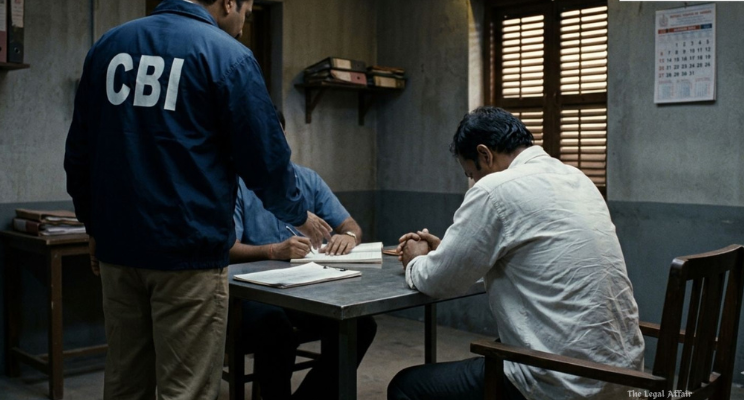
Introduction:
The Delhi High Court, in Ravjeet Singh v. Central Bureau of Investigation, delivered an important ruling clarifying the principles governing cooperation during interrogation while considering a plea for anticipatory bail in a corruption investigation. The case arose from allegations investigated by the Central Bureau of Investigation (CBI) concerning an alleged conspiracy involving defence-related business dealings and purported illegal gratification for securing governmental approvals. Ravjeet Singh, the applicant in the case, approached the High Court seeking anticipatory bail in connection with the investigation conducted by the CBI. According to the investigating agency, the main accused in the matter had allegedly entered into a conspiracy with representatives of certain private companies involved in defence manufacturing and logistics to obtain undue advantages from government departments. The prosecution alleged that Ravjeet Singh had maintained contact with the principal accused and was involved in attempts to secure approvals from the Ministry of External Affairs in exchange for illegal monetary benefits. Based on these allegations, the CBI opposed the grant of anticipatory bail to Singh, primarily contending that he would not cooperate with the investigation and that his custodial interrogation was necessary for uncovering the full extent of the conspiracy. The matter came before Justice Girish Kathpalia of the Delhi High Court, who examined the circumstances of the case, the nature of the allegations, and the arguments advanced by both sides. During the hearing, the Court addressed the claim of the investigating agency that the accused might not cooperate during interrogation. In a notable observation that has attracted significant attention in legal circles, the Court remarked that merely because an accused person appears “smart” or intelligent in responding to questions during interrogation does not mean that he is refusing to cooperate. Justice Kathpalia emphasised that it is the responsibility of the interrogator to effectively extract relevant information and that the law does not impose an obligation upon an accused person to respond in a manner that makes the interrogator’s task easier. After considering the material placed before it, the Court found that the grounds cited by the CBI for opposing anticipatory bail were vague and insufficient. The Court also noted that the main chargesheet in the case had already been filed and that the applicant could be directed to cooperate with the investigation whenever required. Taking these factors into account, the Delhi High Court allowed the anticipatory bail application, reiterating that vague allegations of non-cooperation cannot be used as a basis to deny personal liberty.
Arguments of the Applicant:
The applicant, Ravjeet Singh, represented by Senior Advocate Trideep Pais along with a team of advocates including Dhruv Gautam, Abhishek Tongar, Sarath Manari, Saloni Ambastha, and Sakshi Jain, strongly contested the allegations made by the Central Bureau of Investigation and sought protection from arrest through anticipatory bail. The defence argued that the accusations against Singh were based largely on assumptions and had not been supported by concrete evidence demonstrating his involvement in any criminal conspiracy. Counsel for the applicant submitted that Singh had not committed any offence and that his name had been unnecessarily dragged into the investigation merely because he had been in contact with certain individuals connected with the matter. According to the defence, communication between individuals does not automatically imply participation in a criminal conspiracy, particularly in cases involving professional or business interactions. The defence emphasised that the CBI had failed to establish any direct link between the applicant and the alleged exchange of illegal gratification or improper influence over government officials. Another important argument advanced by the applicant concerned his willingness to cooperate with the investigation. The defence argued that Singh had never refused to participate in the investigative process and had always remained available to the authorities whenever required. It was submitted that the apprehension expressed by the CBI that the applicant might not cooperate during interrogation was entirely speculative and unsupported by factual material. The defence also highlighted that anticipatory bail is a legal mechanism designed to protect individuals from unnecessary arrest when the circumstances of the case do not justify custodial interrogation. According to the applicant, the CBI’s opposition to the bail application was based primarily on vague assertions that Singh might not cooperate in questioning. The defence argued that such an allegation, without specific instances or evidence demonstrating obstruction of the investigation, could not be treated as a legitimate ground for denying anticipatory bail. Counsel for the applicant also pointed out that the main chargesheet in the case had already been filed by the investigating agency. Therefore, the need for custodial interrogation of the applicant was significantly diminished. The defence argued that any further clarification required by the investigators could be obtained by directing the applicant to join the investigation as and when required. The applicant also stressed that he had strong roots in society and no intention to evade the legal process. He was willing to comply with any conditions that the Court might impose, including cooperating with the investigation and appearing before the authorities whenever called upon. On these grounds, the applicant requested the Court to grant anticipatory bail in order to safeguard his personal liberty while ensuring that the investigation could proceed without obstruction.
Arguments of the Prosecution:
The Central Bureau of Investigation, represented by Special Public Prosecutor Vikrant Pachnanda along with Advocate Mukul Katyal, opposed the anticipatory bail application and argued that the allegations against the applicant formed part of a broader conspiracy involving corruption and undue influence in governmental decision-making processes. According to the prosecution, the investigation had revealed that the main accused in the case had conspired with representatives of private companies engaged in defence manufacturing and logistics. The objective of this conspiracy, the prosecution alleged, was to obtain favourable decisions or approvals from government departments in exchange for illegal gratification. The CBI contended that Ravjeet Singh had played a role in facilitating communication and coordination between the main accused and other individuals involved in the scheme. The prosecution alleged that Singh had been in contact with the principal accused for the purpose of securing approvals from the Ministry of External Affairs. These approvals were allegedly sought in exchange for financial benefits, thereby constituting an act of corruption. The prosecution argued that the investigation into such offences required thorough questioning of all individuals connected with the alleged conspiracy. According to the CBI, granting anticipatory bail at this stage could hinder the investigation and prevent the authorities from effectively interrogating the applicant. One of the central arguments advanced by the prosecution was that the applicant might not cooperate fully during interrogation if granted anticipatory bail. The CBI submitted that custodial interrogation would be necessary to uncover the details of the conspiracy and to identify the roles played by different individuals involved in the scheme. The prosecution suggested that the applicant had been evasive in his responses during previous interactions with investigators and might continue to adopt a similar approach if protected by anticipatory bail. The prosecution also emphasised the seriousness of corruption-related offences, particularly when they involve attempts to influence government decisions in sensitive sectors such as defence and foreign affairs. According to the CBI, such allegations must be investigated thoroughly in order to ensure accountability and protect the integrity of public institutions. In light of these considerations, the prosecution urged the Court to reject the anticipatory bail application and allow the investigating agency to continue its probe without restrictions.
Court’s Judgment:
After carefully considering the submissions made by both sides and examining the material placed before the Court, Justice Girish Kathpalia delivered a judgment that clarified the standards governing cooperation during interrogation in criminal investigations. The Court observed that the primary ground on which the CBI opposed the anticipatory bail application was the apprehension that the applicant would not cooperate with the investigation. However, the Court found that this assertion was vague and lacked concrete evidence demonstrating that the applicant had obstructed the investigative process. The Court emphasised that vague and speculative allegations cannot form the basis for denying anticipatory bail. Justice Kathpalia addressed the prosecution’s argument that the applicant had been “smart” in responding to questions during interrogation. In a notable observation, the Court remarked that there is no legal obligation requiring an accused person to behave in a particular manner during questioning. The Court stated that an individual’s intelligence or ability to respond cleverly to questions cannot be interpreted as a refusal to cooperate with the investigation. The Court observed that interrogation is a professional exercise that requires skill and preparation on the part of investigators. Therefore, if an accused person provides answers that are evasive or intelligent, it is the responsibility of the interrogator to ask more precise questions and extract the required information. The Court further noted that the criminal justice system does not impose a duty upon an accused person to make the task of interrogation easier for investigators. As long as the accused does not refuse to participate in questioning or deliberately obstruct the investigation, the mere manner in which he responds cannot be treated as non-cooperation. Another important factor considered by the Court was that the main chargesheet in the case had already been filed. The Court observed that once the chargesheet has been submitted, the requirement for custodial interrogation is significantly reduced. If the investigating agency requires further clarification or information, the accused can be directed to join the investigation and cooperate with the authorities whenever necessary. The Court also emphasised the importance of protecting personal liberty, which is a fundamental principle of criminal jurisprudence. Arrest should not be used as a punitive measure or as a means of exerting pressure on an accused person when the circumstances of the case do not justify such action. In the absence of concrete evidence demonstrating that the applicant had attempted to evade the investigation or tamper with evidence, the Court found no reason to deny him the protection of anticipatory bail. Accordingly, the Delhi High Court allowed the anticipatory bail application filed by Ravjeet Singh and granted him protection from arrest, subject to conditions ensuring his cooperation with the investigation. The ruling serves as an important reminder that the right to personal liberty cannot be curtailed on the basis of vague apprehensions and that the burden lies on investigative agencies to justify the necessity of custodial interrogation.