


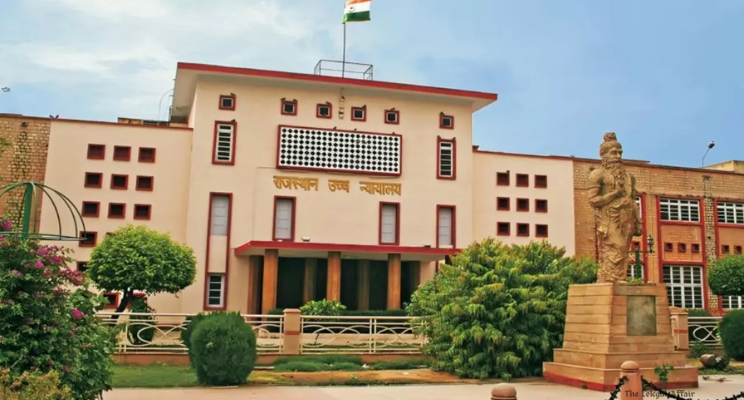
Introduction:
In a significant ruling reaffirming the limited scope of judicial review in matters of recruitment and eligibility, the Rajasthan High Court in Arvind Kumar Gupta v. State of Rajasthan & Anr. (2026 LiveLaw (Raj) 61) dismissed a petition filed by a Bachelor of Dental Surgery (BDS) graduate who sought recognition of his qualification as equivalent to a Degree in Medicine for appointment as a Food Safety Officer.
The bench of Justice Anand Sharma held that once an Expert Committee had examined the issue and concluded that BDS is not equivalent to a Degree in Medicine, the Court could not substitute its own view. The Court further emphasized that it does not possess the authority under Article 226 of the Constitution to expand, modify, or revise eligibility criteria prescribed by the State in its capacity as recruiting authority.
The petitioner’s candidature had been rejected by the Rajasthan Public Service Commission (RPSC) on the ground that he did not meet the prescribed qualification — a Degree in Medicine. Challenging this rejection, the petitioner argued that dentistry is a branch of medicine and therefore should fall within the ambit of the eligibility condition.
The Court, however, rejected the plea, reinforcing the principle that equivalence of qualifications lies within the domain of expert bodies and the State, not the judiciary.
Background of the Case:
The Rajasthan Public Service Commission issued an advertisement inviting applications for the post of Food Safety Officer. The essential qualification prescribed for the post included a Degree in Medicine.
The petitioner, a BDS graduate, applied for the position. His candidature was rejected on the ground that Bachelor of Dental Surgery does not constitute a Degree in Medicine as required under the advertisement.
Aggrieved by this rejection, he approached the Rajasthan High Court under Article 226, seeking a direction to treat his BDS qualification as equivalent to a Degree in Medicine and consequently consider him eligible for appointment.
The controversy centered on whether BDS could legally be regarded as falling within the scope of “Degree in Medicine” for the purposes of recruitment.
Arguments on Behalf of the Petitioner:
The petitioner advanced multiple submissions in support of his claim.
Firstly, reliance was placed upon the definition of “medicine” under the Indian Medical Council Act, 1956. It was argued that the statutory definition contained certain exclusions but did not expressly exclude dental science. Therefore, according to the petitioner, the definition was inclusive and covered modern scientific medicine in all its branches. Dentistry, being a specialized branch, ought to fall within this broad definition.
Secondly, the petitioner referred to responses received under the Right to Information Act from premier institutions, namely the Centre for Dental Education and Research at AIIMS, Delhi, and the Jawaharlal Institute of Post Graduate Medical Education and Research (JIPMER), Puducherry. In response to queries, these institutions reportedly stated that dental surgery is a branch of medicine.
On the strength of these responses, it was argued that the State’s refusal to treat BDS as equivalent to a medical degree was arbitrary and unreasonable.
The petitioner essentially contended that his qualification sufficiently met the underlying objective of the eligibility requirement and that denial of consideration amounted to an unjustified technical exclusion.
Arguments on Behalf of the State:
The State opposed the petition, asserting that a Degree in Medicine is distinct and separate from a BDS degree.
Reliance was placed upon a decision of the Telangana High Court in Dr. Nagaraju Tanneru & Another v. State of Telangana & Others, wherein an Expert Committee had been constituted to examine the issue of equivalence.
The Expert Committee concluded that the Degree in Medicine referred to in the Indian Medical Council Act did not include dental degrees. The schedule of the Act did not mention BDS as equivalent to MBBS or other medical qualifications.
The State further contended that the power to prescribe eligibility criteria for recruitment rests with the employer. As the recruiting authority, the State is entitled to consider factors such as the nature of duties, responsibilities, aptitude required, and public interest while determining qualifications.
It was submitted that judicial interference in such matters would amount to rewriting recruitment rules, which is impermissible.
Court’s Analysis and Findings:
1. Scope of Judicial Review Under Article 226
Justice Anand Sharma emphasized that the High Court’s power of judicial review under Article 226 does not extend to expanding prescribed qualifications or determining equivalence between different degrees.
The Court observed that eligibility criteria form part of policy decisions made by the employer. Courts cannot substitute their own assessment for that of expert bodies or recruiting authorities.
Judicial review is limited to examining whether the decision is arbitrary, illegal, or violative of constitutional principles. It does not permit courts to reframe qualifications.
2. Equivalence of Qualification: Domain of Experts
The Court referred to Supreme Court precedents holding that determination of equivalence is within the exclusive domain of the State and expert bodies.
Equivalence is a technical matter involving academic standards, curriculum comparison, and functional relevance to job requirements. Such matters require specialized knowledge and expertise beyond judicial competence.
The Court noted that once an Expert Committee has examined the issue and arrived at a conclusion, there is little scope for interference unless the decision is demonstrably arbitrary or perverse.
3. Expert Committee’s Resolution
The Court placed significant weight on the findings of the Expert Committee constituted in the Telangana case. The Committee had categorically resolved that BDS is not equivalent to a Degree in Medicine under the 1956 Act.
The schedule of the Act did not include dental degrees within medical qualifications. Therefore, there was no statutory basis for treating BDS as equivalent to MBBS.
Justice Sharma observed that in light of this expert determination, the High Court could not embark upon an independent inquiry into equivalence.
4. Employer’s Prerogative
The Court reiterated that the State, as employer, has the prerogative to prescribe eligibility conditions suited to the job profile.
Food Safety Officers perform duties that may require specific training and expertise in general medicine. The employer is best positioned to assess whether a dental qualification meets those requirements.
Interference by the Court would effectively amount to modifying recruitment criteria — a power the judiciary does not possess.
5. Rejection of Petitioner’s Contentions
The Court rejected the petitioner’s reliance on the inclusive definition of “medicine” and RTI responses from academic institutions.
It held that isolated opinions or interpretations cannot override statutory provisions and expert committee findings.
The Court concluded that the rejection of the petitioner’s candidature was neither arbitrary nor illegal.
Decision:
The Rajasthan High Court dismissed the writ petition.
It held that:
BDS is not equivalent to a Degree in Medicine for the purpose of the Food Safety Officer post.
Determination of equivalence lies within the domain of expert committees and recruiting authorities.
Judicial review cannot be invoked to expand or modify eligibility criteria.
Significance of the Judgment:
This judgment reinforces established principles of service jurisprudence:
Courts cannot rewrite recruitment rules.
Equivalence of qualification is a matter for experts, not judges.
Judicial review is supervisory, not substitutive.
The ruling safeguards the autonomy of recruiting authorities and maintains separation of powers. It prevents courts from stepping into academic and policy domains reserved for specialized bodies.
Conclusion:
The Rajasthan High Court’s decision underscores judicial restraint in matters of recruitment and academic equivalence. By declining to equate BDS with a Degree in Medicine, the Court reaffirmed that eligibility criteria are determined by statutory frameworks and expert evaluation, not judicial interpretation.
The judgment strengthens the principle that courts must respect the expertise of academic and administrative authorities, intervening only where decisions are arbitrary or unconstitutional.
Ultimately, the ruling preserves the integrity of recruitment processes and clarifies that aspirants must strictly meet prescribed qualifications rather than seek judicial expansion of eligibility norms.