


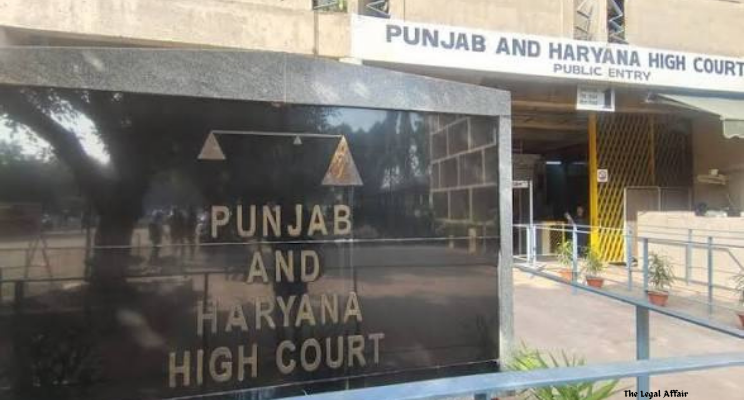
Introduction:
The Punjab & Haryana High Court has initiated suo motu criminal contempt proceedings after taking serious exception to a front-page newspaper advertisement which allegedly sought to portray the judiciary as part of a conspiracy against a convict or accused whose criminal proceedings are still pending. The Court has observed that such paid public narratives, if intended to influence public opinion against the judicial process, may have the tendency to interfere with the administration of justice.
The proceedings titled In Re: Suo motu contempt proceedings against publication of scandalous and contemptuous material intended to scandalize the Court and obstruct the administration of justice concern an advertisement published on the front page of The Hindu and Dainik Bhaskar in their editions dated September 12, 2026. The advertisement carried the prominent heading, “What is Dera Sacha Sauda? (Facts vs Fiction)” and, among other questions, raised the issue, “Was there a conspiracy against Guru Ji?”
The matter concerns Dera Sacha Sauda and the publishers and editors-in-chief of the two newspapers. The Punjab & Haryana High Court has issued notices to the concerned entities and individuals after prima facie finding that the contents of the advertisement may have the tendency to scandalize or lower the authority of the Court and/or interfere with or obstruct the due course of judicial proceedings.
Justice Subhas Mehla had taken note of the publication on September 16, 2026, and initiated contempt proceedings. The notices were made returnable on October 7, when the matter came before a Division Bench comprising Justice Vinod S. Bhardwaj and Justice Ravinder Malik. The Bench has now adjourned the matter to November 25.
The proceedings raise an important question concerning the boundary between permissible public expression and attempts to influence pending judicial proceedings through organised or paid publicity. While individuals and organisations are entitled to express their views regarding judicial proceedings, the power of the press and public platforms cannot be exercised in a manner which tends to undermine the authority of courts or obstruct the administration of justice.
The High Court’s action is rooted in its constitutional status as a court of record. Article 215 of the Constitution confers upon every High Court the power to punish for contempt of itself. The Court has also referred to Section 15(1) of the Contempt of Courts Act, 1971, which permits a High Court to take cognizance of criminal contempt in specified circumstances, including on its own motion.
The Court therefore examined whether the publication could prima facie fall within the statutory definition of “criminal contempt” contained in Section 2(c) of the 1971 Act. In particular, the Court invoked Sections 2(c)(i) and 2(c)(iii), which deal respectively with publication or conduct tending to scandalize or lower the authority of any court and conduct which tends to interfere with or obstruct the administration of justice.
The proceedings do not, at this stage, amount to a final determination of contempt. The Court has only found sufficient prima facie grounds to issue notice and require the concerned persons to respond to the allegations. The substantive question of whether the publication actually constitutes criminal contempt will have to be determined after considering the responses and the material placed before the Court.
The case nevertheless assumes significance because it involves the use of prominent newspaper advertising to advance a narrative concerning pending criminal proceedings and to question whether there was a conspiracy involving the judiciary. The High Court’s observations underscore that public campaigns surrounding pending cases cannot be permitted to become a means of exerting pressure upon the judicial process.
Arguments of the Parties:
At the stage when the Court took suo motu cognizance, the proceedings were initiated by the Court itself rather than through a conventional contempt petition filed by a private party. Consequently, the primary material before the Court was the newspaper advertisement and the circumstances surrounding its publication. The Court was required to consider whether the contents were sufficiently serious, on a prima facie basis, to warrant exercise of its contempt jurisdiction.
The concern arising from the publication was that the advertisement did not merely provide information concerning Dera Sacha Sauda or discuss the background of its spiritual leader, Gurmeet Ram Rahim Singh. Instead, the publication raised a question concerning an alleged “conspiracy against Guru Ji” in the context of ongoing judicial proceedings. According to the Court’s prima facie assessment, such a narrative could be understood as suggesting that courts or the judicial system were participating in a conspiracy against the concerned individual.
The Court treated this aspect differently from an ordinary criticism of a judgment or an expression of disagreement with the judicial process. The issue, as emerging from the order, was the possibility that the advertisement was part of a public campaign capable of creating an impression that the judiciary itself was acting improperly in relation to the pending proceedings.
The Court observed that issuing public appeals and paid narratives which insinuate that courts are parties to a conspiracy against a convict or accused, particularly when appeals and trials remain pending, can amount to an attempt to mobilize public opinion and influence the judicial process. Such conduct, if established, would raise concerns beyond ordinary freedom of expression because the administration of justice requires that pending proceedings be determined on the basis of law and evidence placed before the court, rather than public pressure.
The respondents, who include Dera Sacha Sauda through its management as well as the publishers and editors-in-chief of The Hindu and Dainik Bhaskar, have been called upon to respond to the contempt proceedings. Since the notices have only been issued at the preliminary stage, the detailed defence of the respondents is yet to be adjudicated upon by the Court.
The newspaper publishers and editors may therefore have the opportunity to explain the circumstances in which the advertisement was published, the source and nature of the material contained in it, and whether the publication was intended to influence any pending judicial proceeding. Similarly, Dera Sacha Sauda may be required to explain the purpose and substance of the advertisement and whether its contents were intended to question or undermine the authority of the judiciary.
The Court’s decision to issue notice is significant precisely because it does not prejudge these questions. The respondents will have an opportunity to place their explanations before the Court, and the Court will thereafter determine whether the ingredients of criminal contempt are ultimately established.
At the preliminary stage, however, the Court found that the language and subject matter of the advertisement were sufficiently serious to warrant examination under the Contempt of Courts Act. The reference to a purported conspiracy against “Guru Ji”, when read in the context of pending criminal proceedings, was considered capable of creating a narrative in which the judiciary itself could be portrayed as an interested participant rather than an impartial adjudicating institution.
The State authorities were not the principal initiators of the proceedings. Rather, the High Court exercised its own constitutional and statutory jurisdiction after taking notice of the publication. The Registry was directed to issue notices along with copies of the relevant annexures. The Senior Superintendent of Police, Chandigarh, was also directed to assist the Registry in obtaining the details of the concerned contemnors forthwith.
Thus, the immediate issue before the Court was not whether the allegations made in the advertisement were factually true or false in the ordinary sense, but whether the publication was of such a nature that it could potentially interfere with the administration of justice or undermine the authority of the Court. That distinction is central to the exercise of contempt jurisdiction.
Court’s Judgment:
The Punjab & Haryana High Court, while exercising its contempt jurisdiction, proceeded from the constitutional position that the judiciary must have the ability to protect the administration of justice from acts which threaten to obstruct or undermine judicial proceedings. The Court’s order is founded on Article 215 of the Constitution as well as the relevant provisions of the Contempt of Courts Act, 1971.
Article 215 declares every High Court to be a court of record and expressly confers upon it the power to punish for contempt of itself. This constitutional power operates alongside the statutory framework contained in the Contempt of Courts Act, 1971. The Court specifically referred to Section 15(1) of the Act, which permits a High Court to take cognizance of criminal contempt in circumstances contemplated by the legislation.
The Court therefore examined the publication within the statutory definition of criminal contempt under Section 2(c). The provision broadly concerns publication or conduct which tends to scandalize or lower the authority of any court, prejudices or interferes with judicial proceedings, or otherwise obstructs or tends to obstruct the administration of justice.
In the present matter, the Court specifically invoked Sections 2(c)(i) and 2(c)(iii). The first concerns acts tending to scandalize or lower the authority of a court, while the latter concerns acts which tend to interfere with or obstruct the due course of any judicial proceeding or otherwise obstruct the administration of justice.
Justice Subhas Mehla, who initially took cognizance of the publication, considered the nature and context of the advertisement and observed that public appeals and paid narratives portraying courts as participants in a conspiracy against a convict or accused can have consequences for the administration of justice.
The Court’s concern was particularly heightened because the judicial proceedings involving the concerned person were not a matter that had reached complete finality. Appeals and trials were stated to be pending. In such circumstances, a public campaign questioning the integrity or neutrality of the judicial process could potentially affect the environment in which those proceedings are being conducted.
The Court observed that such conduct may amount to an attempt to mobilize public opinion and influence the judicial process. The principle underlying the observation is that adjudication must take place within the courtroom and through established legal procedures. Public opinion, however strongly expressed, cannot substitute the evidentiary and legal process through which courts determine guilt, innocence, liability or other legal consequences.
The Court did not hold that criticism of the judiciary is itself contemptuous. The mere fact that a publication expresses disagreement with a judgment, criticises a judicial decision, or discusses a pending legal controversy would not automatically amount to criminal contempt. The issue before the Court was the apparent character and tendency of the specific publication, particularly its suggestion of a conspiracy involving the judiciary.
The distinction is important because freedom of speech and freedom of the press occupy an important position in a constitutional democracy. At the same time, these freedoms operate within the constitutional and statutory framework governing the administration of justice. Where a publication crosses from criticism into conduct having the tendency to scandalize the court or obstruct judicial proceedings, the contempt jurisdiction of the court may be attracted.
The High Court, therefore, did not finally determine the respondents’ guilt at this stage. Instead, it recorded a prima facie satisfaction that the contents of the advertisement “may have the tendency to scandalize or lower the authority” of the Court and/or interfere with or obstruct the due course of judicial proceedings.
The expression “may have the tendency” is significant in understanding the procedural stage of the matter. The Court was not required to conclusively establish contempt merely for issuing notice. It was required to determine whether the material disclosed sufficient grounds for initiating proceedings and calling upon the concerned persons to explain their conduct.
The Court consequently took suo motu cognizance under Article 215 of the Constitution read with Sections 2(c)(i), 2(c)(iii) and 15(1) of the Contempt of Courts Act, 1971.
The advertisement had appeared prominently on the front pages of two widely circulated newspapers on September 12, 2026. The heading, “What is Dera Sacha Sauda? (Facts vs Fiction)”, presented the material as an attempt to distinguish factual claims from what was described as fiction. However, the sub-heading questioning whether there had been a “conspiracy against Guru Ji” became particularly relevant to the Court’s contempt examination.
The Court was concerned not simply with the identity of the person referred to in the advertisement, but with the broader implication that the judicial process itself could be part of a conspiracy. If such an allegation is publicly disseminated while judicial proceedings are pending, it has the potential to weaken public confidence in the impartiality of the judicial system and to create pressure around proceedings that are required to be determined independently.
The High Court’s invocation of contempt jurisdiction therefore reflects the institutional responsibility of courts to preserve the integrity of judicial proceedings. The power of contempt is not designed merely to protect the personal dignity of judges. Its broader purpose is to safeguard the administration of justice and ensure that judicial proceedings are not obstructed or undermined.
The Court’s order also demonstrates the procedural safeguards associated with the exercise of contempt jurisdiction. Notices have been issued to all concerned parties, including Dera Sacha Sauda through its management, the Publisher of The Hindu, the Editor-in-Chief of The Hindu, the Publisher of Dainik Bhaskar, and the Editor-in-Chief of Dainik Bhaskar. Copies of the relevant annexures are to accompany the notices so that the respondents are fully apprised of the material forming the basis of the proceedings.
The direction to the Senior Superintendent of Police, Chandigarh, to assist the Registry in obtaining the details of the concerned contemnors further reflects the Court’s effort to ensure that the proceedings are properly brought before the persons against whom notice has been issued.
The matter was initially taken up by Justice Subhas Mehla on September 16, 2026. The notices were made returnable on October 7, 2026. On that date, the matter came before Justice Vinod S. Bhardwaj and Justice Ravinder Malik in accordance with the roster. The Division Bench has now adjourned the proceedings to November 25.
The adjournment means that the contempt proceedings remain pending. The respondents will have an opportunity to respond to the allegations and place their explanations before the Court. Only after considering the responses and the material before it will the Court determine whether the publication ultimately satisfies the requirements of criminal contempt.
The case consequently raises a broader legal question about the limits of public campaigning concerning pending criminal proceedings. A party involved in litigation is not prohibited from defending its position publicly, and criticism of judicial decisions is not automatically impermissible. However, the Court’s preliminary view indicates that there is a constitutional and statutory boundary where publicity begins to portray the judiciary as part of a conspiracy and thereby threatens to influence or obstruct the judicial process.
The proceedings also place the role of newspaper publishers and editors under scrutiny where paid material containing potentially contemptuous allegations is published. The issuance of notice does not mean that the publishers or editors have been found guilty of contempt. Their role, knowledge, intent, and circumstances surrounding publication remain matters for consideration in the proceedings.
Ultimately, the High Court’s intervention at this stage is directed toward preserving the authority and independence of the judicial process. By invoking Article 215 and Section 15(1) of the Contempt of Courts Act, the Court has asserted its constitutional responsibility to respond when material placed before it appears prima facie capable of scandalizing the court or interfering with the due course of justice.
The matter will now come up on November 25, when the responses to the contempt notices and further proceedings are expected to determine whether the allegations contained in the front-page advertisement cross the legal threshold from protected public expression into criminal contempt. Until then, the Court’s order remains a prima facie initiation of proceedings rather than a final finding of contempt against any of the noticees.