


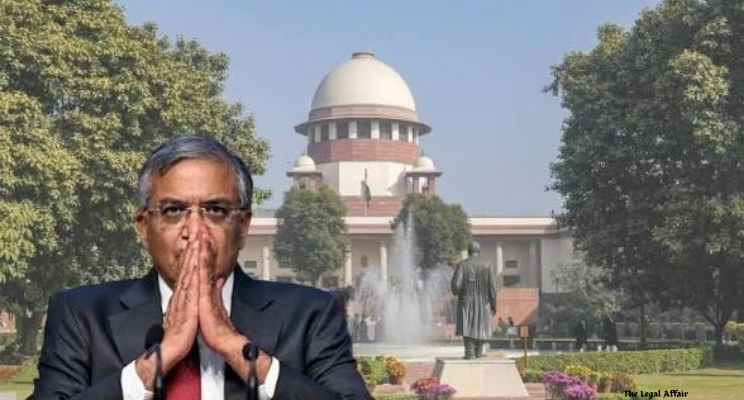
Introduction:
The Supreme Court has declined to pass an ex-parte interim order seeking the suspension of Chief Election Commissioner Gyanesh Kumar, holding that the allegations concerning the functioning of the Election Commission of India must first be considered after obtaining responses from the concerned constitutional and statutory authorities. A Bench comprising Chief Justice of India Surya Kant, Justice Joymalya Bagchi and Justice V. Mohana issued notice to the Union of India, the Election Commission of India, Chief Election Commissioner Gyanesh Kumar, Election Commissioners Dr. Sukhbir Singh Sindhu and Dr. Vivek Joshi, Deputy Election Commissioner Maneesh Garg IAS and Director General (IT) Seema Khanna.
The proceedings arise against the backdrop of allegations concerning the manner in which decisions relating to the Special Intensive Revision of electoral rolls were allegedly taken by the Election Commission. The petitions rely, among other things, on a report published by The Indian Express, according to which 14 important decisions concerning the Special Intensive Revision exercise were allegedly taken in the name of the Election Commission by the Chief Election Commissioner despite objections recorded by the other two Election Commissioners.
The controversy raises significant questions concerning the functioning of a multi-member Election Commission, the statutory requirement governing decision-making within the Commission, the institutional independence of election authorities and the extent to which courts can intervene in the functioning of a constitutional body on the basis of allegations concerning internal decision-making.
One of the petitions was filed by Rakesh Kumar Singh in W.P.(C) No. 1246/2026. The petitioner has questioned the alleged unilateral exercise of powers by the Chief Election Commissioner and has sought a declaration that decisions of the Election Commission, being a multi-member body, cannot lawfully be taken unilaterally. The petitioner has also sought examination of the primary records of the Commission to determine whether the disputed decisions were taken in accordance with the constitutional and statutory framework. Among the interim reliefs sought was suspension of the Chief Election Commissioner.
A connected petition was filed by Advocate Shailendra Mani Tripathi in W.P.(Crl.) No. 401/2026. It seeks, inter alia, quashing of the 14 decisions allegedly taken unilaterally and an independent inquiry through a Judicial Inquiry Commission or Special Investigation Team headed by a retired Supreme Court judge, with the assistance of cybersecurity and information-technology experts.
The controversy is particularly significant because the alleged irregularities concern the Special Intensive Revision exercise, which directly affects electoral rolls and, consequently, the ability of citizens to participate in elections. The petitions allege that around 13 crore names were deleted from electoral rolls across 30 States and Union Territories during the exercise. They further allege irregularities relating to electoral databases, Form 6, restoration of eligible voters and appeals concerning inclusion in electoral rolls.
At the heart of the dispute is Section 18 of the Chief Election Commissioner and other Election Commissioners Act, which provides the statutory framework for decision-making by the Election Commission. The provision contemplates unanimity as far as possible and, where unanimity is not achieved, decision-making by majority. The petitioners contend that this statutory scheme would be rendered meaningless if the Chief Election Commissioner could independently take decisions in the name of the Commission despite recorded objections from the other Election Commissioners.
The proceedings therefore involve questions extending beyond the individual office-holder. They concern the institutional character of the Election Commission and whether the statutory safeguards governing its functioning were followed while decisions having a direct bearing on electoral rolls were taken.
Arguments of the Parties:
Senior Advocate Vikas Singh, appearing for petitioner Rakesh Kumar Singh, strongly pressed for immediate interim intervention by the Supreme Court. He submitted that the allegations could not be treated as an ordinary dispute because they concerned the functioning of an institution entrusted with conducting free and fair elections.
Singh pointed out that the constitutional validity and appointment process under the law governing the Chief Election Commissioner and Election Commissioners was already under consideration before a larger Bench. According to him, however, the pendency of that broader constitutional challenge did not prevent the Court from adopting interim safeguards where the material before it allegedly disclosed serious institutional concerns.
The petitioner’s principal submission was founded upon Section 18 of the governing statute. According to Singh, the Election Commission is a multi-member body and its decisions must therefore comply with the statutory mechanism prescribed for such a body. He emphasised that the legislation requires decisions to be unanimous as far as possible and, where unanimity is not possible, to be determined by majority. The alleged existence of several decisions taken by the Chief Election Commissioner despite objections from the other Election Commissioners, according to the petitioner, therefore warranted immediate judicial scrutiny.
Singh also referred to Section 16 of the legislation, which grants legal protection to the Chief Election Commissioner for acts done or purported to be done in the discharge of official duties. He argued that the statutory immunity afforded to the CEC made judicial scrutiny particularly important where allegations of serious violations of statutory duty had been raised.
The petitioner sought suspension of Gyanesh Kumar as Chief Election Commissioner as an interim measure. Singh submitted that the allegations represented a situation capable of undermining public confidence in the electoral process. He argued that the integrity of electoral rolls is fundamental to the democratic process and that allowing allegedly defective decisions to remain operative until the final adjudication could cause consequences that might not subsequently be capable of effective reversal.
The urgency of the matter was emphasised in strong terms. Singh submitted that citizens were increasingly concerned about the security of their voting rights and argued that the Court needed to intervene before the alleged irregularities could affect the electoral process further. At one stage, he submitted that without interim protection, “the country will burn.”
The Bench, however, immediately raised a practical institutional concern. If the Chief Election Commissioner were suspended, the Court observed, the functioning of the Election Commission itself could be stalled. The CJI questioned who would conduct elections in such circumstances. Singh responded that the remaining two Election Commissioners could discharge the functions of the Commission.
The petitioner thereafter modified the immediate emphasis of his prayer and suggested that, at the very least, the Court should direct the Election Commission to take decisions only in accordance with the statutory requirement of unanimity or majority. In response, the CJI observed that there was already a mandatory statutory framework governing the Commission and that the expectation of the Court was that the authorities would comply with the law. The CJI further indicated that if a violation were ultimately established, the Court could undo decisions found to be contrary to the statutory framework.
Singh, however, questioned the practical effectiveness of a subsequent remedy. He pointed out that certain consequences of electoral decisions might be irreversible. In particular, he argued that the Court might not be able to undo an election or an elected government once the electoral process had been completed. According to him, this made preventive judicial intervention necessary rather than leaving the matter entirely for examination at a later stage.
The petitioner also alleged that the electoral roll itself had been compromised because of the disputed unilateral decisions. The allegations included unauthorised modification of Form 6, centralisation of electoral-roll databases, failure to restore eligible voters through the ECINet system and the filing of approximately 16.10 lakh appeals in West Bengal challenging the inclusion of voters purportedly in the name of the Election Commission.
The connected petitioner, Advocate Shailendra Mani Tripathi, sought broader investigative relief. His petition challenges the 14 decisions allegedly taken unilaterally and seeks an independent Judicial Inquiry Commission or Special Investigation Team headed by a retired Supreme Court judge. The proposed investigation is also sought to be supported by cybersecurity and IT specialists so that the electronic electoral databases and systems could be subjected to forensic scrutiny.
The petition further seeks investigation into the alleged deletion of around 13 crore names from electoral rolls across 30 States and Union Territories during the SIR exercise. It seeks appropriate action, including registration of complaints and prosecution under Section 32 of the Representation of the People Act, 1950, against officials found responsible for any established breach of official duty.
The allegations name, among others, the Chief Election Commissioner, Deputy Election Commissioner Maneesh Garg and Director General (IT) Seema Khanna. The petitioner alleges that the conduct complained of may amount to breaches of official duty relating to the preparation, revision or correction of electoral rolls.
On the other hand, the Supreme Court’s observations during the hearing reflected the respondents’ yet-to-be-heard position and the Court’s reluctance to reach conclusions without first obtaining the official record. The Bench did not accept that newspaper reports, by themselves, could constitute a sufficient basis for an ex-parte order against a constitutional authority.
When Singh argued that an Election Commission press release itself effectively acknowledged the substance of the media reports, Chief Justice Surya Kant made it clear that the Court could not pass an order solely on the basis of newspaper reports. The Court considered it necessary to hear the Election Commission and the other concerned respondents and examine their explanation before determining whether the alleged statutory violations had actually occurred.
Justice Joymalya Bagchi similarly focused on the evidentiary and procedural difficulty involved in granting the requested relief without hearing the other side. He questioned whether the Court could, without hearing the respondents, assume that all the disputed decisions had been taken unilaterally. He indicated that if the records ultimately demonstrated that a particular decision had not been taken in accordance with the statutory framework, the Court could consider appropriate relief, including treating such a decision as ultra vires.
Thus, although the petitioners sought immediate preventive measures, the Court did not reject the underlying allegations at this stage. Instead, it adopted a cautious approach, recognising that the allegations were serious but that their seriousness could not substitute for verification of the factual record.
Court’s Judgment:
The Supreme Court ultimately declined to suspend Chief Election Commissioner Gyanesh Kumar at the preliminary stage and issued notice to the Union of India, the Election Commission of India, the Chief Election Commissioner, the two Election Commissioners and the other concerned officials.
The central feature of the Court’s approach was the refusal to grant an ex-parte interim order against the Election Commission without first hearing the respondents. The Bench’s questions demonstrated that the Court was conscious of the extraordinary nature of the relief sought. Suspension of the head of the Election Commission would have immediate institutional consequences, particularly because the Commission is responsible for conducting elections and exercising constitutional and statutory functions of considerable national importance.
The Court’s approach reflects a basic principle of judicial procedure: serious allegations may justify judicial scrutiny, but the grant of coercive interim relief ordinarily requires a sufficient factual foundation and an opportunity for the affected party to respond. The Court therefore distinguished between entertaining a petition raising substantial questions and accepting the allegations as established.
Justice Bagchi’s observations were particularly significant in this regard. He questioned whether the Court could conclude ex-parte that all disputed decisions were unilateral merely because allegations to that effect had been made. The Court indicated that it would be capable of examining the records and, if they demonstrated that a decision had been taken contrary to the statutory framework, granting appropriate relief.
This approach also addresses the petitioner’s concern regarding Section 18. The provision creates a clear statutory framework for decision-making within the Commission. If the allegation that decisions were taken individually despite objections from the other Election Commissioners is established from the official records, the Court would then have to consider whether such decisions were legally sustainable.
The CJI’s observation that there was a “mandatory law” and that the Court expected the authorities to follow it is important in this context. The Court did not suggest that statutory requirements could be disregarded merely because the Election Commission is a constitutional institution. At the same time, it did not assume that a violation had occurred merely because such a violation had been alleged.
The distinction is important. Judicial review of administrative or constitutional action ordinarily requires the Court to determine whether the impugned action falls within the authority conferred by law. Where a statute prescribes a particular decision-making procedure, compliance with that procedure may form an essential component of the legality of the resulting decision. However, whether the prescribed procedure was actually violated is ultimately a question that may require examination of the relevant records.
The Bench’s remarks also addressed the petitioner’s argument that subsequent judicial intervention might be ineffective because electoral consequences cannot always be reversed. Singh had argued that an election or an elected government could not simply be undone after the event. The Court nevertheless appeared to consider that the immediate suspension of the CEC was too drastic a measure to be ordered without first establishing the factual basis for such intervention.
This does not mean that the Court closed the door on preventive relief. Rather, the Bench indicated that once the relevant records were placed before it, it could examine whether any particular decision was contrary to law and could potentially injunct or invalidate an action found to be ultra vires.
The Court’s insistence on obtaining the respondents’ response is also significant because the allegations concern the internal functioning of the Election Commission. The petitioners relied substantially upon media reporting and the objections allegedly recorded by the other Election Commissioners. The Court considered it necessary to determine the precise nature of those objections, the manner in which the decisions were formally taken, the statutory authority under which they were issued and whether the disputed actions were in fact decisions of the Commission or actions taken administratively within the Commission’s institutional framework.
The controversy also involves an important constitutional consideration concerning judicial restraint. The Election Commission is entrusted with conducting elections, and courts have repeatedly recognised the importance of preserving the independence and institutional functioning of election authorities while simultaneously ensuring that their actions remain within the limits of law. Judicial review does not disappear merely because an authority has constitutional status, but the remedy must be fashioned with due regard to the institutional consequences of judicial intervention.
The Court’s query, “Who will conduct the elections?” was therefore more than a practical question. It reflected the institutional consequences of suspending the head of an electoral body without first determining whether the allegations were established. The petitioner’s response that the remaining Election Commissioners could perform the functions did not lead the Bench to accept that the requested suspension could be ordered immediately.
The petitioner’s reliance on the inability to undo an election also raises a wider question about judicial remedies in electoral matters. Electoral disputes frequently involve competing considerations of institutional stability, timely adjudication and protection of voting rights. The Court’s response indicates that these concerns may have to be balanced against the procedural requirement of hearing the authority whose actions are under challenge.
The connected petition seeking a judicial inquiry and forensic examination of ECINet and ERONet databases similarly remains to be considered after the respondents’ responses. The allegation that approximately 13 crore names were deleted across numerous States and Union Territories is plainly serious if established. However, the Court has not, at this stage, accepted the numerical allegation or made any finding regarding the alleged deletion. The issuance of notice should therefore not be understood as a judicial endorsement of the allegations.
The same applies to the allegations concerning Form 6, the alleged centralisation of electoral databases, restoration of eligible voters and the large number of appeals said to have been filed in West Bengal. These allegations will require examination against the official records and explanations of the Election Commission.
The Court has consequently adopted a two-stage approach. First, it has recognised that the petitions raise questions warranting consideration and has issued notice to all relevant respondents. Second, it has reserved consideration of the substantive and interim reliefs until the Court receives the responses and is able to examine the relevant material.
The proceedings are therefore significant not because the Court has already found the Chief Election Commissioner guilty of any statutory breach, but because the Court has agreed to examine allegations concerning the internal decision-making process of the Election Commission at a time when electoral-roll revision is directly affecting citizens’ voting rights.
The matter will ultimately require the Court to examine the relationship between institutional autonomy and statutory accountability. The Election Commission must remain sufficiently independent to discharge its constitutional responsibilities without improper interference. At the same time, its independence does not place its decisions beyond the reach of law. Where Parliament has prescribed a decision-making mechanism for a multi-member Commission, compliance with that mechanism remains a matter capable of judicial scrutiny.
For the present, however, the Supreme Court has stopped short of the extraordinary relief sought by the petitioners. By issuing notice rather than ordering suspension, the Bench has preserved the functioning of the Election ommission while keeping open the possibility of