


Introduction:
The Karnataka High Court has directed the State Government to consider a representation seeking reconstruction and reinstallation of the Lord Parashurama statue at the Parashurama Theme Park in Karkala, Udupi district. The Division Bench comprising Justice Anu Sivaraman and Justice T.P. Vivekananda disposed of a Public Interest Litigation filed by Uday Shetty Muniyal, observing that the controversy raised in the petition was essentially factual and that the appropriate authority should examine the petitioner’s representation and take a decision in accordance with law.
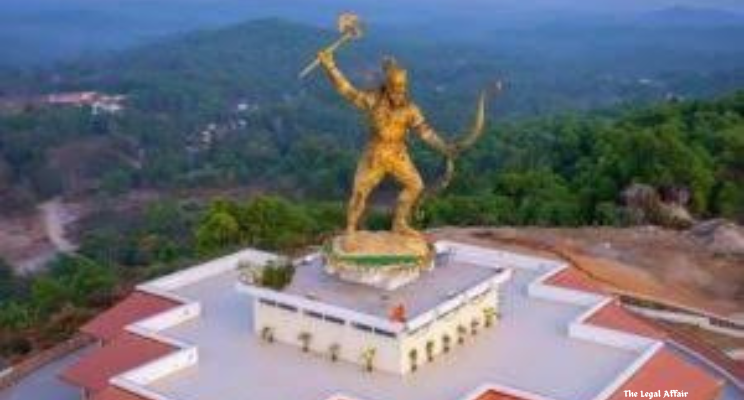
The proceedings arose from concerns surrounding a 33-feet statue of Lord Parashurama that had been installed at the theme park in 2023. According to the petitioner, the statue was subsequently found to be defective and was removed by the authorities. The petitioner alleged that although the statue was intended to be constructed in bronze, brass was used instead, and further alleged irregularities and fraud in connection with its construction.
The petitioner’s grievance was that despite the removal of the statue and the passage of considerable time, the authorities had not taken steps for its reconstruction and reinstallation. The petitioner therefore approached the High Court seeking a direction to the State Government to act upon his representation and initiate a fresh process, including issuance of fresh tenders and engagement of a reputed sculptor for reconstructing the statue.
The PIL was filed in Uday Shetty Muniyal v. State of Karnataka & Others, W.P. No. 22881 of 2025. Advocate Srikanth V.K. appeared for the petitioner. The matter was considered by the Division Bench in the context of the petitioner’s claim that the statue was connected not merely with a public attraction but also with the cultural and religious significance associated with Lord Parashurama in coastal Karnataka.
The petitioner invoked Articles 25 and 26 of the Constitution in support of his grievance. Article 25 protects freedom of conscience and the right to freely profess, practise and propagate religion, subject to the constitutional limitations. Article 26 concerns the freedom of religious denominations to manage their religious affairs, again subject to the constitutional framework. The petitioner sought to place the controversy within this broader context by asserting that the removal and non-reinstallation of the statue affected religious sentiments as well as the cultural heritage associated with Lord Parashurama.
The State’s role in the matter was connected with the administration and development of the theme park and the decision-making process concerning the statue. However, rather than determining the competing factual allegations itself, the High Court concluded that the dispute should first be examined by the competent government authority.
The Bench’s approach was also reflected in its oral observation that the petition did not appear to be a conventional Public Interest Litigation requiring the High Court to adjudicate the underlying factual controversy. The Court remarked during the hearing, “We can easily say it does not appear to be a PIL at all. You want this to be considered by the first respondent, that’s all.”
Ultimately, the Court recorded that the petitioner’s representation, marked as Annexure-D, had been submitted before the first respondent, the Department of Tourism. Since the disputes raised were “purely factual”, the Court held that it was for that authority to examine the representation and take an appropriate decision.
The Court nevertheless ensured that the decision-making process would not take place without hearing persons who could be materially affected by the outcome. It directed that the necessary parties, including the proposed sixth respondent, Nirmithi Kendra Udupi, should be put on notice and heard while the representation was being considered.
The order therefore does not itself direct the State to reconstruct or reinstall the statue. Instead, it requires the competent authority to consider the petitioner’s representation after following an appropriate hearing process. The distinction is important because the factual questions raised in the petition concern the original construction, the material used, the alleged defects, the circumstances leading to removal, the responsibility of various authorities and individuals, and the feasibility and manner of any proposed reconstruction.
The Court’s decision thus leaves the substantive administrative decision with the State Government while ensuring that the petitioner’s grievance receives consideration by the competent authority.
Arguments of the Parties:
The petitioner, Uday Shetty Muniyal, approached the High Court seeking judicial intervention after claiming that repeated representations for reconstruction and reinstallation of the Lord Parashurama statue had not resulted in effective action from the authorities.
His principal grievance was that the 33-feet statue, which had been installed at the Parashurama Theme Park in Karkala in 2023, was later removed after allegedly being found defective. The petitioner contended that the project had not been completed in accordance with what was originally contemplated and that the authorities had failed to take timely steps to restore the statue.
According to the petitioner’s case, the statue was intended to be constructed using bronze. However, he alleged that brass had been used instead. The allegation was presented as one of the circumstances demonstrating irregularity in the execution of the project. The petitioner further alleged that the sculptor involved in the construction had committed fraud.
The petitioner therefore sought a direction requiring the State Government to consider his representation and initiate a fresh process for reconstruction. His prayer contemplated the issuance of fresh tenders and engagement of a reputed sculptor so that a suitable statue could once again be installed at the theme park.
The petitioner also relied upon the broader cultural and religious significance of the statue. He argued that Lord Parashurama has an important association with the traditions and cultural history of the coastal Karnataka region and that the issue therefore had implications beyond a purely contractual or construction-related dispute.
Articles 25 and 26 of the Constitution were invoked in this context. The petitioner sought to emphasise that the preservation of religious and cultural symbols could have a dimension involving constitutional rights and public interest. His contention was that the continued absence of the statue from the theme park, particularly after its earlier installation and subsequent removal, affected the sentiments associated with Lord Parashurama.
The petitioner also pointed out that approximately three years had passed since the statue was removed and submitted that despite representations being made to the authorities, no meaningful steps had been taken towards reconstruction and reinstallation.
During the hearing, however, the Bench sought greater clarity regarding the factual basis of the petitioner’s assertions. The Judges questioned the petitioner about which particular authority had taken steps for the construction of the statue in the first place.
The Bench specifically sought to know what material was available to demonstrate the petitioner’s assertion that the Deputy Commissioner had directed or taken steps for the original construction of the statue. In response, the petitioner maintained that the Deputy Commissioner had indeed taken steps in that regard. He also submitted that certain documents which had not yet been produced before the Court could be placed on record to substantiate the contention.
The Bench further examined Annexure-C to the petition. The petitioner explained that the document related to an FIR registered against the artist who had sculpted the statue. The existence and relevance of the criminal proceedings were therefore also discussed during the hearing.
The Court then sought clarification regarding the person who had lodged the criminal complaint against the proposed seventh respondent, namely the sculptor. The petitioner clarified that the complainant was a different person and was not connected with him.
These exchanges demonstrated why the Court regarded the controversy as predominantly factual. The questions before it were not confined to a straightforward interpretation of a statutory provision. They included questions about who had commissioned or authorised the original work, what material had actually been used, whether the statue was defective, who was responsible for the alleged defects, what the relevant records showed, and what steps could now be taken for reconstruction.
The State authorities, on their part, were not directed by the High Court to immediately undertake reconstruction. The Court instead treated the petitioner’s representation before the Department of Tourism as the appropriate mechanism through which the grievance should initially be considered.
The judicial approach meant that the Court did not undertake a factual adjudication of the competing allegations concerning the construction of the statue. In particular, the Court did not record a finding that brass had in fact been substituted for bronze, nor did it determine whether any fraud had been committed by the sculptor.
Similarly, the Court did not determine whether the Deputy Commissioner had originally ordered or authorised the construction, or whether the removal of the statue was legally or administratively justified. Those matters were left open for consideration by the competent authority on the basis of the relevant records and after hearing the necessary parties.
The direction to hear Nirmithi Kendra Udupi and other necessary parties was particularly relevant in this regard. Since decisions concerning reconstruction, tendering, responsibility for the earlier project and possible engagement of a new sculptor could affect different stakeholders, the Court considered it appropriate that they be given an opportunity to place their position before the Department.
The petitioner’s case therefore ultimately resulted in a narrower relief than the substantive reconstruction direction initially sought. Instead of ordering the State to reconstruct the statue or conduct a fresh tender itself, the Court directed the competent authority to consider the existing representation and take an appropriate decision.
The Court’s order thus preserves the petitioner’s opportunity to pursue his grievance administratively while also avoiding a judicial determination of disputed facts that could more appropriately be examined by the executive authority possessing the relevant records and institutional expertise.
Court’s Judgment:
The Karnataka High Court ultimately disposed of the PIL by directing the Department of Tourism, which was the first respondent, to consider the representation submitted by the petitioner concerning reconstruction and reinstallation of the Lord Parashurama statue.
The Division Bench of Justice Anu Sivaraman and Justice T.P. Vivekananda recorded that the disputes raised in the matter were “purely factual”. On that basis, the Court concluded that it was not appropriate for it to directly adjudicate the factual controversy in the PIL. Instead, the authority before whom the representation had already been submitted was required to examine the grievance and take a decision.
The operative direction was based upon Annexure-D, which contained the representation made by the petitioner before the Department of Tourism. The Court specifically recorded that since the disputes were factual, it was for the first respondent to take a decision on the representation.
This approach reflects an established principle of judicial review. Courts ordinarily do not undertake a detailed factual investigation in writ proceedings when the dispute requires examination of documents, verification of records, determination of responsibility or appreciation of disputed factual circumstances, particularly where the competent administrative authority has not yet taken a decision on the grievance.
The Court’s observations during the hearing reinforced this approach. When the petitioner sought the Court’s intervention, the Bench remarked that the matter appeared essentially to involve a request for consideration of the representation rather than a conventional PIL requiring the Court itself to decide the underlying controversy.
The Court therefore avoided entering into questions such as whether the original statue was properly constructed, whether bronze or brass was used, whether the statue was defective, who was responsible for the alleged irregularities, or whether the sculptor had committed any wrongdoing. Those matters remained open for consideration before the competent authority.
The Court’s decision is also significant because it did not convert the petitioner’s allegations into judicial findings. Although the petitioner alleged that the sculptor had committed fraud and relied upon an FIR concerning the artist, the Bench did not pronounce upon the truth or otherwise of those allegations.
The same principle applied to the petitioner’s contention regarding the role of the Deputy Commissioner. The Bench specifically asked what material established that the Deputy Commissioner had taken steps for construction of the statue. The petitioner maintained that such action had been taken and sought permission to place additional documents on record. The Court, however, did not itself determine the factual issue.
The direction to place necessary parties on notice is another important aspect of the order. The Court directed that, while considering the representation, the necessary parties, including the proposed sixth respondent, Nirmithi Kendra Udupi, should be notified and heard.
This ensures that the administrative decision is not made solely on the basis of the petitioner’s allegations. Persons and institutions connected with the original project or potentially affected by any decision regarding reconstruction must have an opportunity to respond.
The requirement of hearing also strengthens the fairness of the subsequent administrative process. If the Department of Tourism ultimately considers whether reconstruction should take place, whether a fresh tender should be issued, whether a new sculptor should be engaged or whether any other course should be adopted, the decision can be taken after considering the relevant factual material and the responses of the affected stakeholders.
The Court’s treatment of Articles 25 and 26 is also noteworthy. The petitioner had invoked these constitutional provisions by contending that the matter affected religious sentiments and the cultural heritage associated with Lord Parashurama in coastal Karnataka. However, the Court did not proceed to decide whether the removal or non-reinstallation of the statue amounted to an infringement of the rights protected under Articles 25 or 26.
Instead, the Court’s order remained confined to the procedural relief of consideration of the representation. Consequently, the constitutional contentions raised by the petitioner were not converted into a judicial declaration regarding any alleged violation of fundamental rights.
The order also does not mandate that the State Government must necessarily accept the petitioner’s request. The direction is to consider the representation and take a decision. The final administrative outcome therefore remains with the competent authority, subject to the requirements of law and the hearing of necessary parties.
This distinction is important in matters involving public projects. A writ court can direct an authority to consider a representation where an issue falls within the authority’s domain, but such a direction does not ordinarily amount to a command that the authority must decide the representation in favour of the person who submitted it.
The High Court’s order consequently leaves open the substantive questions surrounding the future of the statue. The Department of Tourism will have to examine the material relating to the original construction, the alleged defects, the circumstances in which the statue was removed, the allegations concerning the material used, the relevant administrative records and the feasibility of reconstruction.
The Court’s directions also provide an opportunity for the State to address the petitioner’s grievance through the administrative process rather than requiring the High Court to conduct its own factual inquiry. This is particularly relevant because the petitioner himself indicated during the hearing that additional documents existed which had not yet been placed before the Court.
The earlier direction requiring the petitioner to deposit Rs 5 lakh with the High Court Registry as a contribution was also part of the proceedings. However, the present order ultimately focused on the petitioner’s representation and the responsibility of the competent authority to examine it.
By disposing of the PIL in this manner, the Court neither ordered immediate reconstruction nor rejected the petitioner’s grievance on its merits. Instead, it directed the appropriate government department to examine the representation and decide the matter after putting the necessary stakeholders on notice.
The decision therefore represents a judicially supervised administrative route rather than a final judicial determination concerning the statue itself. The High Court has ensured that the grievance receives consideration while maintaining the distinction between questions of law suitable for judicial determination and disputed facts that require examination by the competent authority.
The matter is consequently left to the Department of Tourism for consideration. The authority will have to assess the petitioner’s representation in accordance with law and after hearing the necessary parties, including Nirmithi Kendra Udupi and other persons who may be affected by the decision.
The ruling ultimately underscores that a PIL cannot automatically transform every factual dispute concerning a public project into a matter for direct judicial adjudication. Where the principal relief sought is consideration of a representation and the underlying controversy requires factual verification, the appropriate course may be to require the competent authority to examine the matter in the first instance.
In the present case, the High Court has therefore kept the focus on due consideration rather than predetermined outcome. Whether the Lord Parashurama statue will ultimately be reconstructed and reinstalled at the Karkala Theme Park will depend on the decision taken by the Department of Tourism after examining the relevant material and hearing the concerned parties.