


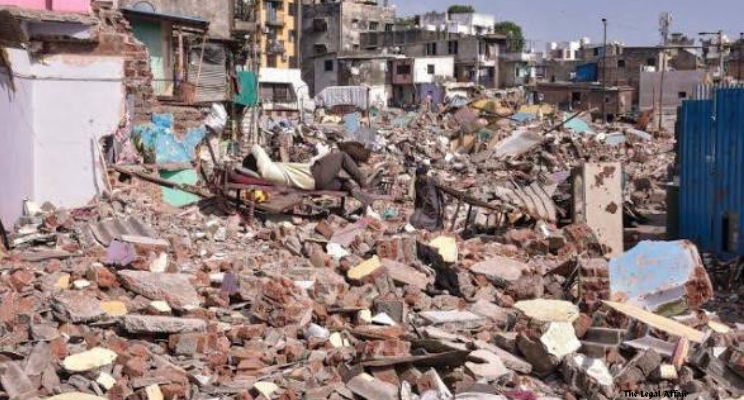
Introduction:
The Gujarat High Court is examining the rehabilitation arrangements offered to residents of Surat’s Nasir Nagar whose homes were demolished during a controversial demolition drive in June 2026. The proceedings have raised questions not only about the manner in which the demolition was undertaken but also about the State and municipal authorities’ subsequent obligation to provide meaningful and habitable rehabilitation to the affected residents.
Justice Nikhil S. Kariel was hearing Ansari M. Ikbal Alihusen & Others v. State of Gujarat & Others, R/Special Civil Application No. 8712 of 2026, filed by a group of residents challenging the consequences of the demolition exercise.
The matter has its genesis in the demolition of residential structures in Nasir Nagar, Surat, which the petitioners have described as an “illegal” demolition drive. During the earlier stages of the proceedings, the Gujarat High Court had prima facie expressed concern over the manner in which the exercise was allegedly conducted.
The Court had particularly considered the circumstances in which police assistance had been sought for a demarcation activity. According to the material placed before the Court, police bandobast had been requested for the purpose of demarcation, but the municipal authorities allegedly proceeded with demolition under the guise of that exercise.
The High Court had observed in June that if police personnel were present at the site pursuant to a request for bandobast and demolition was being undertaken under the pretext of demarcation, it was incumbent upon the police officials present to intervene and prevent such an activity if it was not authorised.
This observation assumes significance because the police and municipal authorities perform distinct functions. While municipal bodies may possess statutory powers concerning removal of unauthorised constructions, those powers must be exercised in accordance with the applicable law and procedural safeguards. Police assistance, on the other hand, cannot automatically legitimise an otherwise unlawful administrative action.
The proceedings subsequently expanded to include questions concerning accountability within the municipal and police administration.
The High Court had earlier asked the State Government to explain why the Surat Municipal Commissioner and senior police officials concerned were continuing in their posts while an inquiry into the demolition episode was pending.
In response, the Gujarat Government informed the Court that the Surat Municipal Commissioner concerned had been transferred and appointed to another post.
The latest hearing, however, focused principally on the question of rehabilitation.
The affected residents told the Court that they had initially been assured that they would be provided alternative accommodation in Jahangirpura under the PM Awas Yojana. According to their counsel, the residents had visited the proposed premises and found them habitable. On the basis of that assurance, they agreed to the proposed rehabilitation arrangement and proceeded on the understanding that the houses would be allotted at Jahangirpura.
The residents now allege that the proposed location has subsequently been changed.
They submitted that instead of Jahangirpura, they were being asked to accept houses in Adajan and Bhestan. More importantly, the residents claimed that they had not been given prior notice that the location of their rehabilitation would be altered.
The dispute therefore goes beyond the question of where alternative houses are situated. It concerns whether persons who lost their homes through a State or municipal action can be shifted to a materially different rehabilitation arrangement without adequate communication, consultation or assurance regarding the condition and suitability of the replacement accommodation.
The residents also challenged the physical condition of the newly proposed houses.
Senior counsel appearing for them referred to photographs placed before the Court and submitted that the accommodation being offered was substantially different from what had originally been represented to them. The residents claimed that they had been assured one-bedroom houses but were now being offered accommodation consisting essentially of one room and a small kitchen.
They further alleged that the houses were in a “dilapidated condition.”
The allegation raises an important issue concerning the meaning of effective rehabilitation. Providing an alternative structure in name may not necessarily amount to genuine rehabilitation if the premises are unsafe, uninhabitable or substantially inferior to the accommodation promised to the affected persons.
The Court was therefore required to consider the petitioners’ latest affidavit, which reportedly ran to approximately 100 pages, and the municipal corporation sought time to respond to its contents.
The matter remained pending, with the High Court granting the Corporation time to file its response and listing the case for further consideration on September 11.
At this stage, the Court has not finally adjudicated upon the competing claims concerning the condition of the proposed houses or the legality of the rehabilitation arrangement. The latest order is essentially procedural, keeping the matter part heard and allowing the municipal authorities an opportunity to respond.
Nevertheless, the proceedings illustrate the broader constitutional and administrative law questions that arise when public authorities undertake demolition drives affecting residential homes and subsequently undertake rehabilitation.
Arguments of the Parties:
The petitioners, comprising residents affected by the demolition in Nasir Nagar, have challenged the manner in which their homes were demolished and have also raised serious objections to the rehabilitation arrangements subsequently offered to them.
The residents’ case is that the demolition exercise was itself undertaken in circumstances that required greater scrutiny. During the earlier hearing, the High Court had prima facie questioned the manner in which police assistance obtained for demarcation was allegedly used in connection with demolition.
The petitioners’ grievance is therefore not confined to the physical loss of their homes. They seek judicial scrutiny of the circumstances in which the demolition was conducted and the responsibility of the authorities involved.
Their case also appears to be founded on the contention that the affected residents were entitled to meaningful rehabilitation after their homes were demolished.
According to senior counsel appearing for the residents, the authorities had specifically represented that alternative accommodation would be provided at Jahangirpura under the PM Awas Yojana.
The residents relied upon this representation and even visited the proposed premises. Having found those houses habitable, they agreed to the arrangement.
The counsel submitted that the entire process was undertaken on the understanding that accommodation would be provided at Jahangirpura. The residents were therefore surprised when the authorities subsequently began asking them to accept houses at Adajan and Bhestan.
A significant grievance raised before the High Court was that no notice had allegedly been given informing the residents that the rehabilitation location would be changed.
The residents contend that such a change cannot be treated as a minor administrative adjustment, particularly where the affected families have already lost their original homes. Location is an important component of rehabilitation because it affects employment, education, access to healthcare, transportation, social networks and other aspects of everyday life.
The residents also challenged the quality of the accommodation being offered.
The senior counsel referred the Court to photographs demonstrating what was described as the poor condition of the houses. According to the petitioners, they had been assured one-bedroom units but were now being offered premises consisting of only one room and a small kitchen.
The condition of the premises was described as dilapidated.
The residents’ argument, therefore, is that rehabilitation cannot be reduced to simply identifying an alternative physical structure. The replacement accommodation must be reasonably habitable and consistent with the assurance made to the affected residents.
Their objections also have to be viewed against the background that the residents did not voluntarily abandon their homes. Their homes were demolished during an administrative exercise. Consequently, any rehabilitation offered by the State or municipal authority assumes heightened importance.
The petitioners therefore sought the Court’s intervention to ensure that their rehabilitation rights were meaningfully protected and that the authorities did not alter the previously represented terms of rehabilitation without adequate justification.
The petitioners also joined the request made by the Corporation for additional time to respond to their detailed affidavit. Rather than opposing the request, their counsel agreed that the matter could remain part heard so that the Corporation could place its response before the Court.
This approach allowed the High Court to examine the competing factual assertions on a fuller record rather than deciding the rehabilitation dispute without hearing the municipal authorities’ response.
On the other side, the Gujarat authorities and the Surat Municipal Corporation sought time to respond to the detailed affidavit filed by the petitioners.
At the latest hearing, the Advocate General appearing for the Corporation informed the Court that the petitioners had filed a 100-page affidavit and requested additional time to answer the allegations and submissions contained therein.
The request was procedural in nature but significant because the petitioners had raised several factual allegations concerning the rehabilitation houses, their location and their physical condition.
The Corporation’s response will be particularly relevant because the residents’ claims regarding the change from Jahangirpura to Adajan and Bhestan, as well as the alleged dilapidated condition of the houses, are matters requiring factual verification.
The municipal authorities may therefore place before the Court their explanation concerning the proposed rehabilitation locations, the applicable housing scheme, the availability and condition of the alternative units, and the reasons for any alteration in the rehabilitation plan.
The State has also previously informed the High Court that the Surat Municipal Commissioner concerned had been transferred and appointed to another post. This followed the Court’s query as to why the Municipal Commissioner and senior police officers concerned continued in their respective positions while an inquiry into the demolition episode was pending.
The administrative action concerning the Municipal Commissioner forms part of the broader backdrop of the proceedings and may have a bearing on the Court’s assessment of institutional accountability.
The State and Corporation’s opportunity to file a detailed response is therefore important to ensure that the Court does not proceed solely on the allegations of the petitioners.
The latest hearing reflects this judicial balance. While the residents’ grievances were taken on record, the Court did not immediately grant the substantive relief sought. Instead, it accepted the joint request for additional time and kept the matter part heard.
This allows the Corporation to answer the allegations and provides the Court with an opportunity to assess the rehabilitation dispute on the basis of both sides’ material.
Court’s Judgment:
The Gujarat High Court, through Justice Nikhil S. Kariel, did not finally decide the rehabilitation dispute at the latest hearing. Instead, the Court took note of the competing submissions and granted the Surat Municipal Corporation time to respond to the detailed affidavit filed by the petitioners.
The matter was accordingly listed as part heard, with the next hearing fixed for September 11.
Although no final finding was rendered on the alleged condition of the rehabilitation houses, the proceedings must be understood against the Court’s earlier prima facie observations concerning the demolition drive.
In June, the High Court had expressed concern over the alleged use of police bandobast sought for demarcation in circumstances where demolition was subsequently undertaken by the municipal authorities.
The Court had observed that if police assistance was sought for demarcation and demolition was being conducted under the guise of that activity, the police officials present at the site had a responsibility to intervene and prevent the demolition.
This observation reflects an important principle of administrative legality: the presence of police personnel at the request of a civil or municipal authority does not transform an otherwise unauthorised act into a lawful one.
Police protection is ordinarily intended to facilitate lawful administrative action and maintain public order. It cannot become a means by which an authority proceeds with an action that exceeds the purpose for which police assistance was obtained.
The High Court’s earlier observation therefore placed emphasis on the responsibility of officials who are present at the site of an administrative operation.
The proceedings subsequently took on an additional dimension concerning accountability. The Court had sought an explanation from the State Government as to why the Surat Municipal Commissioner and senior police officials concerned were being allowed to continue in office while an inquiry into the matter was pending.
The State informed the Court that the concerned Surat Municipal Commissioner had since been transferred and appointed to another post.
The Court’s latest hearing, however, concentrated on what happened to the residents after their homes were demolished.
The rehabilitation issue is significant because the State’s obligation does not necessarily end with the physical removal of structures. Where residents are displaced as a consequence of governmental or municipal action, the adequacy and legality of the rehabilitation measures can become an important component of the overall dispute.
The petitioners’ contention that they were initially promised houses at Jahangirpura under the PM Awas Yojana and later asked to accept accommodation elsewhere therefore warranted consideration.
The Court took note of the submission that the residents had visited the Jahangirpura premises and agreed to the arrangement after finding those houses habitable.
Their subsequent allegation was that the authorities had shifted the proposed rehabilitation locations to Adajan and Bhestan without giving them notice of the change.
The Court did not, at this stage, determine whether that allegation was factually correct.
Similarly, it did not finally rule upon the residents’ contention that the alternative premises were in a dilapidated condition.
The senior counsel for the residents referred to photographs and submitted that the accommodation offered was only a room with a small kitchen despite the earlier assurance of one-bedroom units.
These factual issues require a response from the Corporation. Consequently, when the Advocate General requested time to answer the petitioners’ extensive affidavit, the residents also joined that request.
The Court accepted the joint request and directed that the matter remain part heard.
The decision to allow the Corporation time is consistent with principles of natural justice. Where serious factual allegations are made against a public authority, the authority must ordinarily be afforded an opportunity to place its explanation and supporting material before the Court.
At the same time, keeping the matter part heard ensures that the proceedings remain under the Court’s active consideration rather than being treated as a fresh matter at the next hearing.
The Court’s approach also reflects the need to examine rehabilitation claims carefully rather than making assumptions based solely on either side’s assertions.
The condition of housing, the terms of the PM Awas Yojana, the reasons for changing the location, the availability of alternative units and the communications made to the residents are all matters that can be tested against documentary evidence.
The High Court will consequently be in a better position to determine the appropriate relief after the Corporation files its response.
The earlier observations of the Court concerning the demolition remain an important backdrop.
The legality of a demolition exercise involving residential structures is not determined merely by the fact that the authorities consider the structures unauthorised. Administrative power must be exercised within the framework of law, and procedural safeguards remain significant, particularly where the consequences include displacement of residents.
The Court’s earlier concern regarding the alleged conversion of a demarcation exercise into demolition illustrates this point.
The presence of police officials during the exercise also raises questions concerning their role and responsibilities. The Court had already indicated that officials present at the site could not simply remain passive if demolition was being carried out in circumstances inconsistent with the stated purpose of the police deployment.
The subsequent transfer of the Municipal Commissioner, as informed by the State, provides a separate administrative development while the broader judicial proceedings continue.
The Court’s intervention also demonstrates the importance of judicial scrutiny where administrative decisions directly affect housing and livelihood.
For families whose homes have been demolished, rehabilitation is not merely a question of receiving a roof over their heads. The quality, safety, location and suitability of alternative accommodation can determine whether the rehabilitation is genuine or merely formal.
A replacement dwelling that is unsafe or substantially below the promised standard may not meaningfully address the consequences of displacement.
At the same time, the Court has not prejudged the Corporation’s position. The latest order allows the municipal authorities to respond to the residents’ detailed affidavit before the Court considers the matter further.
This is particularly important because the petitioners have placed extensive material before the Court, reportedly running to 100 pages. The Corporation’s response will enable the Court to distinguish between disputed factual assertions and matters supported by documentary evidence.
The next hearing on September 11 is therefore likely to be significant in determining how the Court proceeds with the rehabilitation issue.
The present order should not be read as a final judicial determination that the proposed houses are in a dilapidated condition or that the change of rehabilitation location was unlawful. Those questions remain open.
What is clear, however, is that the High Court has taken the residents’ concerns seriously enough to retain the matter on its board and require a response from the Corporation.
The case also highlights a larger constitutional principle: when public authorities exercise coercive powers affecting people’s homes, the consequences of that action cannot be considered in isolation from the rights and welfare of those displaced.
The legality of the initial action and the adequacy of the subsequent rehabilitation are closely connected questions of public administration and constitutional governance.
The proceedings before the Gujarat High Court therefore continue to examine oth dimensions.
For the moment, the Court has granted the Corporation time to answer the resi