


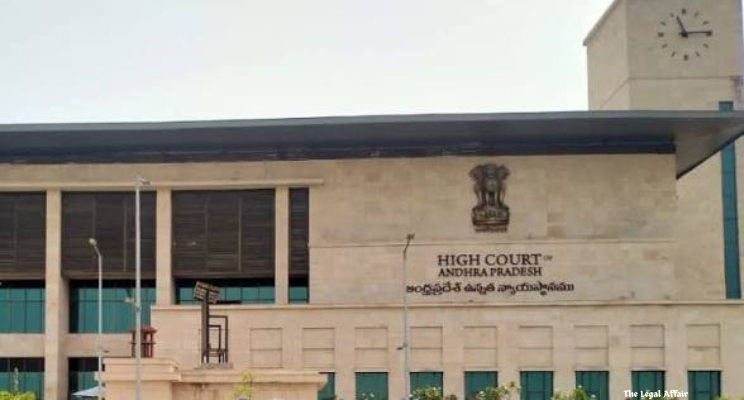
Introduction:
The Andhra Pradesh High Court, in Veerapaneni Venkata Subhashini & Another v. Arikatla Venkata Rathnam & Another (M.A.C.M.A. No. 262 of 2023), delivered a significant judgment reaffirming the beneficial and welfare-oriented nature of the Motor Vehicles Act, 1988. Justice Venkateswarlu Nimmagadda held that the negligence of a deceased driver does not disentitle his legal heirs from claiming compensation under the no-fault liability provisions of the Act. Setting aside the restrictive approach adopted by the Motor Accidents Claims Tribunal, the High Court enhanced the compensation payable to the widow and minor son of the deceased tractor driver from ₹50,000 to ₹5,00,000, together with interest at the rate of 9% per annum from the date of the claim petition until realization.
The appeal arose from a tragic accident that occurred in the year 2012. The deceased was driving a tractor when it overturned, resulting in his death. Following the accident, his widow and minor son instituted a claim petition before the Motor Accidents Claims Tribunal under Section 163-A of the Motor Vehicles Act, 1988. They asserted that the deceased had been employed as a tractor driver by the first respondent, the owner of the tractor, and was earning a monthly income of approximately ₹10,000. On that basis, they sought compensation from the owner and the insurer of the vehicle.
The Motor Accidents Claims Tribunal, however, rejected the principal claim. It concluded that the accident had occurred solely due to the negligence of the deceased himself. The Tribunal also found that the claimants had failed to establish that the deceased was employed as a driver by the owner of the tractor. Since negligence had been attributed to the deceased, the Tribunal declined to grant compensation under Section 163-A and limited the award to ₹50,000 under Section 140 of the Motor Vehicles Act, which provides for interim no-fault compensation.
Aggrieved by this decision, the widow and minor son preferred an appeal before the Andhra Pradesh High Court. They argued that the Tribunal had fundamentally misunderstood the scope of Section 163-A, which was introduced to provide compensation on a no-fault basis without requiring proof of negligence. They also challenged the Tribunal’s rejection of the oral evidence regarding the deceased’s employment, contending that agricultural employment is predominantly informal and documentary proof of wages is rarely available.
The appeal therefore presented important questions concerning the interpretation of the no-fault liability provisions under the Motor Vehicles Act, the evidentiary standards applicable in motor accident claims, and the impact of the amendments introduced by Act 32 of 2019, particularly Section 164, which enhanced statutory compensation payable in cases of death or permanent disability. The judgment ultimately reaffirmed that the Motor Vehicles Act must be interpreted in a manner that advances its welfare objectives and ensures just compensation to victims and their families.
Arguments of the Parties:
The appellants, namely the widow and minor son of the deceased, contended that the Motor Accidents Claims Tribunal had committed serious errors both on facts and in law while deciding their claim petition. They argued that the deceased was employed as a tractor driver by the first respondent and was earning approximately ₹10,000 per month. Although no documentary evidence such as salary slips or appointment letters could be produced, the widow gave consistent oral testimony regarding his employment. It was submitted that in rural and agricultural sectors, workers are ordinarily employed informally and wages are frequently paid in cash without any written documentation. Therefore, the Tribunal ought not to have discarded the unrebutted oral evidence merely because documentary proof was unavailable.
The appellants further argued that the Tribunal had incorrectly rejected their claim under Section 163-A of the Motor Vehicles Act solely on the ground that the deceased himself was negligent in causing the accident. They submitted that Section 163-A creates a special scheme of compensation based on the principle of no-fault liability, under which claimants are not required to establish negligence on the part of any person. Consequently, even if the deceased had contributed to the accident, such negligence could not legally operate as a bar to the maintainability of a claim under the said provision.
The appellants also relied upon the beneficial character of the Motor Vehicles Act. They contended that the object of the legislation is to provide financial relief to victims of road accidents and their dependants. Accordingly, the provisions of the Act must receive a liberal interpretation so that deserving claimants are not denied compensation on technical or hyper-technical grounds.
In addition, the appellants urged the High Court to extend to them the benefit of the statutory compensation introduced by the Motor Vehicles (Amendment) Act, 2019. They argued that although the accident had occurred in 2012, the appeal was being decided after the amendment came into force. Therefore, the Court should award the enhanced compensation of ₹5,00,000 contemplated under Section 164 in order to ensure just and reasonable compensation consistent with the welfare objectives of the legislation.
On behalf of the respondents, including the insurer, the findings of the Tribunal were sought to be defended. It was argued that the accident occurred solely because of the negligence of the deceased tractor driver. Since he himself was responsible for the accident, the respondents maintained that his legal representatives could not claim compensation beyond what had already been awarded under Section 140.
The respondents also questioned the claim that the deceased was employed as a driver by the owner of the tractor. According to them, the absence of documentary evidence regarding employment or payment of wages justified the Tribunal’s conclusion that the alleged employer-employee relationship had not been established.
Another aspect raised before the Court concerned the validity of the deceased’s driving licence. However, despite questioning this issue, the insurer failed to produce any evidence demonstrating that the deceased did not possess a valid and effective driving licence at the time of the accident. This omission became relevant while the High Court evaluated the correctness of the Tribunal’s findings.
Court’s Judgment:
Justice Venkateswarlu Nimmagadda allowed the appeal and substantially modified the award passed by the Motor Accidents Claims Tribunal. The High Court held that the Tribunal had adopted an unduly restrictive interpretation of the Motor Vehicles Act and had failed to appreciate its welfare-oriented character.
At the outset, the Court examined the scope of Section 163-A of the Motor Vehicles Act. It observed that the provision was enacted to create a special statutory mechanism enabling victims of motor accidents or their legal representatives to obtain compensation without being required to establish negligence. The Court reiterated that Section 163-A represents a no-fault liability scheme intended to provide expeditious financial assistance to victims and their dependants.
The Court categorically held that negligence of the deceased does not bar a claim under Section 163-A. Even where the deceased himself contributed to the occurrence of the accident, such negligence becomes legally irrelevant for the purpose of determining entitlement under the no-fault compensation scheme. The object of the provision is to ensure social security and financial relief rather than to determine civil liability based upon fault.
Justice Nimmagadda observed that the death of the deceased in the present case squarely attracted the beneficial provisions of the Motor Vehicles Act. Accordingly, the claim petition filed by the widow and minor son was fully maintainable notwithstanding the Tribunal’s finding that the deceased himself had caused the accident.
The High Court also found serious infirmities in the Tribunal’s appreciation of evidence regarding the deceased’s employment. The Court noted that the widow’s oral testimony regarding her husband’s employment as a tractor driver remained unchallenged and unrebutted. Merely because salary records or appointment letters were not produced could not justify rejection of such evidence.
The Court recognised the practical realities prevailing in the agricultural sector. It observed that agricultural labourers and tractor drivers are frequently employed through informal arrangements, with wages paid in cash and without maintenance of formal employment records. Therefore, insistence upon documentary evidence in every case would impose an unrealistic burden upon claimants and defeat the remedial object of the legislation.
Another important aspect considered by the Court related to the alleged absence of a valid driving licence. The High Court observed that although the insurer questioned the deceased’s driving credentials, it had failed to adduce any evidence whatsoever proving that he did not possess a valid driving licence. In the absence of such evidence, no adverse inference could be drawn against the claimants.
The Court then turned to the impact of the Motor Vehicles (Amendment) Act, 2019. It noted that the amendment introduced Section 164, which enhanced the amount of statutory compensation payable in cases involving death. Although the accident had admittedly occurred before the amendment came into force, the Court held that at the stage of final adjudication it was appropriate to extend the benefit of the enhanced statutory compensation to the claimants.
Justice Nimmagadda emphasised that the Motor Vehicles Act is a beneficial and welfare legislation intended to provide fair and reasonable compensation to victims of motor accidents and their dependants. Such legislation must be interpreted liberally to advance its humanitarian purpose rather than restrict its operation through technical interpretations.
The Court observed that where two interpretations are possible, the one advancing the welfare objective of the statute deserves preference. Since the claimants had remained deprived of adequate compensation for several years after the accident, denying them the benefit of the enhanced statutory compensation would defeat the legislative objective of ensuring just compensation.
Accordingly, the Court held that the claimants were entitled to compensation of ₹5,00,000 under Section 164 of the Motor Vehicles Act notwithstanding the fact that the accident had occurred before the 2019 amendment. The Court reasoned that by the time the appeal was finally decided, the amended statutory framework represented the legislative determination of what constitutes reasonable minimum compensation in cases involving death.
The High Court therefore enhanced the compensation from ₹50,000 awarded by the Tribunal to ₹5,00,000. It further directed that the enhanced compensation shall carry interest at the rate of 9% per annum from the date of filing of the claim petition until the date of realization.
The judgment is significant because it reinforces several important legal principles governing motor accident compensation. Firstly, it reiterates that claims under the no-fault liability provisions of the Motor Vehicles Act cannot be defeated merely because the deceased himself was negligent. Secondly, it recognises the realities of informal employment, particularly in rural and agricultural sectors, by holding that absence of documentary proof does not automatically discredit credible oral testimony regarding employment and income. Thirdly, it underscores that insurers cannot rely upon mere allegations regarding the absence of a driving licence without producing affirmative evidence.
Most importantly, the decision reflects the judiciary’s continuing commitment to interpreting beneficial legislation in a manner that advances its social welfare purpose. By extending the enhanced statutory compensation introduced by the 2019 amendment, the Andhra Pradesh High Court ensured that the dependants of the deceased received compensation that was not merely technically permissible but also just, reasonable, and consistent with the humanitarian objectives of the Motor Vehicles Act.