


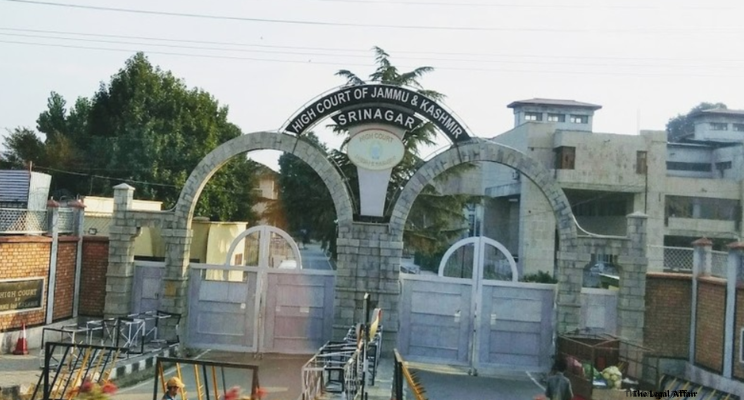
Introduction:
In a crucial ruling clarifying the contours of judicial discretion in cheque dishonour cases, the High Court of Jammu and Kashmir and Ladakh held that the power to grant interim compensation under Section 143A of the Negotiable Instruments Act, 1881 is discretionary and cannot be exercised in a routine or mechanical manner. The case, Nargees Javaid v. Ghulam Jeelani Nengroo, arose from a challenge to a Trial Court order directing the accused to pay 10% of the cheque amount as interim compensation in proceedings under Section 138 of the Negotiable Instruments Act, 1881. The matter was adjudicated by Justice Wasim Sadiq Nargal, who undertook a detailed examination of the statutory framework governing interim compensation. The petitioner had disputed the very issuance of the cheques and denied the signatures, seeking forensic examination. Despite this, the Trial Court allowed the complainant’s application for interim compensation without recording reasons or considering the defence. The High Court intervened, emphasizing that such orders must be based on a prima facie assessment of the case and supported by clear reasoning, failing which they cannot be sustained in law.
Arguments by the Petitioner (Accused):
The petitioner mounted a strong challenge to the Trial Court’s order, primarily on the ground that it was passed in a mechanical and arbitrary manner without proper application of mind. It was contended that the Trial Court had failed to appreciate the nature of the defence raised and had proceeded to grant interim compensation as a matter of routine, contrary to the legislative intent underlying Section 143A.
A central plank of the petitioner’s argument was the categorical denial of the issuance of the cheques. The petitioner asserted that the signatures on the cheques were disputed and that an application for forensic examination had been made. In such circumstances, it was argued, the very foundation of the complainant’s case was under challenge, and the Court ought to have exercised caution before directing payment of interim compensation.
The petitioner further contended that Section 143A uses the term “may,” which clearly indicates that the power to grant interim compensation is discretionary and not mandatory. It was argued that the Trial Court had failed to exercise this discretion judiciously and had not undertaken any prima facie evaluation of the competing claims of the parties.
Another significant argument was the absence of reasons in the impugned order. The petitioner submitted that the Trial Court had merely reproduced the statutory provision without analyzing the facts of the case or explaining why interim compensation was warranted. This, according to the petitioner, amounted to non-application of mind and rendered the order unsustainable.
The petitioner also challenged the quantum of compensation awarded. It was pointed out that the statute permits the grant of interim compensation up to 20% of the cheque amount, which implies that the Court must determine the appropriate percentage based on the facts of each case. The fixation of 10% without any reasoning or justification was argued to be arbitrary.
In support of these submissions, the petitioner relied on judicial precedents emphasizing that discretionary powers must be exercised on sound principles and supported by reasons. It was urged that the impugned order be set aside and the matter be remitted for fresh consideration.
Arguments by the Respondent (Complainant):
The respondent, on the other hand, defended the Trial Court’s order by emphasizing the object and purpose of Section 143A of the Negotiable Instruments Act. It was argued that the provision was introduced to address delays in cheque dishonour cases and to provide immediate relief to complainants who often suffer financial hardship due to non-payment.
The respondent contended that once the accused had been summoned and had pleaded not guilty, the Court was empowered to grant interim compensation at a preliminary stage of the proceedings. It was submitted that the Trial Court had acted within its jurisdiction in allowing the application and directing payment of 10% of the cheque amount.
The respondent also argued that the denial of signatures or the raising of a defence does not automatically preclude the grant of interim compensation. It was contended that such issues are to be adjudicated during the trial, and the interim nature of the relief does not require a detailed examination of evidence at this stage.
Further, the respondent submitted that the quantum of 10% was reasonable and within the statutory limits. It was argued that the Court need not provide elaborate reasoning for selecting a particular percentage, as long as it falls within the permissible range.
The respondent sought to justify the Trial Court’s order as a measure aimed at balancing the interests of both parties and ensuring that the complainant is not left remediless during the pendency of prolonged proceedings.
Court’s Judgment:
The High Court, after a comprehensive analysis of the statutory provisions and judicial precedents, allowed the petition and quashed the impugned order, holding that the Trial Court had failed to exercise its discretion in accordance with law.
At the outset, the Court examined the language of Section 143A and emphasized that the use of the term “may” clearly indicates that the power to grant interim compensation is discretionary. The Court held that such discretion must be exercised judiciously, based on the facts and circumstances of each case, and cannot be invoked mechanically.
The Court further observed that the provision contemplates the grant of interim compensation at a preliminary stage to provide relief to the complainant. However, it also incorporates safeguards to prevent undue prejudice to the accused. This balance, the Court noted, is achieved by requiring the Court to undertake a prima facie evaluation of the case before granting such relief.
A key finding of the Court was that the Trial Court had failed to conduct any such evaluation. The impugned order, according to the High Court, merely reproduced the statutory provision without reflecting any independent application of mind. The absence of reasons was held to be a serious infirmity, as it deprived the parties and the appellate court of the basis for the decision.
The Court also underscored the importance of considering the defence raised by the accused. In the present case, the denial of signatures on the cheques was a significant factor that warranted careful consideration. The Trial Court’s failure to address this aspect further demonstrated its mechanical approach.
On the issue of quantum, the Court held that the statute provides a range of 1% to 20% of the cheque amount, which necessitates a reasoned determination of the appropriate percentage in each case. The fixation of 10% without any justification was found to be arbitrary and unsustainable.
The High Court placed reliance on the judgment of the Supreme Court of India in Rakesh Ranjan Shrivastava v. State of Jharkhand (2024), which emphasized the need for recording reasons while exercising powers under Section 143A. It also referred to its earlier decision in Nazir Ahmad Chopan v. Abdul Rehman Chopan (2020), reiterating that discretionary powers must be exercised on well-recognized principles.
In conclusion, the Court held that the grant of interim compensation under Section 143A must be based on a prima facie assessment of the case and supported by clear and cogent reasons. Orders passed in a routine or mechanical manner cannot be sustained.
Accordingly, the impugned order was quashed, and the matter was remitted to the Trial Court with directions to pass a fresh order in accordance with law, after considering all relevant factors and recording reasons.