


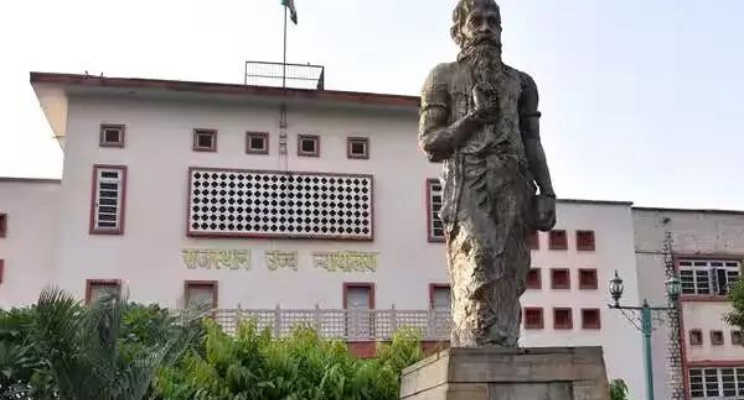
Introduction:
The case of All India Institute of Medical Sciences, Jodhpur & Ors. v. Hansraj Sharma presents an important judicial pronouncement by the Rajasthan High Court on the principles of fairness and equality in industrial adjudication. The matter arose from proceedings before an Industrial Disputes Tribunal, where a significant procedural issue surfaced regarding the representation of parties by legal practitioners under Section 36 of the Industrial Disputes Act, 1947.
The respondent, a workman who had been appointed as a Nursing Officer with the petitioner institution, was removed from service, leading to the initiation of an industrial dispute. During the course of proceedings before the Tribunal, the respondent filed an application under Section 36 objecting to the representation of the petitioner–employer by a legal practitioner. The Tribunal allowed this application, effectively barring the employer from engaging legal counsel.
What made the situation particularly contentious was the fact that the respondent himself was being assisted by an individual who was, in substance, a practicing advocate, albeit appearing in the capacity of an office bearer of a trade union. This asymmetry in representation raised serious concerns about fairness and parity between the parties.
Aggrieved by the Tribunal’s order, the petitioner approached the Rajasthan High Court, contending that such a restriction was arbitrary, discriminatory, and violative of principles of natural justice. The High Court was thus called upon to examine the scope and application of Section 36 and to determine whether the Tribunal’s exercise of discretion had resulted in an unjust and one-sided proceeding.
Arguments of the Petitioners (Employer/AIIMS, Jodhpur):
The petitioners, representing the employer institution, mounted a strong challenge to the Tribunal’s order, primarily on the ground that it created an unequal playing field.
At the outset, the petitioners argued that Section 36 of the Industrial Disputes Act does not impose an absolute prohibition on representation by legal practitioners. Instead, it grants discretion to the Tribunal to permit such representation, subject to certain conditions. The petitioners contended that this discretion must be exercised judiciously and in accordance with principles of fairness and equity.
A key argument advanced by the petitioners was that the respondent was himself being assisted by a practicing advocate. Although the respondent sought to characterize this individual as merely an office bearer of a trade union, the petitioners argued that his professional identity as an advocate could not be ignored. They contended that in substance, the respondent was receiving legal assistance, which placed the petitioners at a disadvantage.
The petitioners further argued that denying them the right to engage a legal practitioner while allowing the respondent to benefit from legal expertise amounted to manifest inequality. Such a situation, they submitted, violated the fundamental principles of natural justice, particularly the principle of audi alteram partem, which requires that both parties be given a fair opportunity to present their case.
The petitioners also emphasized that industrial adjudication, although intended to be less formal, cannot be conducted in a manner that compromises fairness. They argued that the Tribunal’s order effectively rendered the proceedings one-sided and undermined the integrity of the adjudicatory process.
Additionally, the petitioners contended that no prejudice would have been caused to the respondent if they were allowed to be represented by a legal practitioner. On the contrary, permitting legal representation for both parties would have ensured a more balanced and efficient resolution of the dispute.
In essence, the petitioners argued that the Tribunal had exercised its discretion arbitrarily and without considering the factual context, thereby warranting interference by the High Court.
Arguments of the Respondent (Workman):
The respondent sought to defend the Tribunal’s order by relying on the statutory framework of Section 36 and the objectives underlying it.
The respondent argued that Section 36 of the Industrial Disputes Act is designed to maintain the informality of industrial proceedings and to prevent them from becoming overly legalistic. According to him, allowing legal practitioners to represent parties could lead to unnecessary complexity and delay.
He further contended that the restriction on legal representation is intended to protect workmen, who may not have the resources or expertise to engage legal counsel, from being disadvantaged in proceedings against employers with greater financial and legal resources.
Addressing the allegation that he was being represented by a practicing advocate, the respondent argued that the individual in question was appearing solely in the capacity of an office bearer of the trade union. He maintained that such representation is expressly permitted under the Act and does not amount to professional legal representation.
The respondent also submitted that permitting the employer to engage a legal practitioner would tilt the balance in favour of the employer, given its institutional resources and access to experienced counsel.
He argued that the Tribunal had exercised its discretion in accordance with the spirit of the Act and that there was no illegality or arbitrariness in its decision.
Judgment of the Rajasthan High Court:
The Rajasthan High Court, presided over by Justice Anand Sharma, delivered a reasoned judgment setting aside the Tribunal’s order and reaffirming the importance of parity and fairness in adjudicatory proceedings.
At the outset, the Court examined the scope of Section 36 of the Industrial Disputes Act and clarified that it does not impose an absolute bar on legal representation. Instead, it vests discretion in the Tribunal to permit or deny such representation, which must be exercised on sound judicial principles.
The Court emphasized that this discretion cannot be exercised mechanically or in a manner that results in unfairness. It held that the Tribunal must consider the factual circumstances of each case and ensure that its decision does not create an imbalance between the parties.
A crucial aspect of the Court’s reasoning was its finding that the respondent was effectively availing legal assistance. The Court rejected the argument that the individual representing the respondent was merely an office bearer of a trade union. It held that the professional status of a practicing advocate cannot be disregarded simply because he is appearing in a different capacity.
The Court observed:
“Permitting one party to avail legal expertise while denying the same to the opposite party results in manifest inequality and violates the principles of natural justice.”
The Court further held that industrial adjudication, though less formal, cannot be allowed to become one-sided. The objective of maintaining informality must be balanced against the need to ensure fairness and equality between the parties.
The Court also noted that no prejudice would have been caused to the respondent if the petitioners were allowed to engage legal counsel. On the contrary, such permission would have promoted a more balanced and effective adjudication.
Rejecting the respondent’s contention, the Court held that the Tribunal had failed to exercise its discretion judiciously. It found that the order suffered from a fundamental flaw in that it permitted asymmetrical representation, thereby violating the principle of parity.
Accordingly, the High Court allowed the petition, quashed the Tribunal’s order, and permitted the petitioners to be represented by a legal practitioner of their choice.