


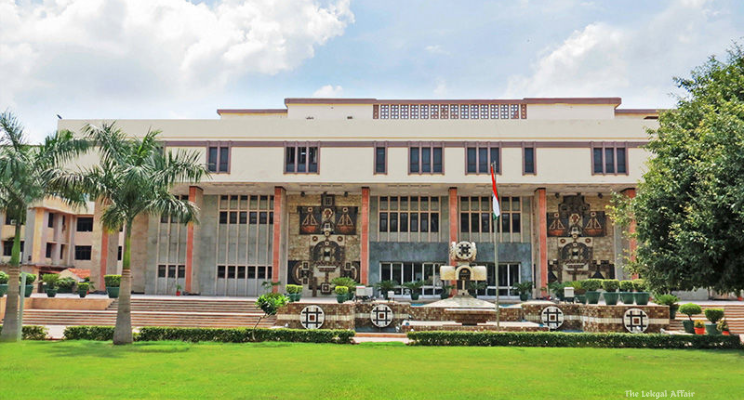
Introduction:
In Union of India & Ors v. Padma Jaiswal IAS (AGMUT:2003) & Other Connected Matters, the Delhi High Court delivered a significant ruling clarifying the scope of disciplinary authority over members of the AGMUT (Arunachal Pradesh, Goa, Mizoram and Union Territories) cadre of the Indian Administrative Service. The Division Bench comprising Justice Anil Kshetarpal and Justice Amit Mahajan adjudicated a batch of petitions filed by the Union Government challenging an order of the Central Administrative Tribunal (CAT), which had held that the Ministry of Home Affairs (MHA) lacked jurisdiction to initiate disciplinary proceedings against IAS officers of the AGMUT cadre. The Tribunal had taken the view that only the State Government where the officer was posted could act as the disciplinary authority under the All India Services (Discipline & Appeal) Rules, 1969. This interpretation effectively curtailed the role of the MHA, despite its administrative control over Union Territories and its established role in handling vigilance matters concerning the AGMUT cadre. The High Court, however, disagreed with this restrictive interpretation and emphasized a broader and more contextual understanding of the statutory framework governing joint cadres. It held that the MHA, acting as a delegate of the Joint Cadre Authority (JCA), is competent to initiate disciplinary proceedings and impose penalties. The judgment is particularly important as it addresses the structural complexities of joint cadres, where officers serve across both States and Union Territories, thereby necessitating a coordinated administrative mechanism. By setting aside the CAT’s findings on jurisdiction, the High Court has reinforced the authority of the Union Government in maintaining discipline within the AGMUT cadre and clarified the interplay between the Indian Administrative Service (Cadre) Rules, 1954, the Joint Cadre Rules, 1972, and the Discipline & Appeal Rules, 1969.
Arguments on Behalf of the Petitioners (Union of India):
The Union of India, representing the Ministry of Home Affairs, challenged the order of the Central Administrative Tribunal on the ground that it had adopted an unduly narrow and fragmented interpretation of the statutory framework governing disciplinary proceedings against IAS officers. The petitioners contended that the Tribunal had erred in concluding that the MHA lacked jurisdiction to initiate such proceedings.
It was argued that the AGMUT cadre is a unique joint cadre comprising multiple States and Union Territories, and therefore cannot be equated with a single-State cadre. The Union emphasized that officers belonging to this cadre serve in diverse administrative units, including Union Territories, which fall directly under the administrative control of the Ministry of Home Affairs. Consequently, it was submitted that the MHA plays a central role in managing the cadre and ensuring administrative discipline.
The petitioners further argued that the concept of a Joint Cadre Authority (JCA), as envisaged under the Indian Administrative Service (Cadre) Rules, 1954, provides the necessary framework for coordinated decision-making in matters relating to cadre management. The MHA, acting as a delegate of the JCA, exercises powers in relation to vigilance and disciplinary proceedings. This arrangement, according to the petitioners, is consistent with the statutory scheme and has been functioning effectively for decades.
The Union also contended that the Tribunal had failed to appreciate the definitional framework under Rule 2(e) of the All India Services (Discipline & Appeal) Rules, 1969, which defines “disciplinary authority” in broad terms to include any authority competent to impose penalties under the Rules. It was argued that this definition does not restrict the power to initiate disciplinary proceedings solely to the State Government where the officer is posted.
Another key submission of the petitioners was that there is no express prohibition in the 1969 Rules against the MHA initiating disciplinary proceedings. In the absence of such a prohibition, the Tribunal’s conclusion that the MHA’s actions amounted to impermissible sub-delegation was unfounded.
The petitioners also highlighted the practical implications of the Tribunal’s interpretation, arguing that it would create administrative incoherence and hinder the effective functioning of the AGMUT cadre. They submitted that a centralized authority like the MHA is essential to ensure uniform standards of discipline and accountability across the cadre.
On these grounds, the Union of India urged the High Court to set aside the Tribunal’s order and uphold the validity of the disciplinary proceedings initiated by the MHA.
Arguments on Behalf of the Respondents (IAS Officers):
The respondent IAS officers defended the order of the Central Administrative Tribunal, maintaining that the MHA lacked the statutory authority to initiate disciplinary proceedings against them. Their primary contention was that the All India Services (Discipline & Appeal) Rules, 1969, clearly vest the power of disciplinary control in the State Government where the officer is posted.
The respondents argued that Rule 7 of the 1969 Rules refers to the “Government of that State” as the competent authority for initiating disciplinary proceedings. According to them, this expression must be interpreted in its plain and ordinary sense, meaning the State Government where the officer is serving at the relevant time.
They further contended that the role of the Joint Cadre Authority (JCA) does not extend to exercising disciplinary powers unless expressly provided for in the rules. The respondents argued that any delegation of such powers to the MHA, without a formal amendment to the 1969 Rules, would amount to impermissible sub-delegation and would be contrary to the principles of administrative law.
The respondents also challenged the validity of the 1989 arrangement under which the MHA was designated as the nodal authority for vigilance matters concerning the AGMUT cadre. They argued that this arrangement lacked statutory backing and could not override the provisions of the 1969 Rules.
Another important aspect of the respondents’ argument was that allowing the MHA to exercise disciplinary powers would blur the lines of accountability and create confusion regarding the chain of command. They submitted that officers are directly accountable to the State Government where they are posted, and therefore, it is only that Government which should have the authority to initiate disciplinary proceedings.
The respondents also expressed concerns about potential arbitrariness and misuse of power if the MHA were allowed to exercise disciplinary authority without clear statutory authorization. They argued that such an interpretation would undermine the safeguards built into the disciplinary framework and expose officers to uncertainty.
On these grounds, the respondents supported the Tribunal’s decision and urged the High Court to uphold its findings.
Judgment of the Court:
The Delhi High Court, after carefully considering the submissions of both sides, delivered a comprehensive judgment setting aside the findings of the Central Administrative Tribunal on the issue of jurisdiction. The Court held that the Tribunal’s conclusion that the Ministry of Home Affairs lacked authority to initiate disciplinary proceedings was legally unsustainable.
At the outset, the Court observed that the Tribunal had adopted an isolated and fragmented reading of the All India Services (Discipline & Appeal) Rules, 1969, without considering the broader statutory framework governing joint cadres. The Court emphasized the need for a harmonious and contextual interpretation of the relevant rules, taking into account the Indian Administrative Service (Cadre) Rules, 1954, and the Joint Cadre Rules, 1972.
The Court rejected the respondents’ contention that the expression “Government of that State” in Rule 7 of the 1969 Rules refers exclusively to the State Government where the officer is posted. Instead, it held that this expression must be understood in the context of the cadre to which the officer belongs. In the case of a joint cadre like AGMUT, the competent authority is the Joint Cadre Authority constituted under the 1954 Rules.
The Court further held that the powers of the Joint Cadre Authority can be exercised through its delegate, and in the case of the AGMUT cadre, the Ministry of Home Affairs acts as such a delegate. The designation of the MHA as the nodal authority for vigilance and disciplinary matters was found to be consistent with administrative coherence and the statutory framework.
Addressing the issue of sub-delegation, the Court held that the respondents had failed to demonstrate any express prohibition in the 1969 Rules against the delegation of disciplinary powers. In the absence of such a prohibition, the plea of impermissible sub-delegation could not be sustained.
The Court also noted that members of the AGMUT cadre serve in both States and Union Territories, and therefore, a centralized mechanism for disciplinary control is necessary to ensure uniformity and efficiency. The role of the MHA in this regard was found to be both logical and legally valid.
The Court categorically held that the Tribunal’s interference at the threshold, on the ground of lack of jurisdiction, was unwarranted. It observed that such interference had the effect of prematurely terminating disciplinary proceedings without allowing them to be examined on merits.
Accordingly, the Court set aside the Tribunal’s order to the extent that it held the initiation of disciplinary proceedings by the MHA to be without jurisdiction. The High Court upheld the competence of the MHA to initiate and pursue disciplinary action against AGMUT cadre officers.