


Introduction:
In Rehabilitation Plantations Ltd. v. State of Kerala, decided in OTC No. 1 of 2025, the Kerala High Court, comprising Justice A. Muhamed Mustaque and Justice Harisankar V. Menon, addressed a long-standing and contentious issue in agricultural taxation—whether expenditure incurred on the upkeep, maintenance, replantation, and replacement of rubber trees constitutes capital expenditure or revenue expenditure for the purpose of deduction under the Income Tax Act, 1961. The case arose from repeated rounds of litigation before the Income Tax Appellate Tribunal, which had rejected the assessee’s claim for deduction by relying on an earlier Division Bench judgment of the same High Court. However, the legal landscape had materially changed following a Full Bench decision of the Kerala High Court in 2023, which categorically held that such expenditure is revenue in nature and allowable under Section 37 of the Income Tax Act, 1961. The present judgment therefore assumes critical importance, as it harmonises the application of tax law with the authoritative interpretation laid down by the Full Bench and restores the assessee’s entitlement to deduction in respect of recurring plantation expenses.
Arguments:
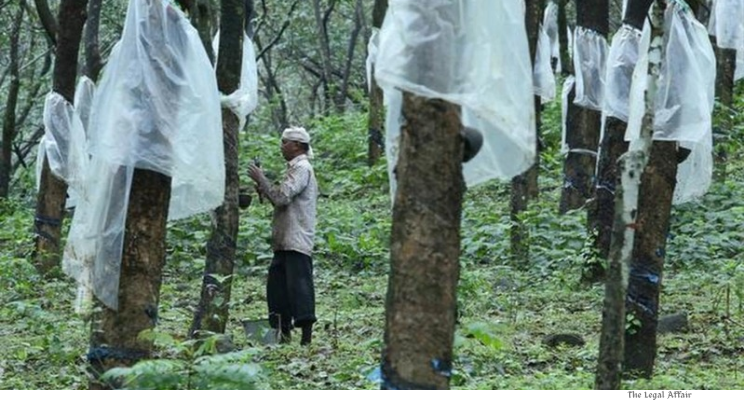
On behalf of the assessee, it was contended that the expenditure incurred on rubber plantations towards upkeep, maintenance, replantation, and replacement of trees is an inherent and recurring aspect of running a plantation business and does not result in the creation of any new capital asset. The assessee argued that rubber plantations are living, biological assets that require continuous care, replacement of old or unproductive trees, and replantation to sustain yield and income. Such expenses, according to the assessee, are incurred wholly and exclusively for the purposes of business and squarely fall within the scope of Section 37 of the Income Tax Act, 1961, which allows deduction of all business expenditure not being capital or personal in nature.
The assessee further submitted that the Income Tax Appellate Tribunal, in the first round of proceedings, rejected its claim solely by relying on the Division Bench judgment of the Kerala High Court in M/s. Rehabilitation Plantations Ltd. v. Commissioner of Income Tax (2012), which had taken the view that replantation expenditure was capital in nature. However, it was pointed out that this very judgment had subsequently been doubted by another Division Bench, leading to a reference to a Full Bench. The Full Bench of the Kerala High Court in 2023 had conclusively held that the earlier Division Bench judgment did not lay down the correct law and that expenditure on upkeep and maintenance of rubber trees is revenue expenditure eligible for deduction under Section 37.
Relying heavily on the Full Bench judgment reported as (2023) 450 ITR 626 (Ker) [FB], the assessee contended that once the legal foundation of the earlier judgment had been removed, the Tribunal was duty-bound to reconsider the matter. The assessee argued that the Tribunal’s refusal to review its earlier order, even after the Full Bench decision, amounted to a manifest error of law, as it continued to apply a precedent that had been expressly declared not good law. The assessee therefore sought judicial intervention to correct this error and restore its statutory entitlement to deduction.
On the other hand, the Revenue/Department, represented by its counsel, supported the orders of the Tribunal. It was argued that the Tribunal had rightly rejected the review petitions, as review jurisdiction is limited and cannot be invoked merely because a subsequent judgment has taken a different view. The Department contended that the assessee was essentially seeking a re-hearing of the matter under the guise of a review, which is impermissible in law. According to the Revenue, the Tribunal’s original decision was based on the prevailing law at the time, and the subsequent Full Bench judgment could not automatically invalidate earlier orders unless specifically reopened through appropriate appellate proceedings.
The Revenue further attempted to distinguish between upkeep expenditure and replantation or replacement expenditure, arguing that while routine maintenance may be revenue in nature, replantation involves enduring benefit and should therefore be treated as capital expenditure. It was also submitted that Rule 7A of the Income Tax Rules, 1962, which deals with income from rubber plantations, envisages a specific computation mechanism, and the assessee’s claim did not align with the statutory scheme.
Judgment:
After carefully considering the rival submissions and the legal position, the Kerala High Court allowed the petition filed by the assessee and decisively ruled in its favour. The Bench noted that there was no dispute that the Tribunal had rejected the assessee’s claim by strictly following the principles laid down in the 2012 Division Bench judgment in Rehabilitation Plantations, which had since been examined and overturned by a Full Bench of the same High Court.
The Court placed significant reliance on the Full Bench judgment of 2023, which had unequivocally held that expenditure incurred on the upkeep and maintenance of rubber trees, including replantation and replacement, is revenue expenditure and therefore allowable as a deduction under Section 37 of the Income Tax Act, 1961. The Full Bench had further categorically declared that the earlier Division Bench ruling “does not lay down the correct proposition of law”, thereby removing its precedential value.
The High Court held that once the Full Bench had authoritatively settled the issue, the Tribunal was not justified in rejecting the assessee’s review petitions by continuing to rely on a judgment that had been expressly declared not good law. The Bench observed that judicial discipline requires all subordinate forums to follow the law as declared by the jurisdictional High Court, particularly when pronounced by a Full Bench.
The Court also reaffirmed the principle that plantation activities are continuous and cyclical in nature, and that replantation or replacement of old trees does not result in the creation of a new capital asset but merely ensures the sustainability of the existing business. Such expenditure, the Court held, is integrally connected with day-to-day business operations and cannot be characterised as capital in nature.
In view of these findings, the Bench allowed the petition, set aside the Tribunal’s rejection of the assessee’s claim, and held that the expenditure incurred on upkeep, maintenance, replantation, and replacement of rubber trees is allowable as a revenue deduction under Section 37 of the Income Tax Act, 1961.