


Introduction:
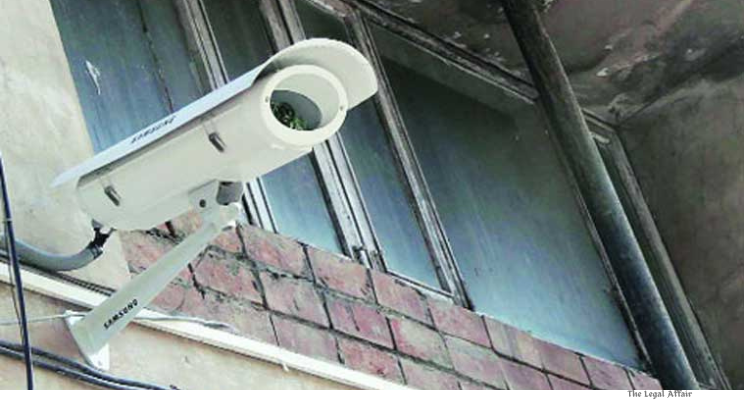
In the case Sivasankaran @ Sankarankutty and Ors. v. State of Kerala & Others, the Kerala High Court was confronted with a sensitive conflict between the right to privacy and the right to security when a group of petitioners approached the Court alleging that a CCTV camera installed by their neighbours was positioned in a manner that intruded into the private corners of their home such as the bedroom and dining room, thereby violating their fundamental right to privacy guaranteed under Article 21 of the Constitution. The petitioners invoked judicial scrutiny on the ground that such surveillance amounted to unwarranted interference with their personal lives and relied on earlier precedents where misuse of CCTV cameras for snooping had been deprecated by the Court. Justice N. Nagaresh, while examining the rival interests at play, acknowledged that privacy is a constitutionally protected right as affirmed in K.S. Puttaswamy v. Union of India, yet also observed that this right coexists with, and must sometimes yield to, competing rights such as another individual’s right to security, particularly when that security is threatened due to circumstances involving prior allegations of crime. The respondents, specifically respondents 5 to 7, defended their installation as a necessary protective measure for an elderly woman living alone who was also the complainant in a criminal case alleging serious offences involving the first petitioner. Against this background, the Court was tasked with determining whether privacy had indeed been violated or whether the camera served a legitimate protective purpose satisfying the test of proportionality.
Arguments of Both Sides:
The petitioners forcefully contended that the CCTV camera installed by their neighbours was strategically positioned in a manner enabling direct visual access into highly private areas of their residence including the bedroom and dining room, thereby amounting to intrusive surveillance that breached the boundaries of constitutionally protected privacy under Article 21. They asserted that such monitoring far exceeded what could reasonably be termed security-oriented surveillance and instead constituted an impermissible invasion into their domestic life, amounting to digital snooping. To strengthen their position, they relied heavily on the judgment in Agnes Michael v. Cheranellore Grama Panchayat, where the Kerala High Court held that individuals cannot, under the guise of installing CCTV cameras for security, be allowed to pry into the private affairs of neighbours, and urged that the same principle applied squarely to their situation. Conversely, respondents 5 to 7, represented by counsel, disputed the allegation of unlawful intrusion and clarified that the camera was installed solely to ensure the security of the fifth respondent, an 80-year-old senior citizen who lived alone and faced a credible security threat as she was the complainant in a criminal case alleging attempt to rape and other serious offences under Sections 354, 354A(1), 354B, 511, and 376 IPC against the first petitioner. The respondents emphasized that the installation was a protective measure necessitated by the gravity of the criminal allegations and not an attempt to capture or monitor the private movements of the petitioners. They asserted that no angle of the CCTV camera enabled visibility into the petitioner’s private spaces and argued that unless the petitioners established clear proof of snooping, the Court ought not interfere with their right to ensure personal safety. They further submitted that security measures, particularly for vulnerable individuals, must be respected unless demonstrably misused.
⚖️ Court’s Judgment:
Justice N. Nagaresh of the Kerala High Court delivered an elaborate and balanced judgment that reconciled competing fundamental rights while evaluating the factual and legal context with precision. The Court reiterated the principle laid down in K.S. Puttaswamy (Retd.) v. Union of India that the right to privacy is an intrinsic element of Article 21 and possesses both intrinsic value, linked to personal autonomy and dignity, and community value, which recognizes that constitutional rights operate within a larger societal framework where the freedoms of individuals may intersect or even conflict. The Court observed that privacy is not an absolute right and may be restricted if the restriction satisfies the test of proportionality, meaning that the measure must be necessary, rationally connected to the objective sought, minimally intrusive, and proportionate to the underlying aim. In applying this doctrine, the Court held that the installation of the CCTV camera by respondents 5 to 7 was directly linked to the right to security of the fifth respondent, a senior citizen who lived alone and was the complainant in a pending criminal case against the first petitioner involving serious allegations of sexual offences. The Court noted that this context provided a legitimate, pressing, and reasonable justification for the installation of surveillance equipment. It further observed that the petitioners had failed to produce any material establishing that the camera was pointed at or capable of recording the interior of their home, and mere apprehension without evidence could not form the basis for judicial interference. Citing the principle that privacy and security must be delicately balanced, the Court emphasized that unless it was conclusively shown that the respondents were using the CCTV camera to snoop into the petitioners’ private affairs, the Court could not compel its removal. The reliance placed by the petitioners on Agnes Michael was distinguished on facts, as that case involved proven misuse of CCTV angles, whereas in the present case the petitioners’ allegation lacked evidentiary support. Justice Nagaresh underscored that the right to security, which also flows from the right to life under Article 21, must be afforded equal protection, especially in circumstances where a vulnerable individual faces potential danger given the history of criminal allegations. Ultimately, the Court concluded that the CCTV camera was installed for legitimate safety reasons and that the petitioners had not demonstrated any actual or potential violation of privacy. Consequently, the writ petition was dismissed, and all prayers for the removal of the CCTV camera were rejected.