


Introduction:
In the case Association for Democratic Reforms and Others v. Election Commission of India, W.P.(C) No. 640/2025 (and connected cases), the Supreme Court of India, through a bench of Justices Surya Kant and Joymalya Bagchi, passed a significant order on August 22, 2025, while dealing with petitions challenging the Special Intensive Revision (SIR) of electoral rolls undertaken by the Election Commission of India (ECI) in Bihar ahead of the Assembly elections scheduled in November. The matter was brought before the Court by various petitioners including the Association for Democratic Reforms (ADR), People’s Union for Civil Liberties (PUCL), political parties such as Rashtriya Janata Dal (RJD), Indian National Congress (INC), Communist Party of India (Marxist), CPI(ML) Liberation, CPI, Nationalist Congress Party (NCP), and others, represented by senior advocates Kapil Sibal, Dr Abhishek Manu Singhvi, Gopal Sankaranarayanan, Prashant Bhushan, Vrinda Grover, and activist Yogendra Yadav. The central issue revolved around the alleged large-scale exclusion of nearly 65 lakh voters from the draft electoral rolls in Bihar, with petitioners raising concerns about transparency, legality, and the rights of voters, particularly migrant workers and marginalized communities. The Court’s intervention was crucial in safeguarding the democratic principle of universal suffrage and preventing disenfranchisement.
Arguments by the Petitioners and Opposition to Bihar SIR:
The petitioners mounted a strong challenge to the legality and fairness of the Bihar Special Intensive Revision, arguing that the exercise was arbitrary, exclusionary, and conducted without adequate transparency. Senior Advocate Kapil Sibal, appearing for RJD MP Manoj Jha, argued that the very scale of exclusions—nearly 65 lakh voters—raised alarming questions about the methodology of the Election Commission. He pointed out that the deletion of names was being carried out en masse, with inadequate disclosure of reasons, thereby shifting the burden on voters to prove their eligibility, which is contrary to the Representation of the People Act, 1950. Dr Abhishek Manu Singhvi, representing PUCL and other organizations, further emphasized that electoral rolls are the foundation of a democracy, and mass deletions without due process risk undermining the legitimacy of elections. He contended that the Constitution enshrines the principle of free and fair elections under Article 324, and any arbitrary deprivation of voting rights amounts to a violation of the basic structure doctrine.
Advocate Prashant Bhushan, representing ADR, argued that Bihar has a significant population of migrant workers, many of whom work outside the state. Insisting that such individuals may not be physically present to submit claims and objections in person, he urged the Court to permit online applications for inclusion in the rolls. He highlighted that many political parties do not have Booth Level Agents (BLAs) in all constituencies, and even the largest opposition party, RJD, has BLAs in only about half the constituencies. In such circumstances, excluding migrant workers and voters without BLAs’ support would create large-scale disenfranchisement. Vrinda Grover, appearing for an organization of voters, pointed out that despite Aadhaar being accepted as proof of identity, Booth Level Officers (BLOs) were refusing to acknowledge Aadhaar as a standalone document, insisting on submission of one of eleven documents specified in the SIR framework. She contended this practice was arbitrary and in violation of the Court’s earlier directions.
Advocate Faouzia Shakil requested that the September 1 deadline for submitting forms be extended, given that the lists of excluded voters were published only on August 19, leaving very little time for affected individuals to respond. She also emphasized that BLOs were not issuing acknowledgment receipts when objections or applications were submitted physically, leaving voters and political parties without proof of their efforts to be included in the rolls. Petitioners argued that the ECI’s refusal to publish reasons for deletions earlier was a deliberate attempt to curtail transparency, and that the Court’s directions on August 14 requiring the publication of names of excluded voters along with reasons were still not being adequately complied with.
Senior Advocate Gopal Sankaranarayanan went a step further to question the legality of the entire SIR exercise itself. He argued that Section 21(3) of the Representation of the People Act, 1950, does not authorize the ECI to conduct mass revisions in a manner that undermines citizens’ right to vote. He contended that the ECI had acted beyond its powers, and unless judicially scrutinized, this would set a dangerous precedent for future elections. In support of this argument, he also cited instances where individuals were wrongly declared dead in Bihar’s draft rolls. Political activist Yogendra Yadav and others expressed concern that the deletions disproportionately affected the poor, marginalized, and minority communities, thereby undermining their political voice.
Arguments by the Election Commission of India:
The Election Commission of India, represented by Senior Advocate Rakesh Dwivedi, strongly defended the Bihar SIR exercise, terming the allegations exaggerated and politically motivated. Dwivedi submitted that the ECI had already filed a compliance affidavit, stating that the names of excluded voters along with reasons for exclusion had been published on the official websites of District Electoral Officers as well as on polling booths. He emphasized that the Court’s directions of August 14 had been fully complied with, and that the lists were now accessible to political parties and BLAs. Dwivedi stressed that the ECI had also shared the lists directly with the BLAs of recognized political parties, but no substantial objections had been raised.
In a pointed criticism of the petitioners, Dwivedi asserted that although there were about 1.6 lakh BLAs appointed by 12 recognized political parties in Bihar, only two objections had been filed, which showed a lack of seriousness and cooperation from political parties. He argued that instead of aiding the revision process, parties were using the issue to generate fear and political narratives. He noted that over 2 lakh forms had already been submitted by new voters for inclusion, showing that the process was open and functioning. “They are only whipping up fear for their political interests,” Dwivedi told the Court.
When it was suggested that Aadhaar cards should be accepted as a standalone document, Dwivedi countered that the Election Commission was already allowing Aadhaar along with eleven other specified documents, and any refusal by BLOs to accept Aadhaar alone was not systemic but an inadvertent error. He urged the Court to repose trust in the ECI and allow some more time to complete the process, asserting that “crores are filing documents, all bogus stories being circulated.” Dwivedi further emphasized that it was the duty of political parties to cooperate with the ECI, especially when they had thousands of BLAs available to help citizens verify documents. According to him, if each BLA verified 10 documents a day, the entire process could be completed in less than a week.
The Court’s Judgment and Directions:
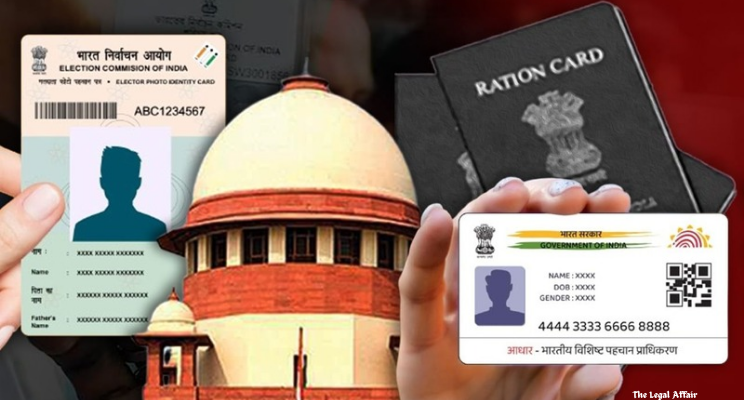
After hearing both sides, the bench of Justices Surya Kant and Joymalya Bagchi delivered a balanced order, recognizing the importance of preventing large-scale disenfranchisement while ensuring the integrity of the electoral roll revision process. The Court held that persons excluded from the draft electoral roll in Bihar could now submit applications for inclusion not only physically but also through online modes. The Court clarified that any of the eleven documents recognized by the ECI or an Aadhaar card would be sufficient for filing inclusion claims. This was a significant relief to migrant workers and others unable to submit forms physically.
The Court also directed all 12 recognized political parties in Bihar to instruct their Booth Level Agents to actively assist voters in filing applications for inclusion, both online and offline. It impleaded all those political parties as respondents in the matter, if they were not already petitioners, thereby ensuring accountability across the political spectrum. Expressing surprise at the low number of objections filed by BLAs despite their huge presence, the Court noted the allegation by political parties that BLOs were not accepting objections or issuing acknowledgment receipts. To address this, the Court ordered that BLOs must acknowledge receipt of objections or applications wherever they are physically submitted.
Reiterating its earlier directions of August 14, the Court recorded that the lists of excluded voters along with reasons for exclusion had been published on websites and polling booths, and also shared with political parties. It directed the ECI to continue giving wide publicity through newspapers, electronic, and social media to ensure that excluded persons were aware of the opportunity to file claims for inclusion. The Court stressed that the revision exercise should not result in the mass exclusion of genuine voters and highlighted its earlier oral observation that while there may be “en masse exclusion,” the approach should be “en masse inclusion.”
The bench emphasized that the right to vote, though statutory, is the bedrock of democracy, and its arbitrary denial cannot be tolerated. It observed that the responsibility for safeguarding this right lies not only with the ECI but also with political parties, civil society, and the administration. By permitting online applications and Aadhaar as a valid document, the Court ensured greater accessibility and reduced barriers to inclusion. By directing acknowledgment receipts for objections, it ensured transparency and accountability in the process. And by roping in all recognized political parties as respondents, it created collective responsibility for the accuracy and fairness of Bihar’s electoral rolls.
The Court’s order also indicated that it will continue to monitor the progress of the revision and would not hesitate to step in further if the process appears to create systemic disenfranchisement. Importantly, it recognized that elections in Bihar, scheduled for November, must proceed on the basis of an electoral roll that inspires confidence and fairness. The Court’s intervention, therefore, was aimed not at undermining the ECI’s autonomy but at ensuring that its actions align with constitutional and statutory mandates, protecting both the integrity of the electoral process and the rights of voters.