


Introduction:
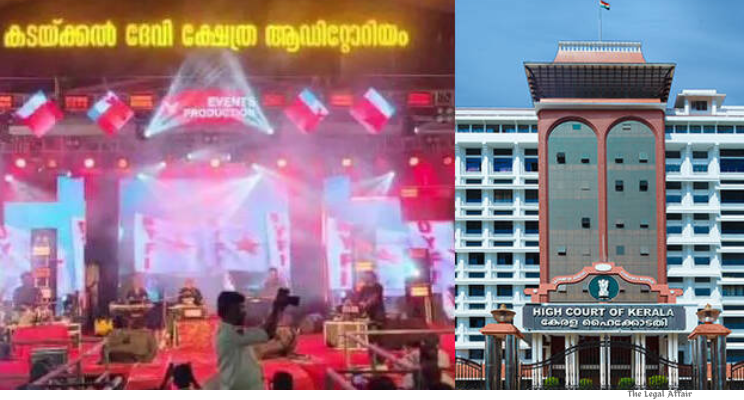
On June 2, 2025, the Kerala High Court, comprising Justice Anil K. Narendran and Justice P.V. Balakrishnan, addressed concerns regarding unauthorised fund collection and political activities during the Kadakkal Devi Temple festival in Kollam district. The court scrutinised the role of the ‘Akosha Committee,’ allegedly formed to conduct festivals, in collecting money from devotees and facilitating performances with political overtones.
Petitioner’s Perspective:
Advocate Vishnu Sunil Panthalam, a devotee of the Kadakkal Devi Temple, filed a writ petition expressing grievance over the performance of revolutionary songs by the Democratic Youth Federation of India (DYFI) during the temple festival on March 10, 2025. He contended that such performances, accompanied by political party flags, violated the sanctity of the temple and hurt the sentiments of devotees. The petitioner argued that the temple premises were misused for political purposes, contravening the principles governing religious institutions.
Respondent’s Perspective:
The Akosha Committee, responsible for organising the festival, was identified as having brought the singer to the temple premises. The committee’s counsel stated that the singer performed songs requested by the public. However, the court questioned the committee’s authority and composition, noting that it included individuals beyond the temple’s advisory committee. The Travancore Devaswom Board (TDB), overseeing the temple, informed the court of its decision to disband the temple advisory committee following the controversy. The TDB stated that until further orders, the temple’s activities would be managed by its subgroup officer under the supervision of the assistant devaswom commissioner.
Court’s Observations and Judgment:
The Kerala High Court orally questioned the Akosha Committee’s authority to collect money from devotees, labelling such actions as a “criminal offence.” The court emphasised that only the temple advisory committee holds the legitimate authority to manage temple affairs and collect funds. It expressed concern over the inclusion of individuals outside the advisory committee in the Akosha Committee and the lack of proper authorisation for their actions.
The court also highlighted the inappropriateness of political performances within temple premises, stating that temples should not be used for political purposes. It underscored the need to preserve the sanctity and traditional character of religious institutions. The court directed the Travancore Devaswom Board to ensure that no activities affecting the sanctity of temples are permitted during festivals or other events.
Furthermore, the court noted that the applications produced for the Akosha Committee’s membership were outdated, filed in 2012. It instructed the TDB’s standing counsel to produce the latest applications made by the additional respondent within the past two years. The matter was posted for further consideration after ten days.
Conclusion:
The Kerala High Court’s intervention in the Kadakkal Devi Temple case underscores the judiciary’s role in safeguarding the sanctity of religious institutions. By questioning unauthorised fund collection and political activities within temple premises, the court reaffirmed the importance of adhering to established protocols and preserving the spiritual essence of religious festivals. The directive to the Travancore Devaswom Board to oversee temple activities and prevent misuse serves as a reminder of the responsibilities entrusted to religious governing bodies. This case highlights the need for transparency, accountability, and respect for religious sentiments in managing temple affairs.