


Introduction:
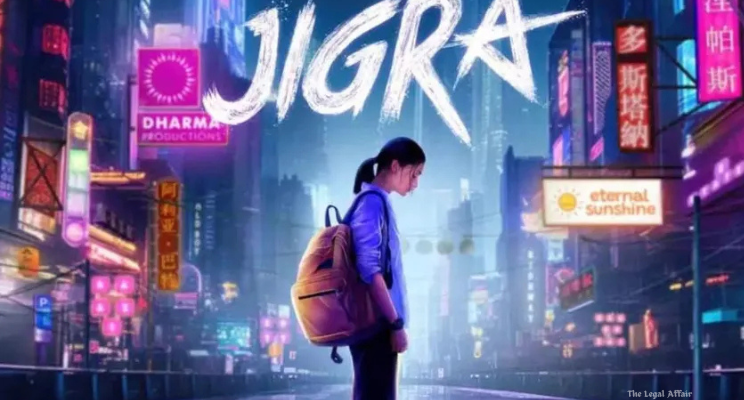
In an interim order passed on October 10, 2024, the Jodhpur Bench of the Rajasthan High Court temporarily lifted the stay imposed by a commercial court that had restrained the release of Dharma Productions’ film Jigra, starring Alia Bhatt. The movie, originally scheduled for release on October 11, 2024, was delayed after the respondent, Bhallaram Choudhary, claimed trademark infringement over the title Jigra and secured an injunction from the Commercial Court at Jodhpur on October 8. Dharma Productions challenged the injunction in the High Court, arguing that no trademark violation had occurred. The division bench, comprising Justice Pushpendra Singh Bhati and Justice Munnuri Laxman, granted interim relief to the production house, staying the commercial court’s order until the next hearing on October 16.
Factual Overview:
The movie Jigra, produced by Dharma Productions, was set to release on October 11, 2024, but the Commercial Court in Jodhpur stayed its release, citing trademark infringement claims made by Bhallaram Choudhary. Choudhary argued that he held the trademark for Jigra in the domain of education and entertainment, which he believed extended to the film’s title. The Commercial Court granted an interim injunction to restrain the movie’s release until the matter could be fully adjudicated. In response, Dharma Productions moved the Rajasthan High Court, contesting the Commercial Court’s decision.
In its appeal, the production house, represented by a team of advocates led by senior counsel Vikas Balia, argued that using the name Jigra as a film title did not amount to trademark infringement because they were not engaged in “trade in goods and services” under that name. They further argued that the respondent’s trademark registration in the field of education and entertainment did not justify a stay on the film’s release, as the title of a movie falls under a different category of intellectual property rights.
The case raised important legal questions concerning the overlap of trademark law and creative expression, with the High Court tasked with balancing the rights of both parties under the framework of the law. The Court ultimately granted an interim stay on the Commercial Court’s injunction, allowing the release of the movie pending further proceedings.
Petitioner’s (Dharma Productions) Arguments:
Represented by senior advocate Vikas Balia, along with a team of advocates including Abhilasha Bora, Akanksha Choudhary, Khushbu Choudhary, Vikas Siddhawat, Mitakshi, and Prithvi Singh, the appellant, Dharma Productions, presented several key arguments:
- No Trademark Infringement:
The primary argument put forth by the appellant was that naming a movie Jigra does not amount to trademark infringement under the Trademarks Act, 1999, as they were not conducting any “trade in goods and services” under that name. Dharma Productions asserted that their company was producing a movie, not offering goods or services under the brand Jigra. Hence, the use of the term in the context of a film title could not be classified as a violation of the respondent’s trademark.
- No Likelihood of Confusion:
The appellant further argued that there was no likelihood of confusion among consumers regarding the use of the term Jigra in the film’s title. They contended that a movie title does not fall within the typical ambit of trademark disputes in the field of education and entertainment, and that Choudhary’s claim was based on an overly broad interpretation of his trademark rights.
- Impact of Stay on Financial Interests:
The counsel for the appellant also argued that the stay on the release of Jigra would cause significant financial harm to Dharma Productions. They pointed out that films involve significant investment, and delays in release could lead to irreversible financial damage. They also argued that if any violation of rights was proven in the future, damages or compensation could be an appropriate remedy rather than restraining the film’s release.
Respondent’s (Bhallaram Choudhary) Arguments:
On behalf of the respondent, Bhallaram Choudhary, senior advocate R.N. Mathur, along with advocates Falgun Buch, O.P. Mehta, V.D. Gaur, Gopal Krishna Chhangani, and Simran Mehta, presented counter-arguments to justify the Commercial Court’s interim injunction:
- Trademark Registration in Education and Entertainment:
The respondent argued that he held a registered trademark for the term Jigra in the field of education and entertainment. According to the respondent, this registration extended to creative works such as films, as they fall under the broader umbrella of entertainment. Therefore, Choudhary claimed that the use of the term Jigra as a movie title infringed upon his rights, and that he was entitled to protection under trademark law.
- Potential Damage to Business Interests:
The respondent further claimed that the release of the movie under the title Jigra would cause harm to his business interests, as it would dilute the distinctiveness of his trademark in the field of education and entertainment. He argued that his brand would suffer if a major film with a similar name were to be released, and that allowing the movie to proceed without protection of his trademark rights could set a damaging precedent.
- Right to Injunctive Relief:
The respondent’s legal team contended that the stay imposed by the Commercial Court was appropriate, as it prevented potential harm before the final resolution of the case. They emphasized that injunctive relief was necessary to prevent irreparable harm to Choudhary’s trademark rights, and that the Commercial Court was within its rights to issue an interim injunction pending a full adjudication of the matter.
Court’s Judgment:
After carefully considering the arguments from both sides, the Rajasthan High Court’s division bench of Justice Pushpendra Singh Bhati and Justice Munnuri Laxman granted interim relief to Dharma Productions by staying the Commercial Court’s order.
- Balance of Convenience:
The High Court applied the threefold test of “prima facie case, irreparable loss, and balance of convenience” to determine whether the stay should be lifted. The Court found that Dharma Productions had a prima facie case in their favor. The Court observed that the movie’s title, Jigra, was unlikely to infringe upon the respondent’s trademark rights, as the appellant was not conducting business in the name Jigra but under the name Dharma Productions. The Court reasoned that the mere use of a common word in the title of a movie did not equate to a violation of the respondent’s trademark in the realm of goods and services.
- Financial Harm to the Appellant:
The Court acknowledged that restraining the release of the movie would likely cause significant financial harm to Dharma Productions, which had invested heavily in the film’s production and marketing. On the other hand, the respondent’s concerns could be addressed through damages or monetary compensation if a trademark violation was proven at a later stage. The Court noted that the appellant could not be subjected to financial loss due to an interim injunction that might not be justified once the matter was fully adjudicated.
- Trademark Laws in the Context of Films:
The bench emphasized that the use of a word as a movie title did not necessarily infringe upon trademark rights in goods and services. The Court noted that the title Jigra did not create confusion or mislead the public into associating the film with the respondent’s business. Therefore, the Court was “prima facie convinced” that the use of the word Jigra as a movie title did not infringe upon the respondent’s trademark rights in the field of education and entertainment.
- Remedy Through Damages:
The Court further stated that if, upon further examination, any infringement of the respondent’s trademark was established, the appropriate remedy would be the award of damages or monetary compensation. The Court held that it was more equitable to allow the movie’s release and address any infringement claims through compensation, rather than imposing an interim stay that could cause substantial financial loss to the appellant.
In conclusion, the High Court stayed the Commercial Court’s order, allowing Jigra to be released on its scheduled date, October 11, 2024. The Court also scheduled the next hearing for October 16, 2024, to address the matter in greater detail once the pleadings and affidavits were completed.