


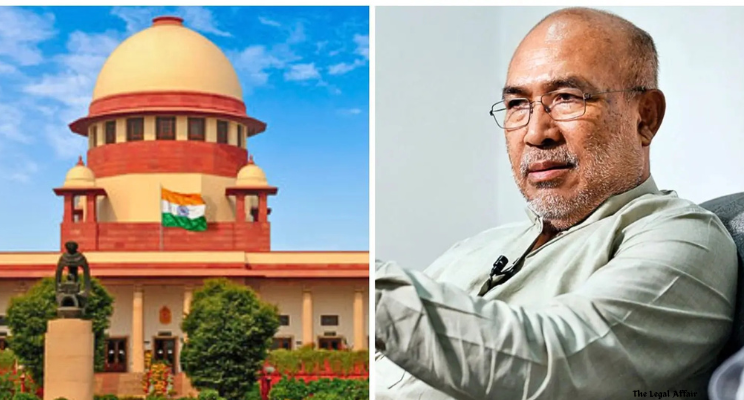
Introduction:
In Kuki Organization for Human Rights Trust v. Union of India, W.P.(C) No. 702/2024, a Bench of the Supreme Court comprising Justice Sanjay Kumar and Justice K. Vinod Chandran was called upon to consider a sensitive and high-stakes plea seeking a court-monitored investigation into an alleged 48-minute audio recording purportedly implicating the former Chief Minister of Manipur, N. Biren Singh, in the ethnic violence that erupted in the State in 2023, violence which had already drawn national and international concern due to its scale, duration, and human impact; the petitioner, a human rights organization representing interests of affected communities, approached the Court alleging that the audio recording contained conversations that, if found to be authentic and attributable to the former Chief Minister, would raise grave questions regarding constitutional governance, rule of law, and accountability of public authorities during communal unrest, and therefore warranted an independent, credible, and scientifically reliable forensic examination under the supervision of the Supreme Court itself; the background to the present direction lay in earlier proceedings where audio clips had been sent to the National Forensic Science University (NFSU), Gandhinagar, which in November 2025 informed the Court that the clips showed signs of tampering and were not scientifically suitable for voice comparison, making it impossible to render any opinion on whether the voice in the recording matched the admitted voice samples of the former Chief Minister; the petitioner, however, disputed that conclusion and asserted that what had been examined earlier were only short, edited excerpts and not the complete 48-minute conversation, thereby rendering the earlier forensic exercise incomplete and unreliable; it was in this context that the Supreme Court, while continuing to monitor the matter, took up the issue of whether the entire recording, along with all admitted voice samples and additional audio furnished by the petitioner, should now be forwarded afresh to the NFSU for comprehensive forensic analysis, so that the Court could have before it an authoritative and scientifically credible report; the proceedings thus involved not merely a technical dispute over audio samples, but also broader constitutional concerns about investigative fairness, transparency of State action, and the judiciary’s role in ensuring that allegations of serious public wrongdoing are examined with procedural integrity, especially when ordinary investigative mechanisms are alleged to be inadequate or compromised.
Arguments:
On behalf of the petitioner, senior advocate Prashant Bhushan advanced a forceful submission that the case had been listed before the Supreme Court on nearly ten occasions and that on each date, government counsel had been present, thereby negating any suggestion that the authorities were unaware of the existence or relevance of the complete 48-minute recording; he submitted that the writ petition itself contained a transcript of the entire conversation, which clearly demonstrated that the petitioner had from the very beginning relied on the full recording and not on any truncated or selectively edited clips; according to the petitioner, it was not merely a procedural lapse but a serious investigative failure that earlier only short excerpts had been sent to the forensic laboratory, resulting in an inconclusive report that conveniently avoided a definitive voice comparison; Bhushan argued that this approach undermined the very purpose of forensic science, which is to arrive at objective truth, and that partial or edited samples are inherently unsuitable for reliable voice matching, particularly when allegations involve manipulation or tampering; he further contended that the responsibility to seek the full recording lay equally, if not more, with the investigating authorities and the State, especially when the matter was under the direct scrutiny of the Supreme Court, and that repeated appearances of government counsel in Court without seeking or ensuring transmission of the full recording demonstrated a lack of seriousness and diligence; when questioned by the Bench as to why the full recording had not been formally served on the respondents, Bhushan responded that there had been no specific direction from the Court requiring formal service and that in any case, the authorities could easily have requested it, particularly given the gravity of the allegations and the repeated hearings, and that procedural technicalities should not be used to obstruct substantive justice; he emphasized that the credibility of the investigation itself was under challenge, and therefore only a court-directed, court-monitored forensic exercise involving the complete audio material could restore public confidence and ensure that the truth, whatever it may be, is brought on record through scientific methods rather than speculation or politically influenced conclusions.
On behalf of the State, Additional Solicitor General Aishwarya Bhati submitted that the State had received the full recording only after the last hearing and that prior to that, only limited audio clips had been forwarded to the forensic laboratory, which explained why the earlier report from the NFSU indicated signs of tampering and inability to conduct reliable voice comparison; she argued that it would be incorrect to attribute mala fides or deliberate suppression to the State machinery when the petitioner had not formally served the complete recording upon the respondents earlier, and that the State could not be faulted for forwarding to the laboratory only what it had received; the ASG sought to convey that the State was not resisting forensic examination of the full audio and that once the complete recording had been made available, it could indeed be sent for fresh examination, but that procedural fairness required recognition of the fact that investigative agencies act on materials formally placed before them; she also sought to counter the implication that the State had intentionally avoided full scrutiny by pointing out that the matter was sub judice and that the State was complying with all directions issued by the Court from time to time; at the same time, the State maintained that forensic examination must be carried out strictly in accordance with scientific protocols, and that any report must be allowed to speak for itself without presuppositions or media-driven conclusions; the exchange between the parties thus reflected two sharply divergent narratives: one portraying investigative apathy or manipulation, and the other asserting procedural limitations and absence of deliberate wrongdoing, both of which underscored why the Court considered it necessary to intervene decisively to settle the factual controversy through a fresh, comprehensive forensic process.
Judgment:
After hearing both sides, the Bench of Justice Sanjay Kumar and Justice K. Vinod Chandran adopted a course that balanced procedural fairness with the need for credible fact-finding, and directed that the entire 48-minute conversation in question, along with the admitted voice recordings of the former Chief Minister and all other voice recordings furnished by the petitioner, be forwarded to the National Forensic Science University, Gandhinagar, for forensic examination, thereby ensuring that the laboratory would have before it the complete and unedited material necessary for scientifically valid voice comparison; the Court specifically recorded that the entire conversation and all admitted samples were available, and mandated that all such recordings supplied by the learned counsel for the petitioner must be included in the material forwarded to the NFSU, thereby eliminating any scope for future disputes regarding incompleteness of samples; recognizing the public importance and sensitivity of the matter, the Court further directed the NFSU to expedite the process and submit its report to the Supreme Court in a sealed cover, indicating that the findings would first be examined judicially before any further directions are issued, thus preserving both the integrity of the investigation and the rights and reputations of individuals concerned; significantly, the Court did not at this stage comment on the merits of the allegations or on the correctness of the earlier forensic opinion, but confined itself to ensuring that a fresh, comprehensive, and procedurally unassailable forensic exercise is conducted, thereby reinforcing the principle that in cases involving allegations of serious public wrongdoing, especially against high constitutional functionaries, the investigative process must not only be fair but must also appear to be fair; by ordering examination of the entire recording rather than selective excerpts, the Court implicitly acknowledged that fragmentary analysis cannot form the basis of conclusions in matters involving alleged tampering, and that holistic examination is essential to determine authenticity, continuity, and voice attribution; the direction to submit the report in sealed cover also reflects judicial caution, ensuring that premature public disclosure does not prejudice ongoing proceedings or lead to politicization of forensic findings; overall, the Court’s approach demonstrates an insistence on scientific rigor, procedural completeness, and institutional accountability, while refraining from drawing any adverse inference against either party at this preliminary stage, thereby keeping open all questions of fact and law until a reliable forensic foundation is laid.